
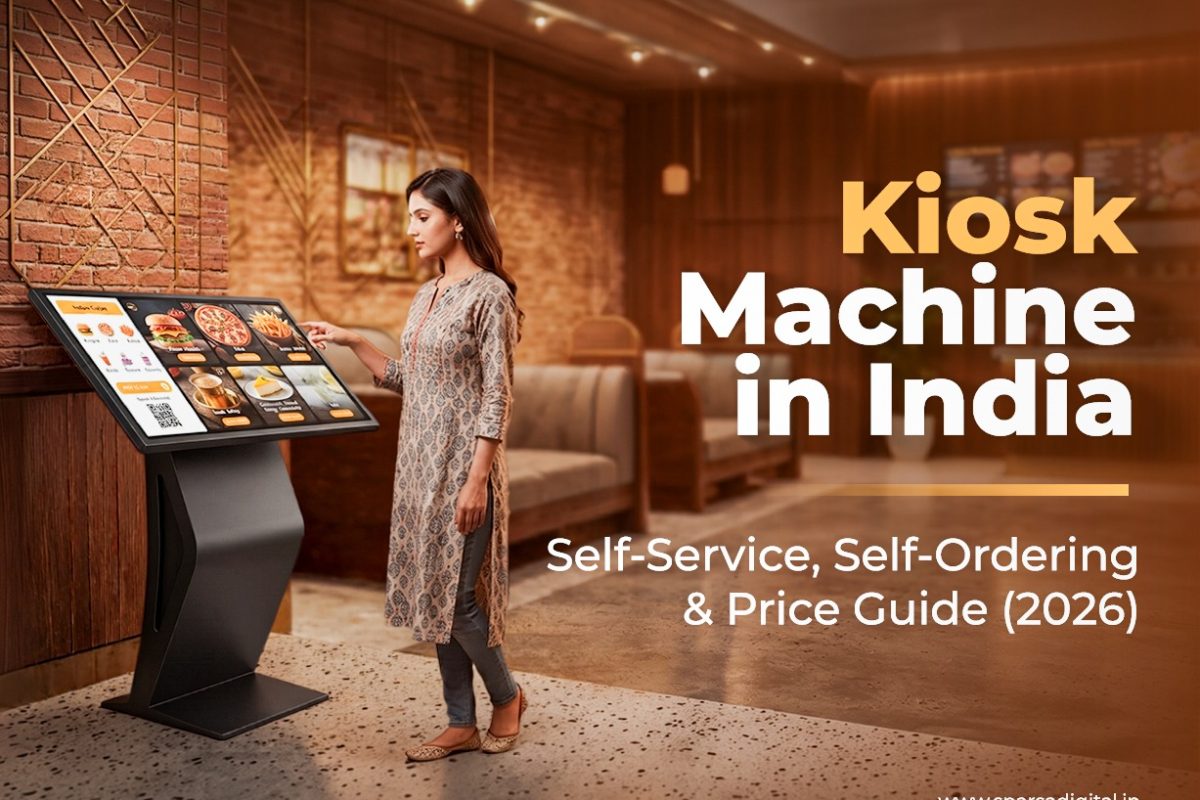
Kiosk Machine in India Self-Service Self-Ordering & Price Guide 2026

Kiosk Machine in India: Self-Service, Self-Ordering & Price Guide (2026)

India is changing fast. Walk into any modern mall, railway station, hospital, or quick-service restaurant today, and there’s a good chance a kiosk machine is standing right in front of you, ready to take your order, check you in, or print your ticket without any human assistance. The kiosk machine market in India is booming, driven by rising labour costs, a tech-savvy population, and a post-pandemic preference for contactless interaction.

Whether you are a business owner exploring automation, a restaurant chain planning to go self-service, or simply curious about how these machines work and what they cost; this complete guide covers everything you need to know in 2026.

What is a Kiosk Machine?

A kiosk machine is a standalone, interactive terminal that allows users to perform a specific task like placing an order, accessing information, printing a ticket, or completing a payment without the help of a staff member. It typically combines a touchscreen display, a processing unit, input/output peripherals (like a card reader, printer, or scanner), and software tailored to a particular use case.

Think of a kiosk machine as a dedicated self-service counter available 24/7. Unlike a general-purpose computer, it is built for a narrow, well-defined function, and built to handle high foot traffic, repeated use, and diverse users including those who may not be tech-savvy.

In simple terms: a kiosk machine removes the middleman between the customer and the service.

The concept is not new. ATMs are technically the world’s most widely deployed kiosk machines, but the modern touchscreen kiosk has evolved into a multi-purpose business tool that goes far beyond dispensing cash.

Key Components of a Kiosk Machine

A typical kiosk machine consists of:

  • Touchscreen display – usually 15 to 32 inches, often with anti-glare coating for outdoor use
  • Processing unit – an embedded computer running Windows, Android, or Linux
  • Payment terminal – integrated UPI, card swipe, or NFC reader
  • Receipt or ticket printer – thermal printers for fast, inkless output
  • Barcode or QR scanner – for loyalty programmes, ticket validation, or document scanning
  • Camera – for identity verification or video-call support in banking kiosks
  • Enclosure/cabinet – floor-standing (pedestal), wall-mounted, or countertop

Types of Kiosks (Self-Service, Self-Ordering, Info Kiosk)

Not all kiosk machines are the same. They are categorised based on the primary task they perform. Here are the main types you will encounter in India:

1. Self-Service Kiosk

The broadest category. A self-service kiosk allows customers to complete a transaction or process independently- check in at a hotel, collect a document, pay a utility bill, or register at a hospital OPD. The goal is speed and convenience without needing to queue at a staffed counter.

Common examples in India: Hospital OPD registration kiosks, bank self-service kiosks, railway ticket vending machines (TVMs), government service kiosks (CSCs), telecom recharge kiosks.

2. Self-Ordering Kiosk

A subset of self-service, the self-ordering kiosk is specifically designed for the food and beverage industry. Customers browse a digital menu, customize their order, and pay- all at the machine. The order is then sent directly to the kitchen display system (KDS).

Common examples in India: McDonald’s, Burger King, Subway, and other QSR chains; food courts in malls; airport food outlets; cafeterias in corporate campuses.

3. Information Kiosk

Also called a digital information kiosk or wayfinding kiosk, this type provides directions, maps, schedules, or general information to visitors. It does not typically handle payments. Its primary role is reducing the information burden on human staff and helping visitors navigate a space.

Common examples in India: Airport and metro station information kiosks, mall directory kiosks, museum guide kiosks, hotel lobby concierge kiosks.

4. Bill Payment Kiosk

Dedicated to accepting payments for utilities, telecom, insurance, or government services. Widely deployed in tier-2 and tier-3 cities across India where digital literacy is growing but internet access on personal devices may be inconsistent.

5. HR and Visitor Management Kiosk

Used within offices and corporate parks for employee attendance, visitor registration, badge printing, and access control. Growing rapidly in India’s tech and manufacturing sectors.

6. Healthcare Kiosk

Found in hospitals and clinics for patient check-in, token generation, appointment booking, and even basic health screening (blood pressure, BMI, oxygen saturation). Government hospitals under Ayushman Bharat and PMJAY schemes have deployed these extensively.

Where Are Kiosks Used in India?

India’s adoption of kiosk machines spans across sectors. Here is a snapshot of where you will find them most commonly:

Quick Service Restaurants (QSR): Chains like McDonald’s India, Burger King, and Wow! Momo have deployed self-ordering kiosks at high-traffic locations to reduce queue times and increase average order value.

Retail and Shopping Malls: Self-checkout kiosks in supermarkets and hypermarkets (Reliance Smart, D-Mart pilots), wayfinding kiosks in large malls, and gift card or loyalty point redemption terminals.

Healthcare: Apollo, Fortis, Max, and government hospitals use kiosks for OPD registration, report collection, payment, and health monitoring.

Banking and Financial Services: Banks like SBI, ICICI, and HDFC have deployed multi-function kiosks for passbook printing, cheque deposit, and account services, reducing branch congestion significantly.

Transportation: Indian Railways’ Ticket Vending Machines (TVMs), metro rail systems in Delhi, Mumbai, Bangalore, and Hyderabad, and airports for check-in, boarding pass printing, and baggage tag printing.

Government Services: Common Service Centres (CSCs) and Jan Seva Kendras use kiosks to deliver services like Aadhaar updates, PAN card applications, and certificate issuance to citizens in rural areas.

Education: Universities and coaching institutes use kiosks for admit card printing, fee payment, and result checking.

Hospitality: Hotels use self check-in/check-out kiosks to speed up the front desk process, especially relevant in the mid-budget and business hotel segments.

Kiosk Machine Price in India

One of the most important factors for any business evaluating kiosk deployment is cost. Kiosk machine prices in India vary significantly based on the type, size, hardware configuration, and software customisation required.

Here is a general pricing guide for 2026:

Kiosk TypePrice Range (INR)Key Variables
Basic Information Kiosk₹40,000 – ₹80,000Screen size, enclosure quality
Self-Ordering Kiosk (QSR)₹80,000 – ₹2,00,000Payment integration, printer type
Self-Service Kiosk (Retail/Bank)₹75,000 – ₹1,80,000Scanner, printer, card reader
Healthcare Kiosk₹90,000 – ₹2,50,000Biometric sensors, camera, printer
Bill Payment Kiosk₹60,000 – ₹1,50,000Cash acceptance module, connectivity
Outdoor Kiosk₹1,20,000 – ₹3,50,000Weatherproofing, brightness rating
HR/Visitor Management Kiosk₹50,000 – ₹1,20,000Facial recognition, badge printer

Factors that affect kiosk machine price in India:

  • Screen size and quality: A 21-inch commercial-grade display costs more than a 15-inch consumer display. Outdoor kiosks need high-brightness panels (1,000+ nits) that add cost.
  • Enclosure material: Powder-coated mild steel is most common; stainless steel or custom-branded enclosures cost more.
  • Payment hardware: Adding a PCI-compliant card reader, UPI QR module, and NFC tap reader can add ₹15,000-₹40,000 to the base cost.
  • Printer type: Thermal receipt printers are standard; label or ticket printers or A4 document printers add cost.
  • Software licensing: Some vendors bundle software; others charge a monthly SaaS fee of ₹3,000-₹15,000 per kiosk.
  • AMC (Annual Maintenance Contract): Expect 8-12% of hardware cost per year for on-site service coverage.
  • Customisation and branding: Custom enclosure colours, vinyl wraps, or branded UI design add to one-time costs.

For businesses deploying multiple kiosks, volume discounts of 10-25% are typically available. Leasing or EMI options are also offered by major vendors, bringing the effective monthly cost of a mid-range self-ordering kiosk to around ₹4,000-₹8,000 per month on a 36-month plan.

Self-Ordering Kiosk for Restaurants

The self-ordering kiosk has become one of the fastest-growing kiosk categories in India’s food service industry. Here is why restaurants, from large QSR chains to standalone cafes, are investing in them.

Why Restaurants Are Adopting Self-Ordering Kiosks

Higher average order value: Studies from global QSR deployments consistently show that customers ordering at a kiosk spend 15-30% more than those ordering at a counter. The reason is simple: the kiosk never forgets to suggest an add-on, never feels awkward upselling, and always shows high-margin items prominently.

Reduced queue wait times: A well-placed set of kiosks can process 3-5 orders simultaneously, dramatically cutting peak-hour queues. For busy restaurant locations in Mumbai, Delhi, or Bengaluru, this directly translates to more covers per hour.

Lower long-term labour cost: While kiosks require upfront investment, they reduce dependence on order-taking staff. The savings on salaries, training, and turnover can recover the hardware cost within 12-18 months for high-volume outlets.

Fewer order errors: Human errors in taking orders, especially for complex customisations are eliminated. The customer directly inputs what they want.

Contactless and hygienic: Post-COVID, many customers actively prefer not interacting with staff for routine transactions. A kiosk with a screen protector that is easy to sanitise meets this preference.

Features to Look for in a Restaurant Self-Ordering Kiosk

  • High-resolution, responsive touchscreen (21″ or larger recommended for QSR)
  • Integration with your existing POS system and kitchen display system (KDS)
  • UPI, card, and cash (if required) payment options
  • Multi-language support (Hindi, regional languages)
  • Loyalty programme integration
  • Remote menu management- ability to update prices or disable items from a central dashboard without touching the kiosk
  • Customer-facing receipt printer or SMS/WhatsApp receipt option

For a QSR outlet with 500-800 daily covers, 2-3 self-ordering kiosks placed near the entrance (separate from the counter) is the standard setup. Larger food courts or mall outlets may deploy 4-6 units.

Self-Service Kiosk for Retail

India’s organised retail sector- supermarkets, electronics stores, fashion outlets, and pharmacies, is increasingly looking at kiosk machines to improve customer experience and streamline operations.

Use Cases in Retail

Self-checkout: Customers scan their items, bag them, and pay- all without involving a cashier. Ideal for customers buying fewer than 10-15 items. Reduces checkout queue length significantly during peak hours.

Product information kiosk: Placed on the store floor, these kiosks allow customers to check product specifications, compare options, check stock availability in other sizes/colours, and locate items within the store. Particularly effective in electronics and home appliance retail.

Loyalty and gift card kiosk: Customers can check their loyalty points, redeem rewards, or purchase and activate gift cards independently.

Click-and-collect terminal: For retailers with an online presence, a kiosk at the store allows online order pickup with OTP verification, reducing the load on customer service counters.

Return and exchange processing: Some large-format retailers are deploying kiosks that initiate a return or exchange request, generate a QR code, and hand off to a small “exceptions” counter, making the process faster for both customer and staff.

Key Considerations for Retail Kiosk Deployment

Retail environments are diverse. A kiosk for a supermarket has different requirements than one for a luxury watch boutique. Key questions to answer before purchasing:

  • Will the kiosk handle payment? If yes, PCI DSS compliance is mandatory.
  • Will it need to connect to your ERP or inventory management system in real time?
  • What is the expected daily transaction volume? This affects hardware durability requirements.
  • Is the location indoor or outdoor / semi-outdoor (like a mall entrance)?

How to Buy a Kiosk Machine in India

Buying a kiosk machine in India involves several steps beyond simply choosing a model. Here is a practical guide to help you make the right decision.

Step 1: Define Your Use Case Clearly

Before contacting any vendor, write down exactly what you want the kiosk to do. Is it purely informational? Does it need to process payments? Does it need a printer? Will it need to connect to an existing software system? The clearer your brief, the more accurate the quote you will receive.

Step 2: Decide on Hardware Specifications

Based on your use case, determine the key hardware requirements- screen size, whether you need an enclosed pedestal or a countertop unit, what peripherals are needed, and whether the kiosk will be placed outdoors (requiring IP54 or higher weatherproofing).

Step 3: Evaluate Software and Integration

Hardware is the easy part. Software is where most kiosk projects succeed or fail. Ask vendors:

  • Does the software support integration with your existing POS, ERP, or CRM?
  • Is the UI customisable to match your brand?
  • Can you update content or menu items remotely?
  • What reporting and analytics does the software provide?
  • Is there a cloud-based management dashboard?

Step 4: Compare Vendors

India has a growing number of kiosk manufacturers and system integrators. Some well-known names include Pyramid Technoplast, Kiosk India, Intuition Systems, Peerless-AV India, and various regional players. Compare at least 3-4 vendors on hardware quality, software capability, after-sales service network, and total cost of ownership.

Step 5: Request a Demo or Pilot

Before committing to a large deployment, request a demo unit or a paid pilot at one location. Evaluate real-world performance, uptime, ease of use for your actual customers, and quality of vendor support.

Step 6: Negotiate AMC and Support Terms

The kiosk will need maintenance. Clarify: What is the response time for on-site service? What parts are covered under warranty? What does the AMC cover? Is remote monitoring included?

Step 7: Plan Placement and Installation

A kiosk in the wrong location will fail regardless of quality. Consider foot traffic patterns, lighting (avoid backlighting that washes out the screen), accessibility for differently-abled users, and power/internet connectivity at the placement point.

FAQs

Q1. What is the lifespan of a kiosk machine?

A well-maintained commercial kiosk machine typically lasts 5-8 years. The touchscreen panel and thermal printer are the most commonly replaced components, usually after 3-4 years of heavy use.

Q2. Do kiosk machines in India support UPI payments?

Yes. Most modern kiosk machines deployed in India include a UPI QR code display and/or an NFC-enabled payment terminal that supports UPI tap payments, PhonePe, Google Pay, and other BHIM-UPI apps.

Q3. Can a kiosk machine work without internet connectivity?

Some functions can work offline, like displaying static information or queuing orders locally, but payment processing, real-time inventory sync, and cloud-based reporting require a reliable internet connection. Most vendors recommend a dedicated broadband line or 4G/5G backup.

Q4. Are kiosk machines accessible for elderly or differently-abled users?

Good kiosk design accounts for accessibility. This includes adjustable screen height, large font options, audio assistance, and compliance with guidelines under India’s Rights of Persons with Disabilities Act. When purchasing, confirm whether the vendor’s software supports accessibility features.

Q5. What is the difference between a kiosk machine and a digital signage display?

A digital signage display is passive. It shows content to the viewer. A kiosk machine is interactive; the user inputs commands and receives a personalized output (an order, a ticket, information specific to their query). Many kiosks combine both functions with a dual-screen setup.

Q6. How long does it take to deploy a kiosk machine?

For a standard deployment with off-the-shelf software, 4-6 weeks from order to installation is typical. Custom software development or deep ERP integration can extend this to 3-6 months.

Q7. Do I need a GST number to buy a kiosk machine in India?

For business purchases, yes. Providing your GSTIN allows you to claim input tax credit on the purchase. Kiosk machines attract 18% GST in most configurations.

Q8. What happens when a kiosk machine breaks down?

Reputable vendors offer AMC contracts with defined SLAs, typically 4-8 business hours response time for metro cities, and 24-48 hours for tier-2 locations. Many vendors also offer remote diagnostics that can resolve software issues without a site visit.

Q9. Can a self-ordering kiosk integrate with Swiggy or Zomato?

Integration with aggregator platforms is technically possible but requires custom middleware development. Most self-ordering kiosks are currently designed to feed orders into the restaurant’s internal POS and KDS, not directly into delivery aggregator systems.

Q10. Is there a minimum order quantity for kiosk machines in India?

Most manufacturers sell single units for pilots or small businesses. However, pricing improves meaningfully at 5+ units, and significant volume discounts apply at 20+ units for enterprise or franchise deployments.

Final Thoughts

The kiosk machine is no longer a novelty in India, it is becoming infrastructure. From the metro station to the neighbourhood clinic, from the airport lounge to the roadside QSR, self-service technology is quietly reshaping how Indians transact, eat, travel, and access services.

For businesses, the case for kiosk investment in 2026 is stronger than ever: rising labour costs, customer demand for speed and convenience, and falling hardware prices have tilted the economics firmly in favour of deployment. The key is to choose the right type of kiosk for your specific use case, partner with a vendor who offers solid after-sales support, and plan your rollout with the actual end-user experience, not just the technology at the centre.

Whether you are deploying your first single kiosk or planning a 50-location rollout, the fundamentals remain the same: clear use case, robust hardware, flexible software, and reliable support.

Touch Screen Kiosk

Impact of Interactive Touch Kiosks and Touch Screen Kiosks on Modern Businesses

In the dynamic landscape of technology, businesses are constantly seeking innovative ways to engage with their audience. Interactive touch kiosks and touch screen kiosks have emerged as powerful tools, reshaping the way customers interact with brands and access information. In this comprehensive blog post, we delve into the intricacies of these interactive technologies, exploring their evolution, applications across industries, benefits, challenges, and future prospects.

Evolution of Interactive Touch Kiosks

A. From Basic Touchscreens to Interactive Experiences:

1. Early Adoption: The journey of interactive touch kiosks traces back to the advent of basic touchscreens in the 1980s. Initially used in public spaces like museums and information centers, these touchscreens allowed users to navigate through static information.

2. Rise of Interactivity: With technological advancements, touch kiosks evolved to offer more engaging and interactive experiences. The integration of multimedia elements, such as videos and images, enhanced user engagement.

B. Integration of Touch Screen Technology:

1. Capacitive vs. Resistive Touchscreens: The evolution of touch screen technology led to the development of capacitive and resistive touchscreens, each with its unique advantages. Capacitive screens offer a more responsive and durable experience, while resistive screens allow for touch input using different objects.

2. Multi-touch Capabilities: The introduction of multi-touch capabilities further expanded the functionality of touch kiosks, enabling users to perform complex gestures like zooming and swiping.

Applications Across Industries:

A. Retail Sector:

1. In-Store Navigation: Retailers utilize interactive touch kiosks to help customers navigate through large stores efficiently, enhancing the overall shopping experience.

2. Product Information: Touch screen kiosks in retail environments provide detailed product information, reviews, and recommendations, aiding customers in making informed purchase decisions.

B. Hospitality Industry:

1. Self-Service Check-In: Hotels and resorts implement touch kiosks for seamless self-service check-in, reducing waiting times and enhancing guest satisfaction.

2. Interactive Concierge: Touchscreen kiosks act as interactive concierge services, offering information on local attractions, dining options, and events.

C. Healthcare:

1. Patient Check-In: Hospitals and clinics deploy touch kiosks for patient check-in, streamlining the registration process and reducing administrative workload.

2. Health Information: Touchscreen kiosks provide patients with access to health information, educational resources, and interactive tools for better understanding their conditions.

D. Education:

1. Campus Navigation: Educational institutions leverage interactive touch kiosks to assist students and visitors in navigating campus facilities, classrooms, and offices.

2. Digital Libraries: Touchscreen kiosks in libraries offer a digital interface for accessing catalogs, searching for books, and accessing educational resources.

Benefits of Interactive Touch Kiosks

A. Enhanced Customer Engagement:

1. Interactive Content: The ability to interact with multimedia content on touch kiosks captivates users, leading to increased engagement and retention of information.

2. Personalized Experiences: Touchscreen technology allows businesses to tailor content based on user preferences, creating personalized and targeted interactions.

B. Efficiency and Time Savings:

1. Self-Service Capabilities: Touch kiosks enable self-service options, reducing the need for human intervention in tasks like check-ins, information retrieval, and transactions.

2. Streamlined Processes: In various industries, touch kiosks streamline processes, minimizing wait times and improving overall operational efficiency.

C. Data Collection and Analytics:

1. User Analytics: Interactive touch kiosks can collect valuable user analytics, providing businesses with insights into customer behavior, preferences, and trends.

2. Feedback Mechanism: Kiosks can serve as feedback mechanisms, allowing customers to provide real-time input and opinions on products or services.

Challenges and Considerations

A. Initial Investment and Maintenance:

1. Cost Factors: The upfront investment in interactive touch kiosks may pose a challenge for some businesses, especially small enterprises.

2. Maintenance and Upkeep: Regular maintenance and software updates are essential to ensure the seamless functioning of touch kiosks, adding to ongoing costs.

B. Security and Privacy Concerns:

1. Data Security: Touch kiosks may pose security risks, especially if they involve the collection of sensitive information. Ensuring robust security measures is crucial.

2. Privacy Regulations: Adhering to data privacy regulations and obtaining user consent for data collection is imperative to build trust with customers.

C. User Experience Design:

1. Intuitive Design: Designing an intuitive user interface is critical for the success of touch kiosks. Poorly designed interfaces can lead to user frustration and disengagement.

2. Accessibility: Ensuring accessibility for users with disabilities is a key consideration, requiring features like voice guidance and compatibility with screen readers.

A. Integration with Artificial Intelligence (AI):

1. Personalized Recommendations: AI algorithms can analyze user behavior and preferences, offering personalized recommendations and content on touch kiosks.

2. Natural Language Processing (NLP): Integration with NLP allows users to interact with touch kiosks using natural language, enhancing the conversational aspect of user engagement.

B. Augmented Reality (AR) and Virtual Reality (VR):

1. Immersive Experiences: The incorporation of AR and VR technologies into touch kiosks can provide users with immersive and interactive experiences, especially in retail and education.

2. Virtual Product Try-Ons: Retailers can use AR to enable virtual try-ons of products, allowing customers to visualize items before making a purchase.

C. 5G Connectivity:

1. Faster Data Transfer: The rollout of 5G connectivity will enable faster data transfer and smoother streaming of high-quality multimedia content on touch kiosks.

2. Enhanced Connectivity: Businesses can leverage 5G to enhance the connectivity of touch kiosks, ensuring a seamless and responsive user experience.

Conclusion

In conclusion, interactive touch kiosks and touch screen kiosks have become integral components of modern business strategies across various industries. The evolution of these technologies from basic touchscreens to sophisticated interactive platforms has redefined the way businesses engage with their audience. While the benefits are substantial, addressing challenges such as initial costs, security concerns, and user experience design is crucial for successful implementation.

Looking ahead, the integration of AI, AR, VR, and 5G connectivity promises to take interactive touch kiosks to new heights, offering businesses unprecedented opportunities to create immersive and personalized experiences. As businesses continue to embrace these innovations, the era of interactive touch kiosks unfolds as a testament to the transformative power of technology in shaping the future of customer engagement and information access.

Self ordering kiosk & Touch kiosk

Here’s How Touch Screen Kiosks and Self-Ordering Kiosks Are Redefining Customer Experience

In the fast-paced world of technology, touch screen kiosks and self-ordering kiosks have emerged as powerful tools revolutionizing customer interactions across various industries. These interactive and user-friendly devices have transformed traditional customer service, empowering individuals to take control of their experiences. In this blog, we will delve into the evolution, functionalities, benefits, and societal impact of touch screen kiosks and self-ordering kiosks.

I. The Evolution of Touch Screen Kiosks and Self-Ordering Kiosks

  • – Early Interactive Technologies
  • The roots of touch screen technology can be traced back to the 1960s, with the development of early touch screens by E.A. Johnson. In the 1980s, touch screens started gaining commercial popularity, but their adoption was limited due to high costs and technological constraints.
  • – The Rise of Touch Screen Kiosks
  • The 1990s witnessed significant advancements in touch screen technology, leading to the introduction of touch screen kiosks in public places like airports, museums, and retail stores. These kiosks provided information and facilitated basic interactions.
  • – Self-Ordering Kiosks in the Restaurant Industry
  • Self-ordering kiosks gained prominence in the early 2000s, initially finding applications in the restaurant industry. Fast-food chains and quick-service restaurants embraced self-ordering kiosks to improve order accuracy and reduce waiting times.

II. Understanding Touch Screen Kiosks

  • – Definition and Functionality
  • Digital kiosks are interactive computer terminals equipped with touch-sensitive displays that allow users to navigate through various options, access information, and perform transactions independently.
  • – Applications of Touch Screen Kiosks 
  • a. Information Kiosks: Used in public spaces to provide information on maps, directions, events, and services.
  • b. Wayfinding Kiosks: Navigation tools in large venues, such as malls and airports, guiding users to their desired destinations.
  • c. Ticketing Kiosks: Enable users to purchase tickets for events, public transportation, and more.
  • d. Retail Kiosks: Assist customers with product information, virtual shopping, and online ordering.
  • e. Healthcare Kiosks: Facilitate patient check-ins, appointment scheduling, and health-related information dissemination.
  •  
  • Benefits of Touch Screen Kiosks
  •  
  • a. Enhanced Customer Experience: Kiosks empower users to access information at their convenience, reducing the need for human assistance.
  • b. Efficiency and Speed: Transactions and processes are expedited, leading to shorter wait times and increased customer satisfaction.
  • c. Cost Savings: Businesses can optimize labor costs and increase revenue opportunities with the integration of touch screen kiosks.
  • d. Data Collection: Kiosks offer valuable data insights, enabling businesses to better understand customer preferences and behaviors.

III. Self-Ordering Kiosks: A Game-Changer in the Restaurant Industry

  • Transformation of the Dining Experience
  • Self-ordering kiosks have reshaped the traditional restaurant experience by providing customers with a digital menu and customizable options for their orders.
  •  
  • – Streamlined Operations
  • Restaurants with self-ordering kiosks have reported improved order accuracy, reduced wait times, and increased order volume due to streamlined operations.
  •  
  • – Upselling and Cross-Selling Opportunities
  • Self-ordering kiosks can intelligently suggest add-ons, upgrades, and related items, leading to higher average order values for businesses.

IV. The Impact of Touch Screen Kiosks and Self-Ordering Kiosks on Various Industries

  • – Retail Industry
  • Touch screen kiosks in retail stores facilitate efficient product browsing, inventory checks, and self-checkout options, enhancing the overall shopping experience.
  • – Travel and Hospitality Sector
  • Touch screen kiosks in airports, hotels, and tourist centers offer wayfinding assistance, flight check-ins, and hotel bookings, simplifying travel procedures.
  • – Healthcare Sector
  • Touch screen kiosks in healthcare facilities improve patient engagement, reduce waiting times, and allow patients to access health-related information easily.
  • – Education Sector
  • Touch screen kiosks in educational institutions aid in campus navigation, event registration, and access to academic resources.

V. The Role of Artificial Intelligence (AI) in Kiosks

  • – Personalization
  • AI-driven touch screen kiosks can analyze user preferences and offer personalized recommendations, enhancing customer satisfaction.
  •  
  • – Natural Language Processing (NLP)
  • Kiosks equipped with NLP can understand and respond to user inquiries and commands, creating a more intuitive and user-friendly experience.

VI. Overcoming Challenges and Concerns

  • – User Adoption and Acceptance
  • Some users may initially be hesitant to interact with touch screen kiosks, requiring businesses to focus on user-friendly designs and clear instructions.
  •  
  • – Data Security and Privacy
  • As kiosks collect customer data, ensuring robust security measures and adhering to privacy regulations becomes crucial.

Conclusion

Touch screen kiosks and self-ordering kiosks have redefined the way customers interact with businesses and organizations. From enhancing efficiency and customer satisfaction to providing valuable insights for businesses, these interactive devices have undoubtedly left a lasting impact on various industries. As technology continues to advance, touch screen kiosks and self-ordering kiosks will continue to evolve, fostering a more seamless and empowering customer experience in the years to come.

Come, begin your journey with Sparsa Digital today. Connect with our experts today and get started with the best of technology. Drive your business to the next level with the right use of the latest technology available in the market today. We make sure that each business gets the most out of the deal ensuring further stability.

Revolutionizing-Customer-Experience--The-Rise-of-Self-Ordering

The Rise of Self-Ordering Kiosks and Self-Service Kiosks

Revolutionizing Customer Experience: The Rise of Self-Ordering Kiosks and Self-Service Kiosks

In recent years, the retail and hospitality industries have witnessed a significant transformation in customer service with the introduction of self-ordering kiosks and self-service kiosks. These innovative technologies have revolutionized the way customers interact with businesses, offering convenience, efficiency, and personalized experiences. In this blog post, we will explore the benefits and functionalities of self-ordering kiosks and self-service kiosks, their impact on various industries, and their implications for businesses and customers alike.

The Rise of Self-Ordering Kiosks

A. Enhanced Customer Experience

  • Convenience and Control: Self-ordering kiosks empower customers to browse menus, customize their orders, and make payments at their own pace, eliminating the need for lengthy queues and improving order accuracy.
  • Personalization: Kiosks can store customer preferences and past orders, allowing businesses to offer tailored recommendations and promotions based on individual preferences.
  • Multilingual Support: With built-in language options, self-ordering kiosks cater to diverse customer bases, enabling seamless interactions for non-native speakers.

B. Operational Efficiency and Cost Savings

  1. Increased Order Accuracy: Self-ordering kiosks minimize miscommunication between customers and staff, resulting in higher order accuracy and reduced instances of order reworks.
  2. Streamlined Order Fulfillment: By directly transmitting orders to the kitchen or production area, kiosks eliminate manual order entry, reducing order processing time and improving operational efficiency.
  3. Staff Optimization: As self-ordering kiosks handle order placement and payment, staff members can be allocated to other critical tasks, such as customer assistance and food preparation.

C. Upselling and Cross-Selling Opportunities

  • Promotional Displays: Kiosks can showcase enticing visuals and recommendations, encouraging customers to explore additional menu items and boosting sales.
  • Dynamic Pricing: Businesses can leverage kiosks to implement dynamic pricing strategies, offering upsells, promotions, and combo deals to increase average order value.

The Impact of Self-Service Kiosks

A. Customer Empowerment and Flexibility

  • Check-In and Check-Out Processes: Self-service kiosks in hotels and airports expedite check-in and check-out procedures, enabling guests to bypass long queues and have greater control over their stay.
  • Retail Self-Service Kiosks: Customers can browse product catalogs, check prices, and even make purchases without relying on staff availability, enhancing the shopping experience.

B. Reduced Waiting Times and Improved Efficiency

  • Ticketing and Information Kiosks: Self-service kiosks at entertainment venues, transport stations, and public spaces allow customers to purchase tickets, obtain information, and navigate easily, minimizing waiting times.
  • Digital Signage and Wayfinding: Kiosks equipped with interactive maps and directions provide real-time guidance, helping customers navigate complex environments efficiently.

C. Cost Savings and Resource Allocation

  • Workforce Optimization: With digital kiosks handling routine tasks, businesses can optimize staff allocation and redirect resources to areas that require human expertise, such as customer support or complex inquiries.
  • Improved Staff-Customer Interactions: By offloading repetitive tasks to kiosks, staff members can focus on delivering personalized assistance and addressing specific customer needs.

Overcoming Challenges and Ensuring Adoption

A. User Interface Design and Accessibility

  1. Intuitive Interfaces: Kiosks should feature user-friendly interfaces with clear instructions and intuitive navigation to ensure seamless user experiences.
  2. Accessibility Considerations: Businesses should design kiosks with accessibility features, such as text-to-speech functionality and adjustable heights, to cater to individuals with disabilities.

B. Data Security and Privacy

  • Compliance with Regulations: Businesses must adhere to data protection regulations and ensure customer information is stored securely and not vulnerable to breaches.
  • Transparent Data Usage: Clear communication with customers regarding data collection and usage builds trust and encourages adoption.

C. Maintenance and Support

  • Regular Updates: Kiosks require frequent software updates and maintenance to address potential bugs and security vulnerabilities.
  • Responsive Support Channels: Businesses should establish effective support channels to promptly address any technical issues or user queries.

Conclusion

Self-ordering kiosks and self-service kiosks have revolutionized customer experiences across various industries, offering convenience, efficiency, and personalization. These technologies empower customers, streamline operations, reduce costs, and unlock new upselling opportunities. However, businesses must overcome challenges such as user interface design, data security, and maintenance to ensure widespread adoption and maximize the benefits for both businesses and customers. With continuous advancements and improvements, self-ordering kiosks and self-service kiosks are poised to shape the future of customer service and drive further innovation in the retail and hospitality sectors.

Wondering where to start? Get in touch with Sparsa today, and begin your journey.

Self-Ordering-Kiosk

Self Ordering Kiosk vs Interactive Kiosk: Which One is Right for Your Business?

Table of contents

With the rise of technology, interactive kiosks/ Self Ordering Kiosk have become a popular choice for businesses looking to enhance their customer experience. These kiosks allow customers to order and pay for their food or products, without the need for a cashier. This technology has revolutionized the way customers interact with businesses, making it efficient for them to purchase products or services.

In this blog, we will explore the differences between self-ordering kiosks and interactive kiosks. This will help you determine which one is the right fit for your business.

Self-Ordering Kiosk

A self-ordering kiosk is a digital ordering system that allows customers to place their orders without assistance from a cashier. These kiosks can be found in various industries, from fast-food restaurants to retail stores. They typically consist of a touchscreen display, a credit card reader, and a receipt printer. Customers can select their desired items from a digital menu, customize their orders, and pay using their credit cards. Once the order is complete, the kiosk prints a receipt and notifies the kitchen or sales team of the order.

One of the primary benefits of self-ordering kiosks is their efficiency. By eliminating the need for a cashier, businesses can reduce labor costs and improve the speed of service. This technology allows businesses to upsell and cross-sell products, as the kiosk can display recommended promotions based on customer’s selections. Additionally, self-ordering kiosks can reduce errors in the ordering process, as customers can view their selections and make changes themselves.

Interactive Kiosk

An interactive kiosk, on the other hand, is a digital display that provides information and engages customers through touchscreen technology. These kiosks can be found in various industries, from museums to retail stores. They typically consist of a touchscreen display, a computer, and a speaker system. Customers can interact with the kiosk by selecting from various options on the screen, such as watching a video. The kiosk can also provide information about the business, such as its history or mission statement.

One of the primary benefits of interactive kiosks is their ability to engage customers. By providing an interactive and personalized experience, businesses can create a memorable and positive experience for their customers. Interactive kiosks can also help businesses collect data about their customers, such as their preferences or interests. This can be used to improve their marketing and sales strategies. Interactive kiosks can reduce the workload of sales staff, as customers can access information and make purchases on their own.

Which One is Right for Your Business?

When considering investing in any specific kiosk, it is important to evaluate the specific needs of your business. Here are some factors to consider:

Industry: Some industries may benefit more from self-ordering kiosks, such as fast food restaurants or convenience stores, while others may benefit more from interactive kiosks, such as museums or hotels.

Customer Base: Consider the demographics of your customer base. Are they tech-savvy and comfortable using digital technology? If so, self-ordering kiosks a good fit. However, if your customer base consists of older or less tech-savvy individuals, an interactive kiosk may be more appropriate.

Budget: Self-ordering kiosks tend to be more expensive than interactive kiosks, as they require more hardware and software. Consider your budget and whether the investment in a self-ordering kiosk will yield a return on investment.

In recent years, self-ordering and interactive kiosks have become popular in the fast-food industry, retail sector, and various other businesses. With the advancement of technology, self-service kiosks have revolutionized how people shop, order food, and perform various other tasks. These kiosks have not only improved the customer experience but also enhanced the efficiency of businesses. In this blog, we will discuss the benefits and challenges of self-ordering and interactive kiosks. Also, focusing on how they are shaping the future of retail.

Self-Ordering Kiosks: What are they?

Self-ordering kiosks are touch-screen devices that allow customers to place orders without the need for human assistance. These kiosks are mostly found in fast-food restaurants, where customers can place their orders and customize them to their preferences. With self-ordering kiosks, customers can browse menus, select items, and pay for orders using cash, credit cards, or mobile payments.

Self-ordering kiosks have been successful in reducing wait times and improving customer satisfaction. Customers can take their time to browse the menu and customize their orders without feeling rushed. Moreover, self-ordering kiosks reduce the need for additional staff during peak hours, allowing businesses to save money on labor costs.

Interactive Kiosks: What are they?

Interactive kiosks, on the other hand, are designed to provide customers with more than just the ability to place orders. It’s offer a range of services, including wayfinding, product information, and digital signage. These kiosks are commonly found in malls, airports, and public spaces. This is where customers can interact with them to get information, and directions, and even make purchases.

Interactive kiosks provide a more engaging experience for customers by allowing them to interact with the brand. This also helps them learn more about the products or services offered. With interactive kiosks, businesses can provide customers with a personalized experience and gather valuable data to improve their marketing strategies.

Benefits of Self-Ordering and Interactive Kiosks

Self-ordering and interactive kiosks offer several benefits for businesses and customers alike. Let’s take a look at some of these benefits:

  • Improved Customer Experience

Self-ordering and interactive kiosks provide customers with a more personalized and engaging experience. Customers can browse menus, customize orders, and get product information at their own pace, without feeling rushed. With self-ordering kiosks, customers can avoid long lines and reduce wait times, improving overall customer satisfaction.

  • Increased Efficiency

Self-ordering kiosks can help businesses improve their efficiency by reducing the need for additional staff during peak hours. Customers can place orders and pay for them without the need for human assistance, freeing up staff as well.

  • Cost Savings

Self-ordering and interactive kiosks can help businesses save money on labour costs by reducing the need for additional staff. Moreover, self-ordering kiosks can help businesses reduce errors in order processing and reduce waste, further reducing costs.

  • Data Collection

Interactive kiosks allow businesses to collect valuable data on customer behaviour, preferences, and demographics. This data can help businesses improve their marketing strategies and provide customers with more personalized experiences.

Still wondering what to choose? Connect with us at Sparsa Digital today and be a step closer to making the right decision.

Sparsa Digital
Privacy Overview

This website uses cookies so that we can provide you with the best user experience possible. Cookie information is stored in your browser and performs functions such as recognising you when you return to our website and helping our team to understand which sections of the website you find most interesting and useful.