

Table of contents
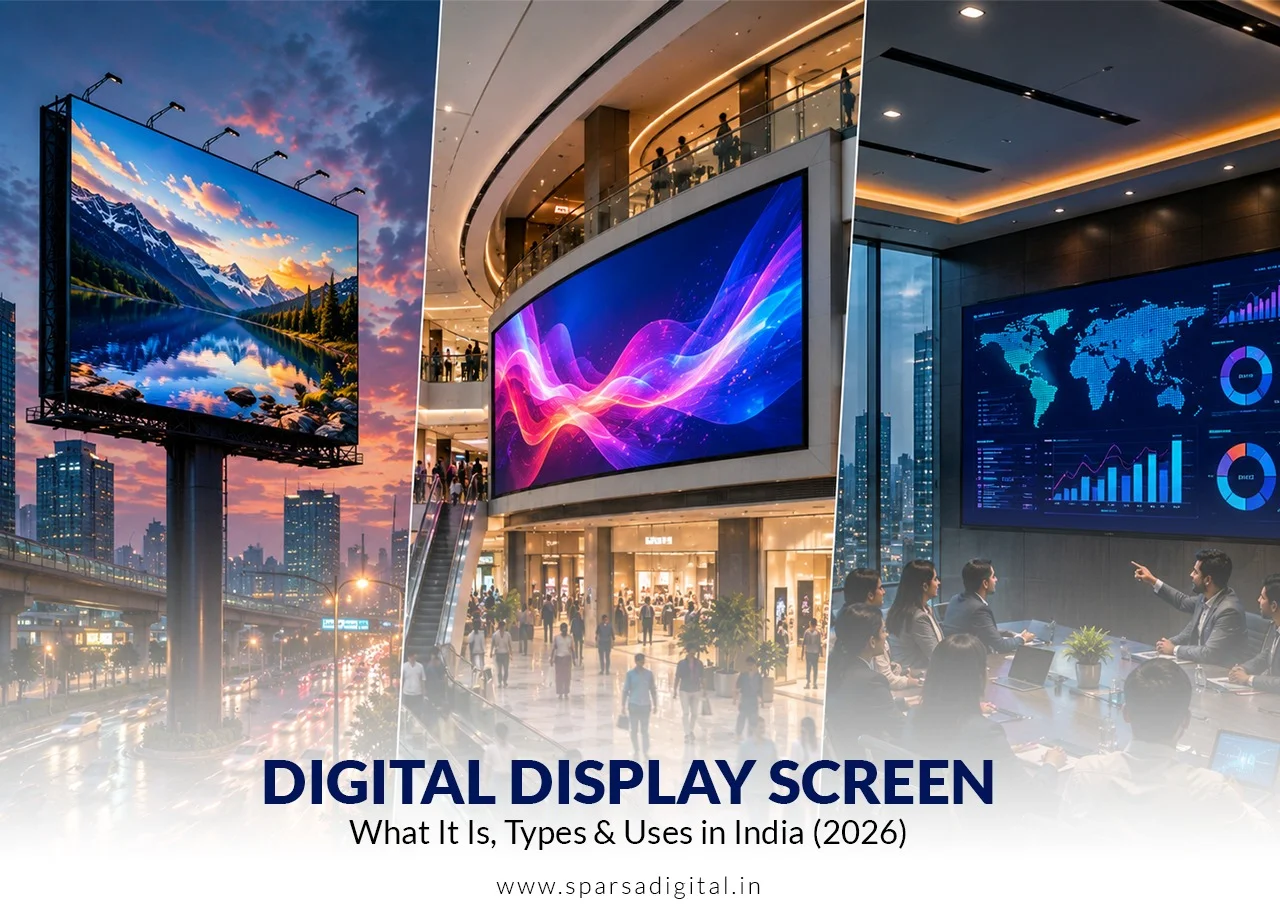
Whether you’re walking through a busy Delhi metro station, browsing a mall in Mumbai, or sitting in a corporate boardroom in Bengaluru, one thing is almost impossible to miss. The glowing, dynamic digital display screen that commands your attention. From simple price boards to massive LED video walls, these screens have become a fundamental part of how businesses, governments, and institutions communicate in modern India.
What Is a Digital Display Screen?
A digital display screen is an electronic output device that presents visual information – text, images, video, animations, or data in real time using digital technology. Unlike traditional printed signs or static boards, a digital screen board can be updated remotely, scheduled to show different content at different times, and even interact with viewers.
At its core, a digital display screen converts electrical signals into visible light to render content on a flat or curved surface. The underlying technologies vary- LCD, LED, OLED, and e-ink being the most common, but the result is the same: dynamic, vibrant, and flexible visual communication.
Key Characteristics of a Digital Display Screen
- Dynamic content: Content can be changed instantly without printing or physical replacement.
- Remote management: Most modern displays connect via Wi-Fi, LAN, or 4G/5G and can be managed from a central dashboard.
- Scalability: From a single screen to a network of hundreds of displays.
- Interactivity: Touchscreen variants allow user engagement.
- Scheduling: Content can be queued and scheduled for specific times or triggers.
Types of Digital Display Screens
Understanding the different types of displays helps businesses and organizations choose the right solution for their specific needs. Here is a breakdown of the major categories available in India in 2026.
1. LED Display Screens
LED (Light Emitting Diode) displays are among the most popular types of electronic display boards in India. They use tiny light-emitting diodes as pixels and are available in both indoor and outdoor variants.
Indoor LED displays are used in malls, airports, auditoriums, and corporate lobbies. They offer high brightness, excellent colour accuracy, and long life spans. Outdoor LED displays, often called LED hoardings or outdoor digital panel boards, are built to withstand rain, dust, and direct sunlight, making them ideal for highways, stadiums, and building facades.
LED displays are further categorised by pixel pitch, i.e. the distance between two adjacent pixels. A smaller pixel pitch (like P1.5 or P2) means higher resolution and is suited for close-up viewing, while a larger pixel pitch (like P6 or P10) is fine for displays viewed from a distance.
Common uses in India: Roadside advertising hoardings, stadium screens, stage backdrops, metro station boards, retail store facades.
2. LCD Display Screens
LCD (Liquid Crystal Display) screens are the most widely used display screens for indoor environments. They work by shining a backlight through a layer of liquid crystals to produce images. LCD panels offer sharp resolution, accurate colours, and are cost-effective for most indoor applications.
Commercial-grade LCDs differ from consumer televisions. They are built for 16-24 hours of daily use, come with anti-glare coatings, have higher brightness ratings, and support landscape or portrait orientations.
Variants include:
- Standard commercial displays for retail, offices, and hospitality.
- Video walls made from narrow-bezel LCD panels arranged in grids (e.g., 2×2, 3×3, or larger).
- Stretch displays include ultra-wide LCD panels used in shelf-edge or transport display applications.
Common uses in India: Office lobbies, retail stores, quick-service restaurants, hotel corridors, banks, and conference rooms.
3. OLED Display Screens
OLED (Organic Light Emitting Diode) displays are premium-tier screens where each pixel generates its own light. This eliminates the need for a backlight, resulting in true blacks, superior contrast ratios, thinner panels, and wider viewing angles compared to LCD.
OLED screens are increasingly being used in high-end retail and luxury brand environments in India where visual impact is critical. They are also found in flagship smartphones, which has made the term “OLED display” familiar to Indian consumers.
Common uses in India: Luxury retail showrooms, flagship stores, premium hospitality, and broadcast studios.
4. Digital Signage Displays (Commercial Displays)
Often referred to as digital screen boards or commercial displays, these are purpose-built screens designed to run 24/7 as part of a managed signage network. They typically include built-in media players or support for external content management systems (CMS).
In 2026, most commercial digital signage displays in India come with Android-based SoC (System on Chip) built in, enabling Wi-Fi and 4G connectivity out of the box. This makes deploying and updating content across hundreds of locations far simpler.
Common uses in India: Retail chains, quick-service restaurant menu boards, pharmacy chains, and franchise businesses.
5. Interactive Touchscreen Displays
These display screens add a layer of interactivity- users can tap, swipe, or pinch directly on the screen. They use capacitive or infrared touch technology and are available in sizes from 10 inches (for kiosks) to 98 inches (for collaboration rooms and showrooms).
Interactive displays have gained massive traction in Indian education, healthcare, and corporate settings. Smart boards in classrooms, self-service kiosks at airports and banks, and interactive wayfinding maps in malls are all examples.
Common uses in India: Classrooms, corporate meeting rooms, hospital self-check-in, retail kiosks, government service centres.
6. Transparent Display Screens
A relatively newer category, transparent displays allow viewers to see through the screen while still showing content. They are built using transparent OLED or transparent LCD technology and are used where the product behind the screen is as important as the screen content itself.
Indian luxury retail and automobile showrooms are beginning to adopt transparent displays for product showcases.
Common uses in India: Jewellery and luxury retail, automobile showrooms, museum installations.
7. e-Paper / e-Ink Display Screens
e-Paper displays (also called electronic paper) mimic the appearance of printed text and consume power only when the content changes. This makes them extremely energy-efficient and ideal for environments requiring static or infrequently updated information.
In India, e-paper displays are being deployed in hospitals (patient bed name tags), libraries, logistics warehouses (shelf labels), and railway stations (platform information boards) where power savings are critical.
Common uses in India: Electronic shelf labels, hospital wards, logistics and warehousing, train stations.
8. Video Walls
A video wall is a large online display surface made from multiple screens, either LCD panels or LED modules- tiled together to create one seamless visual canvas. Video walls can be customised in almost any size or shape and are used where visual impact and scale are paramount.
Common uses in India: Control rooms (power utilities, traffic management), airports, retail brand zones, event venues, and command centres.
9. Digital Poster and Freestanding Displays
These are slim, self-standing digital panel boards designed to look like traditional posters but with dynamic, updateable content. They are popular in high-footfall retail environments and hospitality settings.
Common uses in India: Malls, cinemas, hotels, airports, retail stores, and exhibition centres.
Key Components of a Digital Display System
A digital display system is more than just the screen. Here are the key components that make a complete solution:
Display Panel : The screen itself (LED, LCD, OLED, etc.).
Media Player / SoC : The device that decodes and plays back content. This may be a built-in chip or an external media player box.
Content Management System (CMS) : Software that allows users to upload, schedule, and manage content across one or many screens. Cloud-based CMS platforms are the norm in India in 2026.
Mounting Hardware : Wall mounts, ceiling mounts, floor stands, or custom fabricated structures.
Connectivity : Wi-Fi, LAN, or 4G/5G for remote content updates and monitoring.
Enclosures : For outdoor digital panel boards, weatherproof enclosures protect the electronics from rain, dust, and temperature extremes.
Uses of Digital Display Screens in India
The adoption of digital displays across sectors in India has accelerated significantly. Here is a look at the major use cases.
Retail and Shopping Malls
Retail is one of the largest consumers of display screens in India. From digital menu boards at quick-service restaurants to dynamic price boards on shelves and giant LED facades on malls, displays are transforming how retailers communicate with customers.
Brands use in-store digital signage to promote offers, drive impulse purchases, and create an immersive brand experience. Studies consistently show that digital displays in retail environments increase dwell time and uplift sales conversions.
Outdoor Advertising (DOOH)
Digital Out-of-Home (DOOH) advertising is booming in India. Digital screen boards along highways, at traffic junctions, on flyover pillars, and on building rooftops allow advertisers to run dynamic campaigns that can change by time of day, day of week, or even in response to live events.
Cities like Mumbai, Delhi, Bengaluru, Hyderabad, and Chennai have seen a surge in DOOH installations, and programmatic DOOH, where ad slots are bought and served in real time; is now an established part of the Indian media planning landscape.
Transportation and Airports
India’s rapidly expanding airport infrastructure relies heavily on display screens for passenger information: flight departure and arrival boards, gate information, wayfinding, baggage carousel displays, and security screening instructions are all delivered via digital displays.
Railway stations under the Indian Railways modernisation initiative, metro systems in over 20 cities, and bus rapid transit (BRT) systems also use electronic display boards for real-time passenger information.
Education
Smart classrooms equipped with large interactive display screens have replaced traditional blackboards in thousands of schools and colleges across India. Under government initiatives and private EdTech investment, interactive flat panels (IFPs) are being deployed at scale, enabling teachers to present digital content, run interactive lessons, and annotate in real time.
Healthcare
Hospitals and clinics use digital screen boards in a variety of ways: queue management displays in waiting areas, patient information boards outside wards, digital directories in large hospital complexes, and health awareness campaigns on screens in lobbies.
Corporate hospitals and diagnostic chains also use displays for wayfinding, reducing patient anxiety and improving the overall experience.
Corporate and Hospitality
Corporate campuses use online displays and lobby screens for internal communications – displaying news, KPIs, employee recognition, and meeting room availability. Hotels use displays at entrances, in elevators, at concierge desks, and in conference facilities to enhance guest experience.
Government and Smart City Projects
India’s Smart Cities Mission has driven significant investment in electronic display boards for public spaces- digital information kiosks, public messaging displays, traffic management screens, and emergency alert boards. Government offices are adopting digital signage for citizen communication and internal information display.
Events and Entertainment
Concerts, IPL matches, trade shows, and corporate events in India rely on large-format display screens- LED video walls and stage screens to ensure every attendee has a great view of the action. The events industry in India is one of the most sophisticated users of high-resolution LED display technology.
Maintenance and Care for Digital Display Screens
To maximise the lifespan of a digital display screen, regular maintenance is essential:
- Clean screens gently using a soft, dry microfibre cloth. Avoid liquid cleaners directly on the panel.
- Ensure adequate ventilation around the display to prevent overheating.
- Monitor brightness settings running a screen at maximum brightness continuously reduces backlight/LED lifespan.
- Update firmware and CMS software regularly to ensure security patches and performance improvements.
- Schedule periodic professional servicing for large-format outdoor LED panels, including inspection of cabinets, power supplies, and signal processors.
Frequently Asked Questions (FAQs)
Q1. What is the difference between a digital display screen and a regular TV?
While both use similar display technologies, commercial digital display screens are built for continuous 24/7 operation, have higher brightness levels, support portrait and landscape orientations, come with commercial warranties, and are designed for integration with content management systems. Consumer TVs are not built for this kind of intensive, always-on use.
Q2. What is a digital panel board used for?
A digital panel board is used to present dynamic information in public or semi-public spaces. Common applications include retail price and promotion boards, corporate internal communication displays, hospital queue boards, and menu boards at restaurants.
Q3. How much does a digital display screen cost in India?
Costs vary widely by type and size. Small commercial LCD displays (32-43 inch) start from around ₹15,000-₹40,000. Larger displays (55-86 inch) range from ₹40,000-₹2,00,000+. Outdoor LED panels are priced per square metre and typically cost ₹15,000-₹80,000 per sqm depending on pixel pitch and quality. Interactive touchscreens and video walls carry additional premiums.
Q4. What is a screen board?
A screen board is a broad term for any flat display panel used to show information or content. In common Indian usage, it often refers to digital notice boards or announcement boards seen in offices, hospitals, schools, and public spaces.
Q5. What is a cover display?
A cover display typically refers to the external display on a foldable smartphone that shows basic information (time, notifications, quick controls) when the device is folded. In a retail or signage context, a cover display may also refer to a front-facing screen used at shop entrances or on the exterior of a product cabinet.
Q6. What is an online display in digital signage?
An online display refers to a digital screen that is connected to the internet and receives content remotely through a cloud-based content management system. This enables real-time updates, scheduling, and monitoring from a central location without any physical media or manual intervention at the screen.
Q7. What is the lifespan of a digital display screen?
Commercial LED displays typically last 50,000-100,000 hours of operational life. LCD displays generally offer 50,000-70,000 hours. OLED screens may be slightly lower, around 30,000-50,000 hours depending on usage patterns. With proper maintenance, a digital display screen can serve effectively for 7-12 years.
Q8. Are digital display screens energy efficient?
Modern LED and LCD digital displays are significantly more energy-efficient than older display technologies. Outdoor LED displays, in particular, have improved dramatically in power consumption. Many commercial displays also feature automatic brightness adjustment (dimming in low ambient light) to further reduce energy use.
Q9. Can a digital display screen work without the internet?
Yes. Many digital display screens operate using a local media player loaded with pre-downloaded content, requiring no active internet connection for playback. However, internet connectivity is needed to receive remote content updates, access cloud CMS features, or display live data feeds.
Q10. What sectors use digital display screens the most in India?
In India, the highest adoption of digital display screens is in retail and shopping malls, outdoor advertising (DOOH), transportation (airports, metro, railways), education (smart classrooms), healthcare, corporate offices, hospitality, and government/smart city projects.
Conclusion
The digital display screen has fundamentally changed how information and advertising reach people in India. From the humble screen board in a local bank branch to the towering digital panel board on a Mumbai flyover, these displays are now woven into the fabric of everyday Indian life.
As technology continues to evolve with MicroLED, AI-driven content, and programmatic DOOH on the horizon. The role of electronic display boards will only grow more central to communication strategies across every sector. Whether you are a business owner looking to upgrade your retail display, a marketer exploring online display advertising, or a facilities manager planning a corporate cover display installation, understanding the types and applications of digital displays is the essential first step.
India’s digital display revolution is well and truly underway, and the screen is only getting brighter.
