
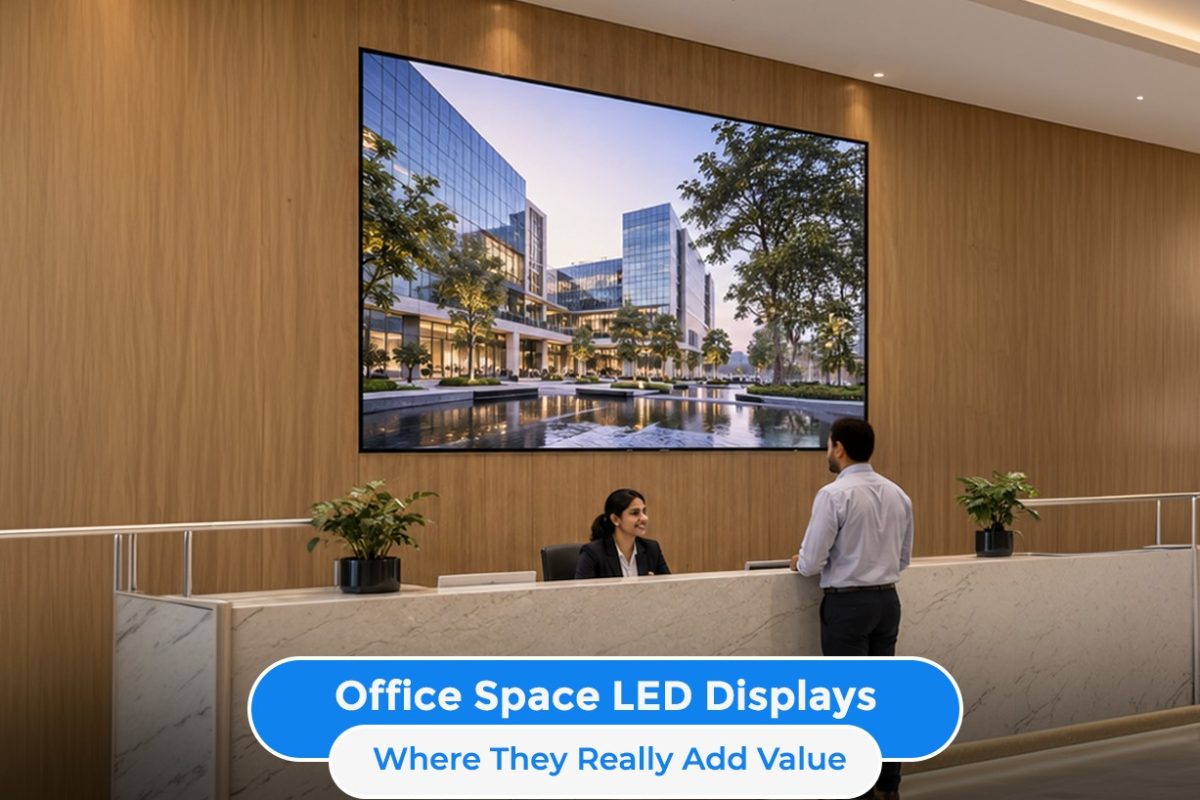
LED Advertising Screen Outdoor & Indoor Options & Prices in India

LED Advertising Screen: Outdoor & Indoor Options & Prices in India

If you have ever stood at a traffic signal in Mumbai, walked through a mall in Bengaluru, or attended an IPL match in Hyderabad, chances are you have locked eyes with a blazing, full-colour LED advertising screen. Bright, dynamic, impossible to ignore; these screens have quietly taken over India’s advertising landscape, replacing static flex banners and painted hoardings with something far more powerful: live, updateable, attention-commanding visual communication.

By 2026, the LED display market in India is one of the fastest-growing in Asia. Falling hardware costs, the spread of 4G and 5G networks, aggressive smart city investments, and the explosion of retail, events, and out-of-home advertising have combined to make the LED advertising screen accessible to businesses far beyond the metro cities and big-budget brands that first adopted them.

What Is an LED Advertising Screen?

An LED advertising screen is an electronic display panel that uses an array of light-emitting diodes (LEDs) to produce bright, vibrant, full-colour visual content for commercial communication. The content shown including images, videos, animations, live data, can be changed remotely at any time, making these displays infinitely more flexible than any printed signage.

Unlike a consumer television, an LED advertising screen is designed for continuous commercial operation: 16 to 24 hours a day, 365 days a year, often in challenging environments. Outdoor variants resist rain, dust, heat, and humidity. Indoor variants deliver razor-sharp resolution for close-up retail viewing. Both categories share the core advantage that sets LED apart from all alternatives- the ability to show dynamic, scheduled, remotely managed content on a surface of virtually any size.

Types of LED Advertising Screens

Understanding the different types available in the Indian market is essential to choosing the right solution. Here is a comprehensive overview of every major category.

1. Outdoor Advertising LED Display Screen

The outdoor advertising LED display screen is the most visible and iconic format in the Indian market. These are the large, luminous panels you see towering over highways, mounted on commercial building rooftops, and standing at prominent traffic junctions across every major Indian city.

Built for India’s demanding outdoor conditions – monsoon rain, coastal humidity, dust storms, and extreme summer heat, outdoor LED panels carry IP65 or higher ingress protection ratings, meaning they are fully sealed against dust and resistant to water jets from any direction.

Key technical specifications for outdoor LED displays:

  • Brightness: 5,000-10,000 nits
  • IP Rating: IP65 minimum; IP66 or IP67 for coastal or flood-prone zones
  • Pixel Pitch: P4 through P16 (selected based on viewing distance)
  • Operating Temperature: -20°C to +60°C
  • Cabinet Material: Die-cast aluminium or galvanised steel
  • Viewing Angle: 140°-160° horizontal and vertical
  • Power Consumption: 300W-800W per sq. m. at maximum load

Outdoor LED screens in India are modular. Standard cabinet sizes such as 960mm × 960mm or 500mm × 1,000mm are assembled in grids to create the final screen. This modular approach also simplifies maintenance, since a faulty cabinet can be swapped out without shutting down the rest of the display.

Primary applications in India: Highway hoardings, building rooftop displays, traffic junction boards, petrol station forecourt signs, stadium perimeter screens, airport exteriors, railway station facades.

2. Outdoor LED Advertising Screen for Building Facades

A specialised and increasingly popular format, the outdoor LED advertising screen for building facades integrates directly into the exterior architecture of commercial buildings. These installations transform the building itself into an advertising medium, creating landmark visual identities that draw attention from hundreds of metres away.

Cities like Mumbai’s BKC, Delhi’s Connaught Place and Aerocity, Bengaluru’s MG Road, and Hyderabad’s Hitech City have seen a wave of such installations as premium commercial real estate developers compete for tenant brands and public attention.

Facade LED screens are often built using transparent LED or mesh LED technology. Panels with a significant proportion of open space between LED nodes, allowing natural light and air to pass through. This reduces the structural load on the building, maintains ventilation, and allows the glass facade behind the screen to remain partially visible during the day. At night, the open mesh becomes invisible and the screen appears solid and vibrant.

Typical pixel pitches for facade applications range from P10 to P25, since these screens are designed to be viewed from 30 to 200 metres away. Extremely fine resolution at those distances would be an expensive irrelevance.

Primary applications in India: Luxury commercial towers, hotel facades, entertainment complexes, shopping mall exteriors, brand headquarters.

3. Indoor LED Advertising Screen

The indoor LED advertising screen brings the same dynamic, high-impact visual communication to enclosed environments including retail stores, corporate offices, hotel lobbies, airports, hospitals, educational institutions, and event venues.

Because indoor environments are controlled for lighting, indoor LED panels do not need the extreme brightness of outdoor displays. Instead, they prioritise resolution, using much finer pixel pitches to deliver crisp, detailed imagery suitable for viewers standing 1 to 8 metres from the screen.

Key technical specifications for indoor LED screens:

  • Brightness: 800-2,000 nits
  • Pixel Pitch: P1.2 through P4 (the finer the pitch, the higher the resolution)
  • Refresh Rate: 3,840 Hz or above (essential for broadcast quality video and photography)
  • Cabinet Construction: Lightweight aluminium, front or rear serviceable
  • Viewing Angle: 160°+ for wide coverage in large spaces

Indoor LED screens are commonly used in video wall configurations. Multiple cabinets tiled together to create seamless, large-format visual surfaces. Unlike LCD video walls, which have physical bezels (frames) between panels, LED video walls are completely seamless. This makes them the preferred choice wherever absolute visual continuity is required.

Primary applications in India: Retail flagship stores, shopping mall atriums, hotel ballrooms and lobbies, corporate experience centres, conference centres, bank branches, entertainment venues, broadcast studios, command and control rooms.

4. LED Screens for Events

LED screens for events represent one of the most dynamic and commercially vibrant segments of the Indian LED display market. India’s events industry which encompasses IPL and ISL matches, national and international concerts, corporate conferences, political rallies, trade expositions, and one of the world’s largest wedding markets, runs on rented LED display infrastructure.

Event LED panels are purpose-engineered for rapid deployment and dismantling. They differ from permanent installation panels in several important ways:

  • Ultra-light cabinets: Most weigh under 7 kg per panel for manual handling without cranes
  • Tool-free assembly: Magnetic or quick-lock connectors allow panels to be assembled into large screens in under an hour
  • Die-cast magnesium alloy frames: Balance structural rigidity with minimal weight
  • Front and rear serviceability: Fast module replacement during live events without disassembling the whole screen
  • High refresh rates: 3,840 Hz or above for flicker-free broadcast camera coverage

Common configurations for Indian events include main stage screens of 12m × 6m to 20m × 10m, supplementary side-fill screens at 45-degree angles, and IMAG (Image Magnification) screens positioned to give rear audiences a close-up view of performers or speakers.

Pixel pitches range from P2.6 to P3.9 for close-viewing stage screens, and P4.8 to P6 for large venue fill screens viewed from 15 metres or more.

Primary applications in India: Concert stage backdrops, IPL match screens, corporate conferences and product launches, political rallies and public events, wedding functions, trade show exhibition stands, religious gatherings and yatras.

5. Digital Signage Display (Commercial LED Format)

The term digital signage display covers a broad category of commercial display solutions, but LED-based digital signage has become increasingly dominant in applications that previously relied on LCD technology, particularly where brightness, seamless tiling, or large format are priorities.

Within LED-based digital signage, several specialised formats have emerged in the Indian market:

LED poster displays are slim, freestanding panels that function as digital alternatives to traditional printed standees. Typically 75 to 98 inches in height and available in portrait or landscape orientation, they are widely used in malls, airports, and retail stores.

Transparent LED displays are built using special LED modules where the PCB (printed circuit board) is extremely thin, creating a 30% to 70% transparent panel. When mounted on glass windows or facades, they can show vivid content without fully blocking the view through the glass, transforming shop windows and glass walls into advertising surfaces.

COB (Chip-on-Board) LED displays use a newer packaging technology where the LED chips are bonded directly to the PCB and encapsulated in a protective layer, rather than being individually housed in an SMD package. COB displays offer superior contrast, reduced reflection, better impact resistance, and higher quality at ultra-fine pixel pitches, making them popular for premium indoor retail and corporate applications.

Primary applications in India: Retail chain stores, QSR menu boards, pharmacy chains, airport concourses, corporate reception areas, hospital lobbies, showrooms, and hospitality venues.

6. Advertising Boards (Digital Replacements for Static Hoardings)

Traditional advertising boards like static flex banners, painted walls, backlit displays, and tin hoardings are being systematically replaced by LED displays across India’s urban landscape. This is driven by both commercial logic and regulatory trends.

From a commercial standpoint, a single LED advertising board can host 6 to 12 advertisers in rotation, with each slot priced individually. This means the site owner earns several times the revenue of a static hoarding occupying the same physical space. Advertisers benefit from the ability to run time-sensitive campaigns, update creative instantly, and target specific dayparts.

From a regulatory standpoint, several Indian municipal corporations have introduced digital advertising policies that cap the number of static hoardings while permitting or even incentivising digital LED displays as part of urban beautification and smart city programmes. Cities like Mumbai, Pune, Ahmedabad, and Hyderabad have been active in this space.

Primary applications: Commercial hoardings in shopping districts, highway advertising, transit route advertising, mall perimeter boards, sports venue perimeter advertising.

LED Advertising Screen Prices in India (2026)

Pricing varies significantly by type, pixel pitch, brand, and installation complexity. The figures below are realistic indicative ranges for the Indian market in 2026.

Indoor LED Screen Prices

Pixel PitchTypical ApplicationPrice per Sq. Metre (Approx.)
P1.2 – P1.5Boardrooms, broadcast studios, premium retail₹80,000 – ₹1,60,000
P1.8 – P2.5Corporate lobbies, flagship stores, malls₹35,000 – ₹80,000
P3 – P4Stage backdrops, hotel ballrooms₹18,000 – ₹40,000
P5 – P6Large indoor auditoriums, exhibition halls₹10,000 – ₹20,000

Outdoor LED Screen Prices

Pixel PitchTypical ApplicationPrice per Sq. Metre (Approx.)
P3 – P4Petrol station signs, retail frontage₹40,000 – ₹75,000
P5 – P6Commercial hoardings, stadium perimeters₹22,000 – ₹45,000
P8 – P10Highway hoardings, large outdoor sites₹12,000 – ₹25,000
P12 – P16Very large building facades, long-range viewing₹7,000 – ₹14,000

Event LED Screen Rental Prices

Screen SizeRental (Per Day, Approx.)
Up to 12 sq. m (e.g., 4m × 3m)₹12,000 – ₹35,000
12-30 sq. m (e.g., 6m × 4m)₹30,000 – ₹75,000
30-60 sq. m (e.g., 8m × 6m)₹65,000 – ₹1,30,000
60-120 sq. m₹1,20,000 – ₹2,80,000
120+ sq. m (large concerts, rallies)₹2,50,000 – ₹10,00,000+

Rental prices are for the screen only. Installation, rigging, operator, content management, and transport may be charged separately. Prices vary by city and season- October through March is the peak event season in India.

Top LED Advertising Screen Brands Available in India

The Indian market is served by brands across several tiers:

Premium Tier: Absen, Leyard, Unilumin, Barco, Daktronics used for flagship installations at international airports, five-star hotels, and major stadiums. Backed by comprehensive warranties and professional service networks.

Mid-Range Tier: Liantronics, Ledman, Retop, Radiant- quality products at competitive price points, widely used by system integrators for commercial hoarding networks and corporate deployments.

India-Based Suppliers: Xtreme Media, Syberry, Magnus, Mirackle- these companies either assemble locally using imported modules or represent international brands. They typically offer strong local technical support, which is invaluable for large networks spread across multiple cities.

Direct-Import / Budget Tier: Numerous Shenzhen-based manufacturers supply directly to Indian buyers via platforms like Alibaba and IndiaMART. Pricing is competitive but buyers need technical competence to evaluate quality, manage shipping and customs, and handle maintenance without a local service network.

How to Choose the Right LED Advertising Screen

Follow this structured process to avoid costly mistakes:

Step 1 : Define the environment. Outdoor or indoor? This determines brightness, IP rating, and cabinet construction. An indoor panel used outdoors will fail within months.

Step 2 : Establish the viewing distance. The minimum comfortable viewing distance for an LED screen is approximately equal to the pixel pitch in millimetres multiplied by 1,000. A P8 panel is ideally viewed from 8 metres or more; a P2 panel delivers sharp imagery from just 2 metres.

Step 3 : Size the screen correctly. Calculate based on the viewing area, content layout, and structural constraints. Oversizing wastes capital; undersizing reduces visual impact.

Step 4 : Decide on content and playback requirements. Static brand messaging needs only a basic media player. Full-motion video with live data overlays needs a higher-spec control system. Multi-screen networks need a robust CMS.

Step 5 : Calculate total cost of ownership. Hardware + installation + civil and structural work + power supply and electrical work + CMS licence + connectivity + annual maintenance. The panel itself is often only 40-60% of the total project cost.

Step 6 : Check regulatory requirements. Outdoor displays in Indian cities require municipal permissions. Some locations need additional clearances from traffic police, NHAI (for highway sites), or the Airports Authority of India (AAI) for installations near flight paths.

Step 7 : Evaluate suppliers rigorously. Request references, arrange site visits to existing installations, clarify warranty coverage (typically 2-3 years for cabinets, 1 year for modules and power supplies), and confirm local spare parts availability and service response times.

Frequently Asked Questions (FAQs)

Q1. What is an LED advertising screen and how is it different from a regular display?

An LED advertising screen is a commercial-grade display built for continuous operation, typically 16 to 24 hours a day, using LED technology to produce bright, vivid, dynamic content for advertising and communication. Unlike a consumer TV or monitor, it is designed for demanding environments, supports remote content management, and can be tiled into any size. It is available in outdoor-rated variants that withstand India’s weather conditions.

Q2. What is the best pixel pitch for an outdoor LED advertising screen in India?

It depends on the viewing distance. For highway hoardings viewed from 15 metres or more, P8 to P10 is a practical and cost-effective choice. For commercial hoardings in shopping districts viewed from 6-12 metres, P5 to P6 delivers sharper imagery. For retail frontage or petrol stations where viewers pass within 3-5 metres, P3 to P4 is appropriate.

Q3. How much does an outdoor LED advertising screen cost in India in 2026?

Outdoor LED panels in India cost approximately ₹12,000 to ₹75,000 per square metre depending on pixel pitch, brand, and specification. A complete turnkey installation, including the panel, structure, electrical work, and CMS for a standard P8 highway hoarding of 12 sq. m. would typically cost ₹4,00,000 to ₹9,00,000 in 2026.

Q4. What are LED screens for events, and can I rent them?

Event LED screens are lightweight, modular panels designed for rapid setup and dismantling at concerts, conferences, sports events, weddings, and political rallies. Yes, rental is widely available across India through event production companies and LED display rental specialists. Rental prices range from approximately ₹12,000 to ₹10,00,000+ per day depending on screen size and location.

Q5. How long does an LED advertising screen last?

Quality LED modules are rated for 50,000 to 100,000 hours of operational life. Running a screen for 12 hours per day, that translates to approximately 11 to 22 years before LEDs reach half their original brightness (the industry standard for measuring LED lifespan). Peripheral components like power supplies and control cards typically need replacement every 5-8 years. With proper maintenance, a well-installed LED advertising screen should give reliable service for 8-12 years.

Q6. What content formats can I show on an LED advertising screen?

LED advertising screens can display full-motion video (MP4, MOV, AVI), static images (JPEG, PNG), animated graphics (GIF), live HDMI inputs (for real-time event feeds or broadcast content), HTML5 dynamic templates (for live data like weather, scores, prices), and multi-zone layouts combining different content types on a single screen. Content is typically managed via a cloud-based CMS that enables scheduling, remote updates, and performance monitoring.

Q7. What is programmatic DOOH and is it relevant in India?

Programmatic DOOH (Digital Out-of-Home) is the automated, real-time buying and selling of advertising slots on digital outdoor screens, using audience data, location context, and competitive bidding, similar to how online display advertising works. Yes, it is active and growing in India’s major metro cities, with several platform providers connecting outdoor screen networks to programmatic demand-side platforms (DSPs). It is most developed in Mumbai, Delhi NCR, and Bengaluru.

Q8. Can an LED advertising screen operate without an internet connection?

Yes. Many LED displays operate using a local media player with pre-loaded content, requiring no active internet connection for playback. However, internet connectivity is required for remote content updates via a cloud CMS, live data feeds, real-time monitoring, and programmatic ad serving. For installations in remote locations, 4G-based connectivity via a SIM card in the control unit is a practical solution.

Q9. What is the difference between SMD and COB LED technology?

SMD (Surface Mounted Device) is the conventional LED packaging technology where individual LED chips are housed in tiny plastic packages mounted on the PCB. COB (Chip-on-Board) bonds the LED chips directly to the PCB and encapsulates them in a single protective layer. COB offers better contrast (no reflection from individual LED housings), improved uniformity, higher resistance to physical damage, and superior performance at very fine pixel pitches. COB displays cost more but are increasingly preferred for premium fine-pitch indoor applications.

Q10. Which sectors use LED advertising screens the most in India?

The highest-volume users of LED advertising screens in India are outdoor advertising operators (DOOH networks), retail chains and shopping malls, the events and entertainment industry (concerts, sports, weddings), corporate campuses and hospitality groups, transportation infrastructure (airports, metro systems, railways), and government and smart city projects. The events sector and outdoor advertising are currently experiencing the strongest growth in 2026.

Conclusion

The LED advertising screen has evolved from a premium novelty into a mainstream commercial infrastructure across India. Whether you need an outdoor advertising LED display screen to command attention on a busy highway, an indoor digital signage display for a flagship retail store, or a large-format LED screen for events that will light up a concert stage, the technology is mature, the supply chain is well-established, and the pricing in India in 2026 is more accessible than ever.

Success with LED advertising comes down to matching the right technology to the right environment, understanding total cost of ownership beyond the panel price, choosing a supplier with genuine local support capability, and keeping up with regulatory requirements. Do those things well, and an LED advertising screen is not just an expense- it is a durable, high-impact asset that delivers measurable commercial returns for years.

India’s digital advertising screen revolution has only just begun. The screens are getting smarter, the content more targeted, and the business case stronger with every passing year. The question is not whether to invest; it is where to start.

LED Running Text Board & Scrolling Display Price & Guide (India 2026)

LED Running Text Board & Scrolling Display: Price & Guide (India 2026)

In today’s fast-moving, attention-driven market, static signage is slowly being replaced by dynamic, digital solutions. One of the most effective tools in this space is the running text LED display, a simple yet powerful way to communicate messages in motion.

From small retail shops to large-scale events and outdoor advertising, LED scrolling displays have become a go-to solution for businesses that want visibility, flexibility, and impact- all in one board.

What is a LED Running Text Board?

A running text LED display is a digital signboard that shows moving (scrolling) text, animations, or messages using LED lights. Unlike traditional boards that display fixed content, these boards continuously scroll information across the screen, making them far more engaging.

At its core, the technology is quite straightforward. The board is made up of multiple LED modules (often called P10, P5, etc., based on pixel density). These LEDs light up in patterns to form letters, numbers, or graphics. The content can be programmed using software, mobile apps, USB drives, or Wi-Fi.

Most modern LED running boards allow:

  • Real-time content updates
  • Multiple languages
  • Adjustable brightness and speed
  • Animated effects (scroll, blink, rotate, etc.)

They are designed for high visibility, even in daylight, thanks to their brightness levels that can reach thousands of nits.

Additionally, these boards are energy-efficient and long-lasting, often consuming as little as 10W-50W depending on size.

In simple terms, a LED scrolling display acts like a digital notice board that never goes unnoticed.

Where is it Used? (Shops, Events, Outdoors)

The versatility of running text LED displays is one of the main reasons behind their growing popularity. They are no longer limited to just electronics shops or pharmacies. You’ll now find them across industries.

1. Retail Shops & Showrooms

Retail stores use led running boards to display:

  • Offers and discounts
  • “Open/Closed” messages
  • Product highlights

Because the text is constantly moving, it naturally grabs attention compared to static signage.

2. Restaurants & Cafés

In food businesses, led banners are commonly used to:

  • Promote daily specials
  • Display combo offers
  • Highlight delivery services

A scrolling message like “20% OFF TODAY” is far more noticeable than a printed poster.

3. Events & Exhibitions

Large-scale LED screens for events are essentially advanced versions of running displays. These are used for:

  • Stage backdrops
  • Sponsor promotions
  • Live announcements

They fall under the broader category of digital advertising screens, offering high-resolution visuals and dynamic content.

4. Outdoor Advertising

Modern cities are increasingly adopting advertising display screens instead of traditional flex boards. In fact, many urban projects in India are replacing static hoardings with LED displays for real-time content updates and better visibility.

These outdoor boards are weatherproof and designed to operate in extreme conditions.

5. Corporate & Institutional Use

Banks, offices, schools, and hospitals use LED scrolling displays to:

  • Share announcements
  • Display token numbers
  • Provide directions or alerts

LED Scrolling Display vs Static Sign Board

While both serve the purpose of communication, the difference between a digital advertising screen and a traditional board is significant.

A static board is limited; it displays one message at a time and requires manual replacement for updates. In contrast, a running text LED display is dynamic and programmable.

With LED displays:

  • You can change content instantly
  • Display multiple messages in rotation
  • Use motion to attract attention

Static boards, on the other hand, are:

  • Cheaper initially
  • Easier to install
  • Limited in engagement

For businesses looking to stand out, LED displays offer a clear advantage. They combine advertising with motion, which naturally draws the human eye.

Price of LED Running Text Boards in India

The led running display board price in India depends on several factors, including size, color type, resolution, and usage (indoor vs outdoor).

To give you a realistic understanding, here are some popular options available in the market:

Typical Price Range (2026)

  • Small indoor boards: ₹2,000 – ₹5,000
  • Medium shop boards: ₹5,000 – ₹15,000
  • Large outdoor boards: ₹15,000 – ₹75,000+

For example, a basic red LED board can cost around ₹1,400 per sq. ft., while advanced multicolor boards are priced higher depending on features.

What Affects the Price?

Several factors influence the cost of an advertising screen:

  • Size & dimensions
  • Single color vs RGB display
  • Pixel pitch (P10, P5, etc.)
  • Indoor vs outdoor build (IP rating)
  • Connectivity (USB, Wi-Fi, cloud control)

Larger, high-resolution digital advertising screens used for events or billboards can cost significantly more due to advanced technology.

Best LED Running Text Boards to Buy

Choosing the right LED running board depends on your use case, budget, and installation environment. Below are some reliable options currently available:

Best Overall (Shop Use)

This is a balanced option offering good visibility, programmable content, and affordability- perfect for retail stores.

Best Budget Option

Ideal for small businesses looking for a low-cost entry into digital signage.

Best for Outdoor Advertising

Designed for outdoor environments with better brightness and durability.

Best for Events & Large Displays

Perfect for exhibitions, events, and large-format advertising.

PRODUCT COMPARISON TABLE

FeatureVARTEC P10 LED Running Display BoardOutdoor Moving Message Board P10P10 Outdoor LED Scrolling DisplayRGB Multicolour LED Display
Best UseShopsBudget useOutdoor shopsEvents
SizeMediumSmallLargeVery large
ConnectivityWiFiBasicWiFiAdvanced
Color TypeMulti-colorSingle colorRGBFull RGB
Price Range₹3K-₹5K₹2K-₹3K₹15K+₹70K+
VisibilityHighMediumVery highUltra high

Installation Guide

Installing a LED running display board is relatively simple, but doing it correctly ensures better performance and longevity.

Step 1: Choose the Right Location

Install the board where it is clearly visible to your target audience, usually at eye level or slightly above.

Step 2: Ensure Power Supply

Most boards run on standard AC power. Make sure you have a stable connection to avoid flickering or damage.

Step 3: Mounting

Boards can be:

  • Wall-mounted
  • Hanging
  • Frame-supported

Ensure the mounting is secure, especially for outdoor installations.

Step 4: Content Setup

Use the provided software or app to:

  • Add text
  • Set scrolling speed
  • Adjust brightness

Step 5: Weather Protection

For outdoor use, ensure:

  • IP65-rated protection
  • Proper casing
  • Surge protection

A well-installed board can run continuously for years with minimal maintenance.

FAQs

1. What is a running text LED display used for?
It is used for advertising, announcements, and promotions using scrolling text.

2. What is the price of a LED running board in India?
Prices start from ₹2,000 and can go up to ₹70,000+ depending on size and features.

3. Which is better: LED scrolling display or static board?
LED displays are better for engagement and flexibility.

4. Can I update content on LED boards?
Yes, via USB, mobile apps, or Wi-Fi.

5. Are LED boards suitable for outdoor use?
Yes, if they are weatherproof and have proper IP ratings.

6. What is pixel pitch in LED boards?
It refers to the distance between LEDs; smaller pitch means higher resolution.

7. Do LED boards consume a lot of electricity?
No, they are energy-efficient compared to traditional lighting.

8. How long do LED boards last?
Typically 30,000-50,000 hours.

9. Can LED boards display multiple messages?
Yes, they can rotate multiple messages in sequence.

10. Are LED displays good for events?
Yes, they are widely used as digital advertising screens and event displays.

Final Thoughts

The rise of running text LED displays reflects a broader shift toward digital and dynamic advertising. Whether you’re a small shop owner or managing large-scale promotions, these boards offer a flexible and impactful way to communicate.

With affordable pricing, easy customization, and strong visibility, investing in a LED scrolling display in 2026 is not just a trend, it’s a smart business move.

Neon Sign Board & Neon Light Board Price, Types & Ideas (India 2026)

Neon Sign Board & Neon Light Board: Price, Types & Ideas (India 2026)

In an era where first impressions often decide whether a customer walks into your store or scrolls past your page, signage has become more than just a name display. It’s a branding statement. Among the many options available today, the neon sign board continues to dominate for its ability to instantly grab attention and create a strong visual identity.

From aesthetic cafés and salons to retail stores and home décor setups, neon light boards are everywhere in 2026. What’s interesting is how this category has evolved, from fragile gas-filled tubes to modern, flexible LED-based solutions that are both stylish and practical.

What is a Neon Sign Board?

A neon sign board is an illuminated display that uses glowing tubes to form text, logos, or decorative shapes. Traditionally, these tubes were filled with gases like neon or argon, which emit light when electrified. This is what gave neon signs their signature warm glow that became iconic in vintage storefronts and retro spaces.

However, the concept has evolved significantly over the years. Today, when most people refer to a neon light board, they are often talking about LED-based neon signs. These use flexible LED strips enclosed in silicone tubing to mimic the appearance of traditional neon while overcoming many of its limitations.

The charm of neon lies in its ability to combine function and aesthetics. It doesn’t just tell people your business name- it creates a mood, a vibe, and a memory.

Modern neon boards are used for:

  • Shopfront branding
  • Interior décor
  • Event backdrops
  • Social media-friendly installations

Whether it’s a glowing café quote or a bold storefront name, a neon board naturally draws attention, especially in low-light environments.

Neon vs LED Sign Board: Key Differences

While both traditional neon and LED signage fall under the umbrella of illuminated displays, they differ significantly in terms of technology, performance, and practicality.

Traditional neon signs are made using glass tubes filled with gas. When electricity passes through, the gas emits light. This produces a soft, warm glow that many people still associate with classic signage. However, these signs are delicate, consume more power, and require careful handling.

On the other hand, modern LED light boards for shops are designed with efficiency and durability in mind. They use LED strips that are flexible, safer, and much easier to customize. These boards can replicate the neon effect while offering better brightness control and significantly lower energy consumption.

From a business perspective, LED neon boards are usually the more sensible choice. They are cost-effective, long-lasting, and require minimal maintenance. Traditional neon, while beautiful, is now more of a niche choice for those specifically looking for a retro or premium aesthetic.

In simple terms, if you want something practical and budget-friendly, go for LED. If you’re aiming for a vintage, high-end visual appeal and don’t mind the upkeep, traditional neon can still be a great option.

Best Neon Sign Board Designs for Shops

Design plays a crucial role in how effective your light board for shop will be. A well-designed neon sign doesn’t just inform; it attracts, engages, and even encourages customers to take photos and share them online.

One of the most popular design approaches is logo-based signage. Turning your brand logo into a glowing neon light sign board creates instant recognition and gives your storefront a polished, professional look. This works especially well for salons, boutiques, and cafés where branding is key.

Another widely used style is minimal text signage. Short, catchy phrases like “Open,” “Hello Beautiful,” or “Coffee Time” are often used as decorative light display boards. These are not only visually appealing but also enhance the ambiance of the space.

For businesses that prefer subtle branding, icon-based designs are a great option. A glowing outline of a coffee cup, scissors, or shopping bag can communicate your business type without overwhelming the viewer. These designs are clean, modern, and highly effective.

Backlit acrylic boards are also gaining popularity in 2026. These combine a solid base (usually acrylic) with neon lighting to create a premium, layered effect. This type of led light board design is ideal for brands looking to position themselves as high-end.

Another emerging trend is the use of multi-color or gradient lighting. Instead of a single color, businesses are experimenting with blended hues that create a more dynamic and Instagram-friendly look.

When choosing a design, it’s important to keep readability in mind. Your sign should be easy to understand from a distance and should align with your brand identity. Overcomplicating the design with too many colors or fonts can reduce its impact.

Neon Light Board Price in India 2026

Understanding the light board price is essential before making a purchase decision. In India, the cost of a neon sign board can vary widely depending on factors like size, material, design complexity, and whether it’s customized.

For LED-based neon boards, which are the most common choice today, prices typically start at around ₹2,000 for small signs. These are usually simple text-based designs suitable for indoor use. As the size and complexity increase, the price can go up to ₹15,000 or more for medium-sized boards.

Large, fully customized boards used for storefronts or branding purposes can range anywhere between ₹15,000 and ₹40,000+. These often include acrylic backing, multiple colors, and installation support.

Traditional neon boards, due to their craftsmanship and materials, are generally more expensive. Even basic designs can start from ₹8,000 and go up significantly depending on customization.

If you’re considering an acrylic-based led light board for shop, the pricing falls somewhere in between. These boards offer a premium look without the fragility of glass neon, making them a popular mid-range option.

Several factors influence pricing:

  • The overall size of the board
  • Number of colors used
  • Complexity of the design
  • Indoor vs outdoor specifications
  • Brand or vendor reputation

For most small to medium businesses, LED neon boards offer the best balance between cost and performance.

Custom Neon Sign Board: How to Order

Ordering a custom neon sign board has become a streamlined process in recent years, thanks to the rise of online vendors and specialized manufacturers.

The first step is to clearly define your requirement. Think about what you want your sign to communicate- is it your brand name, a logo, or a decorative phrase? Also consider where it will be placed, as indoor and outdoor boards have different specifications.

Once you have clarity, the next step is choosing the type of board. As discussed earlier, LED neon is usually the preferred option for most businesses due to its durability and affordability.

Design selection comes next. If you already have a logo, you can share it in a vector format. If not, most vendors offer basic design assistance. They typically provide a digital mockup so you can visualize how the final product will look.

After finalizing the design, you’ll need to decide on materials such as acrylic backing, mounting style, and whether you need waterproofing. These choices will directly impact the final light board price.

Installation is usually straightforward. Most boards come with wall-mounting options or hanging kits, making them easy to set up.

Before placing your order, it’s always a good idea to check for warranty and after-sales support. A standard warranty of 6-12 months is generally expected for LED boards.

Where to Buy Neon Sign Boards in India

When it comes to purchasing a neon light board, you have multiple options depending on your budget and customization needs.

Online marketplaces like Amazon and Flipkart are convenient for browsing ready-made designs or semi-custom options. They are ideal for small businesses or individuals looking for quick solutions.

For more personalized requirements, local signage vendors are often the best choice. They allow you to discuss your needs in detail and offer better customization. Plus, you can physically inspect the quality before making a decision.

India also has several wholesale markets known for signage and display materials. Cities like Delhi, Mumbai, and Bangalore have dedicated areas where you can find competitive deals on light display boards and related products.

If you’re looking for premium finishes or unique designs, specialized neon brands are worth exploring. These companies focus solely on neon signage and often provide higher quality and better design options.

FAQs

1. What is a neon sign board used for?
A neon sign board is primarily used for branding, advertising, and decoration in commercial and residential spaces.

2. Which is better: neon or LED light board?
LED boards are generally better due to their durability, energy efficiency, and lower cost.

3. What is the starting price of a neon light board in India?
Prices typically start from ₹2,000 for small LED-based boards.

4. Are neon boards suitable for outdoor use?
Yes, but they should be specifically designed to be waterproof and weather-resistant.

5. How long do LED neon boards last?
They usually last between 30,000 to 50,000 hours.

6. Can I customize my neon board design?
Yes, most vendors offer full customization in terms of text, color, size, and style.

7. Do neon boards consume a lot of electricity?
Traditional neon does, but LED neon boards are highly energy-efficient.

8. What is the best light board design for shops?
Simple, readable designs with strong branding elements work best.

9. Where can I find affordable neon boards?
Online platforms and local vendors both offer budget-friendly options.

10. Is installation complicated?
No, most modern boards are easy to install and come with mounting kits.

Final Thoughts

A thoughtfully designed neon sign board can completely transform how your business is perceived. It’s not just about visibility, it’s about creating an experience that people remember.

With the advancements in LED technology, getting a high-quality neon light board is now more accessible than ever. Whether you’re a small business owner or building a premium brand, investing in the right signage can significantly enhance your presence and customer engagement.

If you’re planning to get one, take your time to explore designs, compare light board price options, and choose something that truly represents your brand.

Smart Board Price in India 2026 Full Price List by Size & Brand

Smart Board Price in India 2026: Full Price List by Size & Brand

Understanding the smart board price in 2026 is crucial for anyone planning to invest in modern teaching or collaboration tools. With digital transformation accelerating across schools and offices, the smart board price in India has become more competitive, yet varies significantly based on size, brand, and features.

Whether you’re evaluating the smart board cost for a classroom or comparing the interactive board price for corporate use, this detailed guide will help you make an informed decision.

Smart Board Price List 2026 (All Sizes)

The smart board price is largely influenced by screen size. Below is a comprehensive breakdown of the digital board price based on different size categories available in India.

SizeUsagePrice Range (INR)
55 inchSmall rooms / startups₹45,000 – ₹90,000
65 inchClassrooms / offices₹75,000 – ₹1,50,000
75 inchLarge classrooms₹1,20,000 – ₹2,50,000
86 inchConference rooms₹2,00,000 – ₹4,50,000
98 inch+Auditoriums₹4,00,000 – ₹8,00,000+

This range reflects the average smart board price in India, but premium models with AI features and 4K resolution can significantly increase the smart digital board price.

Another important factor is whether the board is a standalone panel or projector-based system. Standalone panels generally have a higher smart board cost, but offer better performance and durability.

Price by Brand Comparison Table

Brand reputation plays a major role in determining the smart board price. Here’s a detailed comparison:

BrandEntry PricePremium PriceKey Strength
Samsung₹90,000₹5,00,000+Premium quality displays
BenQ₹80,000₹3,50,000Education-focused features
LG₹1,00,000₹4,50,000High-end performance
ViewSonic₹70,000₹3,00,000Budget-friendly
Promethen₹1,20,000₹5,50,000Global education leader

The variation in smart board cost depends on software integration, warranty, and hardware capabilities. For instance, boards with built-in teaching tools tend to have a higher smart board for teaching price.

What Affects Smart Board Price?

Several key factors determine the final smart board price you pay:

1. Screen Size

Larger screens directly increase the digital board price due to higher production costs.

2. Display Resolution

4K panels cost more than Full HD, impacting the smart board price in India.

3. Touch Technology

Advanced multi-touch systems raise the interactive board price.

4. Software Ecosystem

Boards with built-in apps and cloud integration increase the smart digital board price.

5. Connectivity

Wi-Fi, Bluetooth, and screen mirroring features also affect the smart board cost.

6. Installation & Support

Installation, training, and AMC packages can add to the overall smart board price.

Understanding these factors helps you better evaluate whether a higher smart board cost is justified.

Smart Board Price for Schools

For educational institutions, the smart board for teaching price is a major consideration. Schools typically choose based on budget and classroom requirements.

Price Breakdown:

  • Basic setup: ₹50,000 – ₹1,00,000
  • Standard classroom: ₹1,00,000 – ₹2,50,000
  • Advanced digital classrooms: ₹2,50,000 – ₹5,00,000

The smart board price in India for schools may be lower when purchased in bulk. Government tenders and educational subsidies also help reduce the overall smart board cost.

Schools prioritize durability, ease of use, and compatibility with teaching tools when evaluating the smart board for teaching price.

Smart Board Price for Offices

Corporate buyers look at performance and collaboration features when considering the smart board price.

Price Range:

  • Small meeting rooms: ₹70,000 – ₹1,50,000
  • Mid-size conference rooms: ₹1,50,000 – ₹3,00,000
  • Enterprise setups: ₹3,00,000 – ₹7,00,000+

The interactive board price for offices often includes features like video conferencing, wireless sharing, and cloud collaboration. These features increase the smart digital board price, but also enhance productivity.

Is a Smart Board Worth the Cost?

Many buyers question whether the smart board price justifies the investment. The answer depends on usage.

Advantages:

  • Improved engagement
  • Better collaboration
  • Digital storage
  • Reduced long-term costs

Although the upfront smart board cost may seem high, it replaces multiple tools like projectors, whiteboards, and conferencing systems.

For schools, the smart board for teaching price delivers better learning outcomes. For businesses, the ROI comes from improved efficiency.

Where to Buy at Best Price

Getting the best smart board price in India requires smart comparison.

Buying Options:

  • Authorized dealers
  • Online marketplaces
  • B2B suppliers
  • Direct manufacturers

To reduce the smart board cost, compare multiple vendors, check warranties, and negotiate for bulk discounts. Seasonal offers can also lower the digital board price significantly.

FAQs

1. What is the average smart board price in India?

The average smart board price in India ranges from ₹75,000 to ₹3,00,000 depending on features.

2. Why is the smart board cost high?

The smart board cost includes advanced display, touch technology, and software.

3. What is the smart board for teaching price?

The smart board for teaching price starts around ₹50,000.

4. Which is the best budget smart board?

Brands like ViewSonic offer competitive interactive board price options.

5. Can I reduce the smart board price?

Yes, bulk buying and discounts can lower the smart board price in India.

6. What affects digital board price the most?

Screen size and features heavily influence the digital board price.

7. Are smart boards durable?

Yes, most justify their smart board cost with a long lifespan.

8. Do all smart boards include installation?

Not always; installation may increase the smart board price.

Conclusion

The smart board price in India in 2026 reflects not just the cost of hardware, but the value of an entire digital ecosystem designed to enhance communication, learning, and collaboration. As demand continues to grow across schools, coaching institutes, startups, and large enterprises, the smart board price in India has become more competitive, making it accessible to a wider audience than ever before.

When evaluating the smart board cost, it is important to look beyond the initial investment. A smart board is not just a display, it replaces multiple tools such as projectors, whiteboards, conferencing systems, and even some software subscriptions. This consolidation of tools often makes the overall smart digital board price more cost-effective in the long run.

For educational institutions, choosing the right smart board for teaching price can directly impact student engagement and learning outcomes. Interactive visuals, real-time annotations, and digital storage create a more immersive classroom experience compared to traditional methods. Similarly, in corporate environments, investing in the right interactive board price improves productivity, enhances team collaboration, and simplifies complex presentations.

Another key consideration while assessing the smart board price is scalability. Many modern boards are designed to integrate with evolving technologies such as cloud platforms, AI tools, and hybrid work solutions. This ensures that your investment in a smart board remains relevant and valuable for years to come.

It is also worth noting that the digital board price varies widely depending on features, but not every user needs the most expensive option. By carefully analyzing your requirements, whether it’s for a classroom, office, or training setup; you can find a smart board that delivers the right balance between performance and cost.

Moreover, as competition increases among brands, buyers can expect better deals, improved features, and more flexible pricing. Comparing vendors, checking after-sales support, and understanding warranty terms can significantly influence the overall smart board cost and help you secure the best deal.

In conclusion, the smart board price should be viewed as an investment in efficiency, engagement, and future-ready technology. Whether you are upgrading a single room or implementing a large-scale digital transformation, choosing the right smart board can create long-term value that far outweighs its initial cost.

If you’re planning to purchase one, take the time to compare options, evaluate features, and align your choice with your goals. With the right approach, your investment in a smart board will not only justify its price but also deliver measurable improvements in the way you teach, present, and collaborate.

Smart Board for Teaching & Classroom Best Picks in India

Smart Board for Teaching & Classroom: Best Picks in India

Digital classrooms are no longer a luxury, they are becoming the standard across schools, colleges, coaching institutes, and training centres in India. A smart board for teaching helps educators explain concepts visually, collaborate in real time, save notes instantly, and make lessons more engaging. Whether you run a preschool, CBSE school, college, or tuition centre, choosing the right board can improve teaching outcomes and reduce dependence on traditional projectors.

Today’s smart board for classroom setups usually come as Interactive Flat Panels (IFPs), combining a touchscreen display, whiteboard software, Android/Windows support, and wireless sharing. Compared to chalkboards or projector systems, they offer better brightness, lower maintenance, and smoother teaching workflows.

This detailed guide covers the best models in India, features to compare, pricing, setup tips, and teacher feedback for 2026.

Why Teachers Need a Smart Board

A modern teacher board does much more than display content. It transforms passive lectures into interactive sessions.

1. Better Student Engagement

Students respond better to visuals, videos, animations, and touchscreen interaction. Teachers can draw diagrams live, zoom maps, play science videos, or annotate PDFs instantly.

2. Faster Lesson Delivery

Instead of switching between books, projector remotes, and whiteboards, everything happens on one digital board for teaching.

3. Save & Share Notes

Teachers can save whiteboard notes and share them with students later through email or apps.

4. Hybrid Learning Ready

Many 2026 smart boards include cameras, microphones, and screen-sharing tools; useful for online classes and parent sessions.

5. Cleaner & Lower Maintenance

No chalk dust, no projector lamps, no calibration issues. Many Indian institutions now prefer interactive flat panels over projector-based smart classes.

Best Smart Boards for Teaching in India

Below are some strong options available in India based on features, pricing, brand trust, and education suitability.

1. BenQ RP Interactive Flat Panel

Best for premium schools and colleges. BenQ is known for eye-care display technology, durable panels, classroom software, and reliable after-sales support.

Best for: CBSE / International schools
Approx price: ₹1.7 lakh+

2. MAXHub U3 Interactive Flat Panel

MAXHub U3 Interactive Flat Panel

A strong business + education hybrid option with smooth writing response and video conferencing tools.

Best for: Colleges, coaching centres
Approx price: ₹1.8 lakh+

3. BIG VUE Pro 75 Inch Smart Interactive Panel

Feature-rich board with Android 14, multitouch, large screen, and value pricing.

Best for: Mid-budget schools
Approx price: ₹1.09 lakh+

4. DeltaView Spark 65 Smart Board

Balanced option for smaller classrooms and tuition centres.

Best for: Coaching / 25-35 students
Approx price: ₹1.09 lakh+

5. Evota Interactive Flat Panel

Emerging option focused on classrooms and teacher usability.

Best for: Budget institutions
Approx price: ₹1.05 lakh+

Smart Board for Primary School vs College

Choosing the right board for teaching depends on age group and usage.

For Primary School

Need:

  • Bright colors and engaging visuals
  • Easy touch response
  • Built-in drawing tools
  • Smaller sizes (55”-65”)
  • Durable glass protection

Best fit: 55” to 65” smart writing board

For Middle & High School

Need:

  • 4K clarity
  • Multi-touch collaboration
  • Subject apps
  • Split-screen teaching

Best fit: 65” to 75” digital board for classroom

For College / Universities

Need:

  • Large display
  • HDMI / USB-C connectivity
  • Annotation on presentations
  • Recording lectures
  • Hybrid teaching camera

Best fit: 75” to 86” smart class board

Key Features to Look for (Teaching Use)

When buying a smart board for teaching, don’t focus only on price.

1. Screen Size

  • 55” = Small tuition room
  • 65” = Standard classroom
  • 75” = Large classroom
  • 86” = Auditorium / college halls

2. Resolution

Always prefer 4K for readable text and diagrams.

3. Touch Points

20-point or higher multitouch is ideal.

4. Operating System

Android built-in is standard. Windows OPS optional for advanced needs.

5. Whiteboard Software

Look for:

  • Infinite canvas
  • Shapes & equations
  • Screen recording
  • PDF annotation

6. Connectivity

HDMI, USB, Wi-Fi, Bluetooth, casting support.

7. Warranty & Service

Very important for schools. Prefer brands with India-wide support.

Smart Board for Classroom Setup Guide

Even the best class board performs poorly if installed badly.

Placement Height

The center of the screen should align with the teacher’s eye level.

Viewing Distance

  • 65” for up to 30 students
  • 75” for 30-50 students
  • 86” for larger rooms

Power Backup

Install UPS or inverter support.

Internet

Stable Wi-Fi improves app usage and cloud sharing.

Audio

For large classrooms, add external speakers.

Wall vs Stand

  • Wall mount = permanent classrooms
  • Mobile stand = shared classrooms

Price Guide for School Budgets

The smart board for teaching price in India depends mainly on size, brand, software, and warranty.

Budget RangeBest Use CaseTypical Size
₹60,000 – ₹95,000Small tuition / coaching55”
₹95,000 – ₹1.35 lakhStandard schools65”
₹1.35 lakh – ₹2 lakhLarge classrooms75”
₹2 lakh – ₹4 lakh+Premium institutions86”+

Recent Indian market listings also show interactive panels from ₹63,000 up to ₹7 lakh depending on size and configuration.

Hidden Costs to Consider

  • Installation
  • Wall mount / trolley stand
  • Extended warranty
  • OPS PC module
  • Training for teachers
  • Content subscriptions

Real Teacher Reviews

Based on common market feedback and educator discussions:

“Students pay more attention”

Teachers often report better attention spans when lessons include visuals and touch interaction.

“Math & Science became easier”

Graphs, diagrams, and equations are easier to explain live.

“Saved time daily”

No more board cleaning, projector setup, or marker shortages.

“Need teacher training initially”

Some educators need 1-2 weeks to fully adapt.

“Buy service, not just hardware”

After-sales support is often more important than brand name alone.

Smart Board vs Projector: Which is Better?

FeatureSmart BoardProjector Setup
BrightnessExcellentDepends on room light
Touch WritingBuilt-inExternal add-on
MaintenanceLowHigh
Clarity4K availableLower
Shadow ProblemNoYes
LifespanStrongLamp replacement needed

For most institutions in 2026, the digital smart board is the better long-term investment.

Who Should Buy What?

Tuition Centre

Buy a 55”-65” budget model.

CBSE School

Buy 65”-75” branded panels with training support.

College

Buy a 75”-86” board with conferencing tools.

Preschool

Buy a smaller panel with child-friendly touch response.

FAQs

What is the best smart board for teaching in India?

BenQ, MAXHub, BIG VUE, ViewSonic, and other classroom-focused interactive flat panels are strong options depending on budget.

What is the average smart board for teaching price?

Most Indian classroom buyers spend between ₹95,000 and ₹2 lakh.

Is a smart board better than a projector?

Yes, for daily teaching use. It offers better clarity, less maintenance, and built-in touch tools.

Which size smart board is best for classroom?

65” for normal classrooms, 75” for larger rooms.

Can teachers write with a finger?

Yes. Most boards support finger touch and stylus writing.

Does a smart board need internet?

No, but the internet helps for apps, videos, and cloud sharing.

Can I use PowerPoint on it?

Yes. Most panels support PPT, PDFs, Chrome, and screen mirroring.

Final Verdict

Investing in a smart board for teaching is no longer just about upgrading classroom technology, it is about improving the overall learning experience for both teachers and students. In 2026, schools, colleges, coaching centres, and training institutes across India are shifting toward smarter classrooms where lessons are more visual, interactive, and easier to understand. A well-chosen smart board for classroom can help teachers explain concepts faster, keep students engaged, reduce manual effort, and create a more modern academic environment.

When selecting the right model, always consider your classroom size, number of students, teaching style, and long-term budget. For most institutions, a 65-inch or 75-inch digital smart board provides the ideal balance of visibility, functionality, and value. Smaller tuition centres may find 55-inch panels sufficient, while colleges and seminar halls may benefit from 86-inch displays with conferencing features.

It is also important to look beyond the initial purchase price. Strong after-sales support, warranty coverage, responsive touch performance, software updates, and teacher training can make a huge difference in day-to-day usage. A lower-priced board with poor service may cost more in the long run than a reliable branded option.

Ultimately, the best board for teaching is one that makes educators more confident and students more involved in learning. If chosen wisely, a smart classroom board becomes a long-term educational investment that can serve your institution for many years while keeping pace with the future of digital learning.

LED Sign Board for Shop Types, Designs & Where to Buy in India

LED Sign Board for Shop: Types, Designs & Where to Buy in India

In today’s competitive retail market, first impressions matter. Whether you own a clothing store, salon, café, pharmacy, bakery, mobile shop, showroom, or office, the right led sign board can attract attention, increase walk-ins, and improve brand visibility day and night.

Modern businesses across India are moving from traditional painted boards to illuminated signage such as glow sign board, led name board, acrylic boards, and digital displays. These signboards look premium, consume less electricity, and help customers identify your business instantly.

If you are planning to open a new store or upgrade your storefront, this complete guide covers the best types of LED boards, pricing, design ideas, buying tips, and where to buy in India.

What is an LED Sign Board?

An led sign board is a shop or business display board that uses LED lighting to illuminate text, logos, or graphics. These boards are installed outside stores, offices, restaurants, malls, clinics, and showrooms for branding and visibility.

Unlike traditional boards, LED boards are brighter, energy-efficient, and visible even at night or in crowded market areas.

They are commonly known as:

  • glow sign board
  • led glow sign board
  • light sign board
  • glow board
  • led name board
  • logo light board
  • shop display board

Why Shops Prefer LED Boards in 2026

  • Better visibility in day & night
  • Lower power consumption
  • Premium modern appearance
  • Long lifespan
  • Custom designs available
  • Better recall value for customers

Why a Good Shop Sign Board Matters

Your signboard is often the first advertisement customers see.

Helps Build Trust

A neat, bright signboard gives a professional image.

Increases Footfall

Well-lit boards stand out in crowded markets.

Improves Brand Recall

Custom fonts, logos, and colors help people remember your store.

Works 24×7

Even after closing hours, your board promotes your business.

Types of LED Sign Boards for Shops

There are many styles available depending on your business type and budget.

1. Acrylic LED Letter Board

One of the most popular options in India. Acrylic cut letters with LED backlight or front glow.

Best for: Salons, boutiques, cafés, clinics, offices

Benefits

  • Premium look
  • Customizable fonts
  • Long lasting
  • Waterproof options available

2. ACP Glow Sign Board

ACP (Aluminium Composite Panel) boards with raised acrylic letters and LED lighting.

Best for: Retail stores, electronics shops, franchises

Benefits

  • Strong body
  • Modern finish
  • Great for larger storefronts

3. Flex LED Glow Sign Board

Flex printed board with internal LED lighting.

Best for: Budget stores, temporary branding, local shops

Benefits

  • Affordable
  • Large sizes available
  • Easy to install

4. Neon Style LED Board

Modern LED strips are made to look like neon signage.

Best for: Cafés, bars, bakeries, studios, décor stores

Benefits

  • Trendy aesthetic
  • Instagram-friendly look
  • Low electricity use

5. Digital Scrolling LED Board

Programmable LED display showing changing text.

Best for: Pharmacies, schools, coaching centres, restaurants

Benefits

  • Change messages anytime
  • Display offers/promotions
  • Great for notices

6. Logo Light Board

Backlit custom logo board for brand identity.

Best for: Corporate offices, salons, showrooms

Benefits

  • Premium branding
  • Elegant reception signage
  • Great for indoor use

LED vs Glow vs Neon: Which is Best?

Many buyers get confused between led sign boards, glow boards, and neon signs.

TypeBest ForProsCons
LED Sign BoardShops & officesBright, efficient, durableSlightly higher initial cost
Glow Sign BoardGeneral storefrontsAffordable, commonDesign quality varies
Neon Style BoardCafés & aestheticsStylish lookNot ideal for every business
Flex BoardBudget shopsCheapestLower premium feel

Best Choice by Need

  • Best Overall: LED sign board
  • Best Budget: Flex glow sign board
  • Best Luxury Look: Acrylic LED letters
  • Best Trendy Style: Neon style board
  • Best Promotions: Scrolling LED board

LED Sign Board Design Ideas

The right display board design can transform your storefront.

1. Minimal White Letters on Black ACP

Clean and premium. Great for salons and fashion stores.

2. Warm Backlit Gold Letters

Popular for jewellery and luxury boutiques.

3. Bold Red/Yellow Retail Branding

Works for grocery, electronics, fast food.

4. Logo + Name Combination

Strong branding for franchises and chains.

5. Dual Language Board

English + Hindi/regional language for wider reach.

6. Neon Quote + Brand Name

Great for cafés and youth-focused stores.

Best Designs by Business Type

Business TypeRecommended Board Style
Clothing StoreAcrylic LED letters
SalonBacklit premium board
BakeryWarm glow neon style
PharmacyBright white LED board
Mobile ShopACP + bold LED logo
RestaurantLarge illuminated branding
ClinicClean white/blue LED board
OfficeElegant logo light board

How to Choose the Right Size

Size matters because your board should be readable from distance.

Small Shops (8-12 ft Frontage)

Recommended width: 6 to 10 ft

Medium Shops (12-20 ft Frontage)

Recommended width: 10 to 16 ft

Large Showrooms

Recommended width: Full façade branding

Height Suggestions

  • 1.5 ft to 2 ft for compact boards
  • 2 ft to 3 ft for medium shops
  • 3 ft+ for highway visibility

Easy Rule

Letters should be readable from at least 5x the shop width distance.

LED Sign Board Price in India

The sign board price depends on material, size, lighting type, city, installation, and customization.

Average Price Range in India (2026)

Board TypeApprox Price
Printed Flex Board₹2,000 – ₹8,000
Basic Glow Sign Board₹5,000 – ₹15,000
Acrylic LED Name Board₹8,000 – ₹35,000
ACP Premium LED Board₹15,000 – ₹60,000+
Neon Style LED Board₹5,000 – ₹25,000
Scrolling LED Display₹7,000 – ₹50,000+

Price by Size

SizeEstimated Cost
4 ft x 2 ft₹4,000 – ₹10,000
6 ft x 2 ft₹8,000 – ₹18,000
8 ft x 3 ft₹15,000 – ₹35,000
12 ft x 3 ft₹25,000 – ₹60,000+

What Increases Cost

  • Thicker acrylic letters
  • Premium ACP sheets
  • Waterproof drivers
  • Custom logos
  • Multi-color LEDs
  • Installation height
  • Metal framework

Display Board Price for Indoor Use

Indoor boards usually cost less than outdoor waterproof boards.

Indoor Options

  • Reception logo boards
  • Countertop LED boards
  • Menu boards
  • Promotional stands

Price Range: ₹3,000 – ₹25,000

Where to Buy LED Sign Boards in India

1. Local Signage Vendors

Best for custom measurement and installation.

Benefits

  • Site visit available
  • Faster delivery
  • Easy repairs later

2. Printing & Branding Agencies

Useful for chains or franchise stores.

3. E-commerce Platforms

Good for ready-made boards, neon signs, scrolling LED boards.

4. Industrial Marketplaces

Good for bulk or B2B purchases.

Best Cities for Signage Market

  • Delhi
  • Mumbai
  • Bengaluru
  • Ahmedabad
  • Jaipur
  • Hyderabad
  • Chandigarh

How to Choose the Right Vendor

Always ask these questions:

  • Is waterproofing included?
  • What is the warranty period?
  • Which LED brand is used?
  • ACP thickness?
  • Installation included?
  • Time for completion?
  • After-sales repair support?

Installation Tips

Good installation increases lifespan and safety.

Use Proper Frame Support

Especially for larger outdoor boards.

Waterproof Wiring

Essential during monsoon.

Use Stabilizer if Voltage Fluctuates

Protects drivers and LEDs.

Keep Drainage Space

Avoid water collecting behind the board.

Mount at Visible Height

Not too high, not hidden by cables or trees.

Clean Regularly

Dust reduces brightness.

Common Mistakes to Avoid

Choosing Too Small Board

Customers may miss your shop.

Overcrowded Design

Too many colors and words reduce readability.

Cheap Low-Quality LEDs

Brightness drops quickly.

Ignoring Local Rules

Some markets have signage size restrictions.

No Maintenance Access

Plan an easy servicing route.

Best Board by Budget

Under ₹10,000

  • Flex glow board
  • Small acrylic board

₹10,000 – ₹25,000

  • Good acrylic LED board
  • Neon style sign

₹25,000 – ₹50,000

  • ACP premium board
  • Large front-lit brand signage

₹50,000+

  • Large showroom branding
  • Multi-layer premium boards
  • Chain store signage

Is LED Sign Board Worth It?

Yes, especially for shops competing in busy markets. A strong signboard can increase walk-ins and brand trust far beyond its one-time cost.

For many businesses, the board becomes the most visible marketing asset.

FAQs

What is the average LED sign board price in India?

Small boards start around ₹5,000, while premium custom storefront boards can exceed ₹60,000.

Which is better: glow sign board or LED board?

Modern LED boards are usually better due to brightness, efficiency, and lifespan.

How long does an LED sign board last?

Typically 3-7 years or more depending on quality and weather exposure.

Which board is best for clothing shop?

Acrylic LED letters or premium ACP boards.

Can I customize the logo and colors?

Yes, most vendors offer full customization.

Is installation included in price?

Sometimes yes, but always confirm separately.

Which board is best for café?

Neon style LED signs or warm backlit branding.

Are LED boards waterproof?

Outdoor boards can be waterproof if built properly.

Can I buy online?

Yes, especially ready-made neon signs and scrolling LED displays.

Which city has best signage vendors?

Delhi, Mumbai, Bengaluru, Ahmedabad, and Hyderabad are strong markets.

Final Verdict

A professionally made led sign board is one of the smartest investments for any shop or business in 2026. It improves visibility, attracts attention, strengthens branding, and helps customers find you quickly. In many cases, a good signboard works harder than paid advertising because it promotes your business every single day.

If your budget is small, start with a clean glow sign board or acrylic LED name board. If you want a premium image, choose ACP signage with illuminated letters. Cafés, salons, boutiques, and modern brands can also benefit from stylish neon-inspired boards.

The best board is not always the cheapest one, it is the one that matches your brand identity, location visibility, and long-term durability needs. Spend wisely on design, material quality, and installation, and your shop display board can deliver value for years.

Top 7 Businesses That Should Use LED Video Walls for Advertising

Top 7 Businesses That Should Use LED Video Walls for Advertising

In today’s highly competitive marketplace, businesses need advertising solutions that are dynamic, eye-catching, and capable of delivering real-time content. Traditional banners and printed signage are slowly being replaced by digital technologies that provide greater flexibility and visual impact. One of the most powerful tools in this transformation is the LED video wall.

Across industries, companies are investing in LED displays to enhance brand visibility, improve customer engagement, and modernize their marketing strategies. From retail stores to corporate offices, LED video walls are becoming a key component of modern advertising infrastructure.

If you are wondering which industries can benefit the most from this technology, this guide explores the top 7 businesses that should use LED video wall solutions for advertising and marketing. It also explains how these displays improve customer engagement, brand recall, and overall marketing performance.

Why LED Video Walls Are Powerful Advertising Tools

Before exploring the industries that benefit the most, it is important to understand why businesses are adopting LED displays at such a rapid pace.

1. High Visual Impact

LED video walls offer bright, vibrant visuals that capture attention instantly, even in high-traffic environments.

2. Dynamic Content

Businesses can display videos, animations, promotions, or live updates on the same screen.

3. Long-Term Cost Efficiency

Although the initial investment may be higher than traditional signage, LED displays reduce recurring printing costs.

4. Flexible Advertising

Content can be updated remotely within seconds using digital signage software.

5. Scalability

LED video walls are modular, allowing businesses to expand display size based on space and requirements.

These benefits make LED displays one of the best LED wall for advertising solutions available today.

1. Retail Stores and Shopping Malls

Retail stores are among the biggest adopters of LED display technology because visual merchandising plays a major role in attracting customers.

How LED Video Walls Help Retail Businesses

Retailers use LED displays to:

  • Promote new product launches
  • Highlight seasonal discounts
  • Display brand campaigns
  • Showcase product videos
  • Improve store ambience

A LED display wall for retail stores can be installed near entrances, inside showrooms, or in window displays to attract customers.

LED Video Wall for Shopping Mall Advertising

Shopping malls benefit significantly from large LED video walls placed in high-traffic zones such as:

  • Atriums
  • Escalator areas
  • Entrance halls
  • Food courts

A LED video wall for shopping mall advertising allows mall management to promote multiple brands and events simultaneously. Retailers inside the mall can also run targeted promotions.

Example Use Case

A fashion retailer installs a 3m × 2m LED video wall near the store entrance. The display plays product videos and promotions, drawing customers into the store.

2. Corporate Offices and Reception Areas

Modern corporate offices are increasingly adopting LED displays to enhance communication and branding.

LED Wall for Corporate Office Reception

Reception areas are the first touchpoint for visitors. Installing a LED wall for corporate office reception helps create a professional and innovative brand image.

Common content displayed includes:

  • Company introduction videos
  • Brand storytelling
  • Corporate achievements
  • Live data dashboards
  • Event announcements

These displays not only enhance aesthetics but also improve internal and external communication.

Benefits for Corporate Marketing

A commercial LED screen for advertising in corporate offices helps:

  • Reinforce brand identity
  • Communicate company vision
  • Impress visitors and clients
  • Deliver real-time updates

Large enterprises and tech companies frequently use LED video walls to create modern digital workspaces.

3. Restaurants and Food Chains

Restaurants and quick-service food outlets are increasingly adopting LED displays to modernize their marketing.

LED Video Wall for Restaurants Marketing

A LED video wall for restaurants marketing can be used for:

  • Digital menu boards
  • Food promotions
  • Combo deals
  • Brand storytelling
  • Entertainment content

Restaurants can showcase high-quality food visuals, which significantly influence customer purchasing decisions.

Advantages for Restaurants

LED displays help restaurants:

  • Update menus instantly
  • Promote limited-time offers
  • Improve order efficiency
  • Enhance dining atmosphere

Fast food chains and premium restaurants often install LED video walls near the entrance or behind the counter.

4. Event Venues and Entertainment Industry

Events, concerts, exhibitions, and conferences rely heavily on large displays to deliver immersive experiences.

LED Video Walls for Event Advertising

Event organizers use LED displays for:

  • Stage backdrops
  • Sponsor promotions
  • Live event broadcasting
  • Brand advertisements

The LED video wall for digital signage in event venues helps attract sponsors and deliver impactful visual experiences.

Why Events Need LED Displays

Events benefit from LED video walls because they:

  • Provide large-scale visibility
  • Enhance audience engagement
  • Display high-resolution visuals
  • Support live video feeds

For large concerts or exhibitions, LED video walls can reach sizes of 10 meters or more.

5. Real Estate Developers and Property Showrooms

Real estate companies rely heavily on visual marketing to showcase projects.

LED Display Wall for Business Marketing in Real Estate

Developers install LED video walls in sales offices and property showrooms to display:

  • 3D walkthroughs
  • Property highlights
  • Location advantages
  • Investment benefits

This immersive presentation improves buyer understanding and confidence.

Advantages for Real Estate Marketing

LED video walls help real estate companies:

  • Create impactful presentations
  • Visualize large-scale projects
  • Attract walk-in clients
  • Improve sales conversions

Large developers frequently use commercial LED screens for advertising in property exhibitions and sales offices.

6. Airports, Transportation Hubs, and Public Spaces

Airports, metro stations, and railway stations are ideal environments for LED advertising because of high footfall.

LED Video Wall for Digital Signage in Public Areas

LED displays in transportation hubs are used for:

  • Passenger information
  • Brand advertising
  • Event announcements
  • Public awareness campaigns

Brands use these spaces for high-impact advertising campaigns.

Why Transportation Hubs Are Ideal

Transportation hubs offer:

  • Massive audience reach
  • Long viewer dwell time
  • High brand visibility

This makes them perfect locations for LED display wall for business marketing.

7. Hotels and Hospitality Industry

Hotels and resorts are also adopting LED video walls to improve guest experiences and marketing.

How Hotels Use LED Displays

Hotels use LED video walls for:

  • Lobby displays
  • Event promotions
  • Conference signage
  • Wedding announcements
  • Entertainment visuals

A LED video wall for digital signage can enhance the overall luxury experience for guests.

Benefits for Hospitality Marketing

Hotels benefit from LED displays by:

  • Promoting hotel amenities
  • Advertising events and conferences
  • Providing guest information
  • Enhancing interior design

Luxury hotels often install LED video walls in lobbies, banquet halls, and conference areas.

Industries Using LED Video Walls: Summary

The adoption of LED video walls continues to grow across industries.

Here are the top industries using LED video walls:

  1. Retail stores and shopping malls
  2. Corporate offices
  3. Restaurants and food chains
  4. Event venues and entertainment companies
  5. Real estate developers
  6. Transportation hubs
  7. Hotels and hospitality businesses

Each of these industries benefits from the visual impact and flexibility of LED displays.

How Much Does LED Display Wall Advertising Cost?

One of the most common questions businesses ask is about pricing.

The LED display wall price for advertising usually depends on:

  • Screen size
  • Pixel pitch
  • Indoor or outdoor use
  • Installation complexity
  • Control system and software

Average Price Range in India

Approximate LED wall price per square meter:

Pixel PitchPrice Range
P2 – P2.5₹4,50,000 – ₹8,00,000
P3 – P4₹2,50,000 – ₹5,00,000
P6 – P10₹1,20,000 – ₹2,50,000

Businesses should consider both screen size and resolution when calculating investment.

Key Factors to Consider Before Installing an LED Video Wall

Before installing an LED display wall, businesses should evaluate several factors.

1. Viewing Distance

Pixel pitch should match the distance between viewers and the screen.

2. Screen Size

Larger spaces require bigger displays for maximum impact.

3. Content Strategy

Dynamic content increases advertising effectiveness.

4. Installation Environment

Indoor and outdoor displays have different brightness requirements.

5. Maintenance and Support

Regular maintenance ensures long-term performance.

These considerations help businesses choose the best LED wall for advertising.

The Future of LED Video Wall Advertising

LED display technology is evolving rapidly, bringing new possibilities for businesses.

Emerging trends include:

  • Transparent LED displays
  • Flexible LED panels
  • Interactive LED video walls
  • AI-powered content management
  • Ultra-fine pixel pitch displays

As digital marketing becomes more visual and immersive, LED displays will continue to play a major role in advertising strategies.

Conclusion

LED video walls have become one of the most powerful advertising tools for modern businesses. Their ability to deliver dynamic content, vibrant visuals, and real-time updates makes them far more effective than traditional signage.

From retail stores and shopping malls to corporate offices, restaurants, events, and hotels, many industries are adopting LED displays to attract customers and strengthen brand communication.

Businesses looking to improve visibility, enhance customer engagement, and modernize their marketing strategies should strongly consider installing LED displays. As technology continues to evolve, LED video walls will remain a key element of digital advertising and smart business marketing.

Frequently Asked Questions (FAQs)

Why do businesses use LED video walls?

Businesses use LED video walls because they offer high brightness, large display sizes, and dynamic content capabilities. These displays attract attention, improve brand visibility, and allow businesses to update marketing messages instantly.

Which industries benefit most from LED displays?

The industries that benefit most include:

  • Retail and shopping malls
  • Corporate offices
  • Restaurants and food chains
  • Real estate companies
  • Event venues
  • Transportation hubs
  • Hotels and hospitality businesses

These are some of the most common industries using LED video walls for advertising and communication.

Are LED video walls good for retail marketing?

Yes. A LED display wall for retail stores is highly effective because it attracts customers, promotes offers, and enhances visual merchandising. Retailers often use LED video walls near entrances or inside showrooms.

Is LED display better than traditional signage?

Yes, LED displays offer several advantages over traditional signage:

  • Dynamic video content
  • Remote content updates
  • Higher brightness and visibility
  • Long-term cost efficiency

These features make LED displays a powerful commercial advertising solution.

How long do LED video walls last?

High-quality LED video walls typically last 80,000 to 100,000 hours, depending on usage and maintenance.

Can small businesses use LED video walls?

Yes. LED displays are modular, which means businesses can install small LED walls or compact digital signage displays based on available space and budget.

What Size LED Video Wall Do You Need Complete Size & Price Guide

What Size LED Video Wall Do You Need? Complete Size & Price Guide

LED video walls are transforming modern advertising, retail stores, corporate offices, and event venues. Businesses are increasingly adopting LED displays to create immersive visual experiences that attract customers and improve communication. However, before installing a display, one of the most important decisions is selecting the right LED video wall size.

Choosing the wrong size can lead to poor visibility, wasted budget, or inefficient space usage. That is why businesses often look for a LED video wall size and price guide before planning installation.

Understanding LED Video Wall Size

An LED video wall is created by combining multiple LED display panels to form a single large screen. The overall display size depends on the number of panels, panel dimensions, and pixel pitch.

The size of an LED video wall is generally measured in width × height and sometimes also in square meters. For example:

  • 3m × 2m LED wall = 6 square meters
  • 4m × 3m LED wall = 12 square meters
  • 6m × 4m LED wall = 24 square meters

Many suppliers calculate LED wall price per square meter, which helps estimate the total cost based on the display size.

Understanding these measurements is essential when using a LED video wall size calculator or planning a commercial installation.

Why Choosing the Right LED Wall Size Matters

Selecting the correct display size impacts several factors:

1. Visibility

The screen must be large enough for viewers to clearly see the content from a distance.

2. Viewing Distance

The audience distance determines the required pixel pitch and screen size.

3. Content Impact

Larger screens create stronger visual impact for advertising and branding.

4. Budget Planning

The LED video wall price based on size increases as the display area grows.

5. Space Availability

The display should fit the installation location without overwhelming the environment.

Businesses planning LED display wall size for advertising must balance these elements carefully.

How to Calculate LED Video Wall Size

Many businesses use a LED video wall size calculator to determine the ideal display dimensions. However, the process can also be understood manually using a few basic steps.

Step 1: Measure the Installation Area

First, determine the available wall or structure space where the LED wall will be installed.

Example:

  • Wall width: 5 meters
  • Wall height: 3 meters

Maximum possible display size: 5m × 3m

However, the final display size may be smaller depending on viewing distance and budget.

Step 2: Determine Viewing Distance

Viewing distance plays a major role in selecting display size.

Typical recommendations:

Viewing DistanceRecommended Screen Width
3-5 meters2-3 meters
5-10 meters3-5 meters
10-20 meters5-8 meters
20+ meters8+ meters

This step is critical when deciding the LED screen size for advertising board installations.

Step 3: Select Pixel Pitch

Pixel pitch refers to the distance between LED pixels.

Common options include:

  • P1.5 – P2.5: Ultra-high resolution indoor displays
  • P2.5 – P4: Retail stores and corporate environments
  • P4 – P6: Advertising and showrooms
  • P8 – P10: Outdoor billboards

Smaller pixel pitch allows viewers to stand closer to the screen while maintaining clarity.

Step 4: Calculate Number of Panels

Most LED panels come in standard sizes such as:

  • 500mm × 500mm
  • 500mm × 1000mm

Example:

Desired screen size: 4m × 2m

Panel size: 500mm × 500mm

Calculation:

  • Width: 4m ÷ 0.5m = 8 panels
  • Height: 2m ÷ 0.5m = 4 panels

Total panels = 32 LED modules

This is the core principle behind a LED video wall size calculator.

Commercial LED Video Wall Size Guide

Businesses across industries use different screen sizes depending on their requirements. Below is a commercial LED video wall size guide for common applications.

1. Indoor LED Video Wall Size for Retail

Retail stores use LED displays to promote offers, showcase products, and enhance store ambience.

Typical indoor LED video wall size for retail includes:

  • 2m × 1.5m – Small boutiques
  • 3m × 2m – Medium retail stores
  • 4m × 2.5m – Large showrooms
  • 6m × 3m – Shopping malls

For high-end fashion stores and malls, larger LED walls create immersive shopping experiences.

2. Best LED Wall Size for Showroom Display

Showrooms require high visual impact to highlight products such as automobiles, electronics, or furniture.

Common sizes include:

  • 3m × 2m – Compact showrooms
  • 5m × 3m – Automobile showrooms
  • 6m × 4m – Premium experience centers

Choosing the best LED wall size for showroom display depends on showroom layout and viewing distance.

3. LED Video Wall Size for Stage Events

LED walls are widely used in concerts, corporate events, and conferences.

Popular LED video wall size for stage events includes:

  • 6m × 3m – Small events
  • 8m × 4m – Medium events
  • 12m × 6m – Large concerts
  • 20m+ – Stadium events

Event organizers prefer modular displays because they can adjust screen size based on stage design.

4. LED Screen Size for Advertising Boards

Outdoor advertising boards typically require large displays for maximum visibility.

Common LED screen size for advertising board installations:

  • 6m × 3m – Roadside advertising
  • 8m × 4m – Urban billboards
  • 12m × 6m – Highway advertising
  • 20m × 10m – Large digital billboards

Outdoor screens usually use larger pixel pitch because viewers watch from greater distances.

LED Video Wall Price Based on Size

The cost of an LED display is usually calculated per square meter. Therefore, the larger the display, the higher the overall investment.

Below is a general LED wall price per square meter in India:

Pixel PitchPrice Per Sq. Meter (Approx.)
P1.5₹8,00,000 – ₹10,00,000
P2₹6,00,000 – ₹8,00,000
P2.5₹4,50,000 – ₹6,00,000
P3₹3,50,000 – ₹5,00,000
P4₹2,50,000 – ₹3,50,000
P6₹1,80,000 – ₹2,50,000
P10 (Outdoor)₹1,20,000 – ₹1,80,000

These prices can vary based on manufacturer, brightness, installation complexity, and control systems.

LED Video Wall Price Guide Based on Size

Here is a simple LED video wall size and price guide using approximate pricing.

LED Wall SizeAreaEstimated Price Range
2m × 1.5m3 sq. m₹7L – ₹12L
3m × 2m6 sq. m₹15L – ₹30L
4m × 2.5m10 sq. m₹25L – ₹50L
6m × 3m18 sq. m₹45L – ₹90L
8m × 4m32 sq. m₹80L – ₹1.5Cr

This LED video wall price based on size helps businesses estimate budgets before contacting suppliers.

Factors That Affect LED Video Wall Price

Several factors influence the final cost beyond size.

1. Pixel Pitch

Smaller pixel pitch increases price due to higher resolution.

2. Indoor vs Outdoor Displays

Outdoor displays require waterproofing and higher brightness, increasing costs.

3. Installation Structure

Mounting frames, cabinets, and structural support add to expenses.

4. Content Control System

Media players, processors, and software are required to manage content.

5. Maintenance & Warranty

Service contracts and spare modules also impact total cost.

Understanding these elements helps businesses accurately plan the LED video wall size and price guide for their project.

Best Practices for Choosing LED Video Wall Size

To select the right display size, consider the following recommendations.

1. Prioritize Viewing Distance

A screen that is too small may not deliver the desired visual impact.

2. Match Pixel Pitch With Screen Size

High resolution is important for indoor environments where viewers are close.

3. Consider Content Type

Large video content may require wider screens.

4. Plan Future Expansion

Modular LED walls allow easy expansion later.

5. Balance Budget and Visibility

A slightly larger screen can significantly improve advertising effectiveness.

These strategies help businesses make informed decisions when using a commercial LED video wall size guide.

The LED display industry continues to evolve rapidly.

Emerging trends include:

  • Ultra-fine pixel pitch displays for indoor retail
  • Curved LED walls for immersive experiences
  • Transparent LED displays for storefronts
  • Massive LED billboards for DOOH advertising
  • Flexible LED panels for creative installations

These innovations are pushing the boundaries of traditional LED display wall size for advertising.

Conclusion

Selecting the right LED video wall size is one of the most important steps in planning a display installation. Businesses must consider viewing distance, installation space, pixel pitch, and budget before choosing a display.

Using a LED video wall size calculator, companies can easily estimate the number of panels required and determine the total display area. This also helps calculate the LED video wall price based on size.

From retail stores and showrooms to advertising billboards and stage events, the right display size ensures maximum visibility and engagement. By following this LED video wall size and price guide, businesses can confidently choose the ideal LED display that delivers both visual impact and long-term value.

Frequently Asked Questions (FAQs)

What is the standard size of an LED video wall?

There is no single standard size for LED video walls because they are modular. However, common installations include 3m × 2m for retail stores, 6m × 3m for events, and 8m × 4m or larger for advertising billboar

How do you calculate LED video wall size?

To calculate LED video wall size:
Measure the installation area.
Determine the viewing distance.
Select appropriate pixel pitch.
Divide the desired width and height by the LED panel size.
Many companies also use a LED video wall size calculator to simplify this process.

What size LED wall is best for retail stores?

The most common indoor LED video wall size for retail is 3m × 2m or 4m × 2.5m, depending on store size and viewing distance. Larger malls may use screens up to 6m × 3m for maximum visual impact.

Does a larger LED wall increase price?

Yes. LED displays are priced per square meter, so increasing the screen size directly increases the overall cost. Additionally, larger displays may require stronger mounting structures and higher power capacity.

What is the ideal LED screen size for advertising boards?

For roadside advertising boards, the typical LED screen size for advertising board ranges from 6m × 3m to 12m × 6m. Highways and large urban billboards may use even larger displays.

What factors influence LED wall price per square meter?

Several factors influence pricing, including:
Pixel pitch
Display brightness
Indoor or outdoor use
LED brand and technology
Installation structure and control systems

Revolutionizing Retail Pharmacy

Revolutionizing Retail Pharmacy: Stock Management and Emerging Trends Shaping the Industry

Table of Contents

  1. Introduction

  2. The Growing Complexity of Retail Pharmacy Operations

  3. Why Stock Management in Retail Pharmacy Matters More Than Ever

  4. Components of Effective Stock Management

  5. Digital Tools and Automation in Inventory Control

  6. Real-World Impact of Poor Stock Management

  7. Future-Focused Trends in Retail Pharmacy Industry

  8. Technology and Innovation Driving Change

  9. Patient-Centric Approaches in Modern Pharmacies

  10. Case Studies of Digital Transformation

  11. Strategies for Pharmacy Owners

  12. Conclusion

  13. Frequently Asked Questions (FAQs)

1. Introduction

The retail pharmacy industry is in the midst of a digital and operational revolution. Evolving consumer expectations, increasing product variety, and stricter compliance regulations are transforming how pharmacies operate. Two critical focus areas driving success in this landscape are stock management in retail pharmacy and the broader trends in retail pharmacy industry.

While pharmacies have always managed inventory, the sheer volume and complexity of stock today, ranging from OTC products to specialized medications, require more than traditional methods. At the same time, staying ahead of industry trends is vital to remain competitive and meet modern healthcare demands.

This blog explores the intersection of effective inventory control and the future-facing trends shaping the retail pharmacy industry, offering insights, examples, and strategies for pharmacy professionals.

2. The Growing Complexity of Retail Pharmacy Operations

A modern retail pharmacy is far more than a medication dispensary. It’s a multifaceted healthcare hub that offers:

  • Prescription fulfillment

  • Vaccination and diagnostic services

  • Wellness and nutritional products

  • Digital health consultations

These services demand tight coordination across staff, IT systems, compliance processes, and most critically, inventory. Effective stock management in retail pharmacy ensures pharmacies maintain the right products, at the right quantities, and at the right time, while minimizing waste and cost.

3. Why Stock Management in Retail Pharmacy Matters More Than Ever

Effective stock management in retail pharmacy is crucial to the financial, operational, and clinical performance of a pharmacy. Poor inventory practices can lead to:

  • Out-of-stock issues that impact patient trust

  • Overstocking that ties up capital and leads to wastage

  • Non-compliance with storage regulations for temperature-sensitive drugs

  • Inaccurate forecasting leading to poor purchasing decisions

In contrast, optimized stock management in retail pharmacy supports profitability, improves patient outcomes, and ensures regulatory compliance.

4. Components of Effective Stock Management

To build a robust system, pharmacy managers need to consider the following components of stock management in retail pharmacy:

a. Demand Forecasting

Leveraging sales data and seasonal patterns to predict product needs.

b. Automated Reordering

Systems that trigger alerts or orders when stock levels hit predefined thresholds.

c. Batch and Expiry Tracking

Essential for reducing expired medications and meeting regulatory requirements.

d. Inventory Audits

Routine checks to ensure records match physical stock.

e. Supplier Integration

Direct system integration with vendors for real-time pricing and restocking.

All these components combine to ensure smooth operations and strong customer satisfaction in a retail pharmacy.

5. Digital Tools and Automation in Inventory Control

Technology plays a significant role in modernizing stock management in retail pharmacy. Leading systems include:

  • Pharmacy Management Software (PMS): Offers inventory, billing, and patient records in one interface.

  • RFID and Barcode Scanning: Helps in faster and accurate product tracking.

  • Cloud-Based Platforms: Enables real-time monitoring across multiple outlets.

  • AI-Based Predictive Analytics: Forecasts demand, suggests reordering patterns, and identifies slow-moving stock.

By integrating these tools, pharmacies can transform their inventory control, improving both efficiency and decision-making.

6. Real-World Impact of Poor Stock Management

Let’s consider a few examples of what happens when stock management in retail pharmacy is ignored or poorly handled:

  • A busy pharmacy chain in Delhi faced losses of ₹10 lakhs annually due to expired stock that went unnoticed.

  • Another clinic-based pharmacy ran out of critical heart medication during peak hours due to lack of demand forecasting.

  • Poor categorization led to duplicate orders in a regional pharmacy, causing 40% of its over-the-counter medications to be overstocked for six months.

These issues highlight the need for real-time data, automation, and structured inventory processes.

The trends in the retail pharmacy industry reflect a shift toward automation, personalization, and holistic health services. Here are some dominant ones:

a. Pharmacy-as-a-Service (PaaS)

Retail pharmacies are becoming health consultants by offering telemedicine, wellness programs, and digital diagnostics.

b. E-commerce and Home Delivery

Online prescription ordering and 24-hour delivery services are becoming the norm.

c. Sustainability Initiatives

Reducing plastic use, eco-friendly packaging, and minimizing drug wastage are gaining traction.

d. AI-Powered Customer Engagement

Chatbots and virtual assistants help patients with refills, medication reminders, and information.

These trends in the retail pharmacy industry demonstrate how the role of pharmacists is expanding from dispensing to full-scale health advocacy.

8. Technology and Innovation Driving Change

As the trends in retail pharmacy industry evolve, new technologies are becoming more central:

  • IoT Devices: Sensors that monitor drug storage temperatures in real time

  • Blockchain: Enhancing drug authenticity and reducing counterfeit risk

  • Robotic Dispensing Units: Used in high-volume pharmacies to automate fulfillment

  • Wearables Integration: Sync with patient medication schedules and pharmacy apps

These innovations are not just buzzwords, they’re actively changing how pharmacies operate, especially when integrated with solid stock management in retail pharmacy practices.

9. Patient-Centric Approaches in Modern Pharmacies

One of the most noticeable trends in the retail pharmacy industry is the shift toward patient-centric services. Pharmacies now serve as access points for:

  • Blood pressure and glucose testing

  • Chronic disease management

  • Counseling and behavioral health referrals

  • Immunization drives

All of this requires strategic planning and stock management in retail pharmacy to ensure availability of consumables, equipment, and medications needed to support these services.

10. Case Studies of Digital Transformation

Case Study 1: MedPlus Pharmacy

MedPlus adopted AI-enabled stock management in retail pharmacies across 1000+ stores. Results included:

  • 98% reduction in expired stock

  • 15% boost in inventory turnover

  • Better product availability for seasonal spikes

Case Study 2: CVS Health, USA

CVS has aligned its stores with emerging trends in the retail pharmacy industry by offering digital health services, vaccination scheduling, and even virtual primary care via in-store kiosks.

Case Study 3: Independent Pharmacy, Pune

This store used low-cost cloud software for stock management in retail pharmacy, reducing overstocking by 40% in just 6 months.

These cases show how digital adoption supports both stock control and industry trend alignment.

11. Strategies for Pharmacy Owners

If you’re a pharmacy owner or manager, here’s how to align with the trends in retail pharmacy industry and strengthen your inventory control:

  1. Invest in Inventory Management Software: Ensure it includes predictive analytics and expiry tracking.

  2. Train Your Team: A system is only as good as the people using it.

  3. Audit Regularly: Monthly reviews of inventory reduce financial risk.

  4. Stay Trend-Savvy: Subscribe to pharma journals and attend industry webinars.

  5. Implement Loyalty Programs: These increase repeat visits and help forecast demand.

These tactics help bridge the gap between current practices and future-forward operations in the retail pharmacy landscape.

12. Conclusion

The future of the retail pharmacy industry lies at the intersection of operational efficiency and consumer experience. Two vital pillars: stock management in retail pharmacy and staying current with trends in the retail pharmacy industry, are critical for success.

Pharmacies that embrace automation, predictive analytics, and patient-centric models will not only survive the current wave of change but lead the market. Whether you’re a large chain or an independent pharmacy, the time to modernize is now.

The pharmacy of the future is not just a store- it’s a smart, responsive, and connected health destination.

13. Frequently Asked Questions (FAQs)

Q1. Why is stock management in retail pharmacy important?

Effective stock management in retail pharmacy ensures accurate drug availability, reduces expired product losses, and improves operational efficiency.

Q2. What tools help in stock management in retail pharmacies?

Cloud-based PMS, barcode/RFID scanners, AI-based forecasting, and batch tracking tools are widely used for stock management in retail pharmacies.

Key trends in the retail pharmacy industry include telehealth integration, e-commerce growth, robotic dispensing, and AI-based customer service.

Q4. How can pharmacies stay competitive in the current industry environment?

By adopting technology, improving stock management in retail pharmacy, and aligning services with customer needs, such as wellness and home delivery.

Q5. What challenges come with poor stock management in pharmacies?

They include financial losses, medication unavailability, compliance risks, and reduced customer trust, all of which hurt pharmacy operations.

Q6. How does digital transformation support stock management?

Automation reduces errors, forecasts demand accurately, and improves stock rotation, making stock management in retail pharmacy more data-driven and efficient.

Curved Outdoor LED Video Wall

Curved Outdoor LED Video Wall: The Ultimate Guide to Outdoor LED Video Wall Installation

In the evolving world of outdoor advertising and digital communication, businesses are constantly searching for innovative ways to capture attention. Traditional hoardings and static billboards are gradually being replaced by dynamic digital displays that deliver high-impact visuals and real-time messaging. Among these advanced solutions, the curved outdoor LED video wall stands out as one of the most powerful and visually stunning technologies available today.

With its immersive design and architectural flexibility, a curved outdoor LED video wall does more than just display content. It transforms buildings into digital landmarks. However, the performance and longevity of any display depend heavily on professional outdoor LED video wall installation. From structural planning to final calibration, each step plays a crucial role in ensuring durability and flawless performance.

Understanding the Curved Outdoor LED Video Wall

A curved outdoor LED video wall is a large-format digital display system built using flexible or specially engineered LED modules that can bend along convex or concave surfaces. Unlike flat LED screens, these displays follow architectural contours, creating a seamless and futuristic visual effect.

The curvature allows brands to present content in a more engaging format. Instead of a traditional rectangular billboard, a curved structure wraps around corners or building facades, making advertisements visible from multiple angles. This expanded viewing range significantly enhances visibility and engagement.

When planning such a project, professional outdoor LED video wall installation becomes essential. Curved structures demand precise alignment, custom framework design, and accurate load calculations to maintain structural integrity.

Product Banner (1)

Why Choose a Curved Outdoor LED Video Wall?

1. Immersive Visual Experience

A curved outdoor LED video wall creates a panoramic effect. The natural arc enhances depth perception and makes content appear more lifelike. This immersive quality is especially effective in high-traffic urban areas.

2. Wider Viewing Angles

Because of its curved shape, viewers can see the display clearly from different directions. This makes a curved outdoor LED video wall ideal for intersections, malls, commercial hubs, and stadium exteriors.

3. Architectural Enhancement

Modern buildings often feature curved designs. A curved display integrates smoothly with these structures, enhancing the building’s aesthetics rather than appearing as an add-on.

4. Increased Brand Recall

Dynamic curved visuals are more memorable than flat static displays. Businesses that invest in proper outdoor LED video wall installation often experience higher engagement and stronger brand recall.

5. Durability in Outdoor Conditions

High-quality outdoor LED systems are built to withstand harsh weather conditions. With expert outdoor LED video wall installation, the structure can resist heavy rain, dust, strong winds, and temperature variations.

Key Applications of Curved Outdoor LED Video Walls

Retail and Commercial Spaces

Retail brands use a curved outdoor LED video wall to display promotions, product launches, and interactive campaigns. The immersive effect draws shoppers into stores.

Corporate Headquarters

Companies install curved displays on building facades to showcase brand stories, achievements, and live updates.

Sports Stadiums

Stadiums rely on large-scale outdoor LED video wall installation for live match streaming, advertisements, and audience engagement.

Transportation Hubs

Airports, metro stations, and bus terminals use curved LED walls for real-time schedules and advertising.

Smart City Projects

Municipal authorities incorporate a curved outdoor LED video wall for public announcements, emergency alerts, and digital campaigns.

Technical Specifications to Consider

Choosing the right technical configuration ensures optimal performance after outdoor LED video wall installation.

Pixel Pitch

Pixel pitch determines image clarity. For outdoor use, pixel pitches typically range from P4 to P10. A smaller pitch offers better resolution but comes at a higher cost.

Brightness

Outdoor displays require high brightness levels, usually between 5000 and 8000 nits, to remain visible in direct sunlight.

IP Rating

A minimum IP65 rating is recommended for a curved outdoor LED video wall to ensure protection against dust and water.

Refresh Rate

A refresh rate of 3840Hz or higher ensures flicker-free visuals, especially for video playback and live broadcasts.

Cabinet Material

Die-cast aluminum cabinets are preferred due to their lightweight and durable properties, which are crucial during outdoor LED video wall installation.

The Complete Outdoor LED Video Wall Installation Process

Proper outdoor LED video wall installation is a multi-step process that requires technical expertise and structural planning.

1. Site Survey and Feasibility Study

Engineers evaluate the building structure, wind load factors, electrical capacity, and mounting possibilities. For a curved outdoor LED video wall, 3D modeling is often used to design the curvature accurately.

2. Structural Framework Development

A strong steel framework is constructed to support the LED cabinets. Wind load calculations ensure the structure can withstand extreme weather conditions.

3. Electrical and Power Setup

Dedicated power lines, grounding systems, and surge protection devices are installed. Stable power supply is critical for long-term performance.

4. LED Cabinet Mounting

Each cabinet is carefully aligned to maintain the desired curvature. Precision during outdoor LED video wall installation ensures seamless visuals without gaps.

5. Waterproofing and Sealing

Special sealing techniques are applied to protect internal components from moisture and dust.

6. System Calibration and Testing

Brightness, color consistency, and module functionality are tested thoroughly before final commissioning.

Structural and Safety Considerations

Installing a curved outdoor LED video wall involves several safety measures:

  • Wind resistance certification
  • Earthquake-resistant mounting
  • Fire-retardant materials
  • Adequate ventilation systems
  • Secure cable management

Professional outdoor LED video wall installation ensures compliance with local regulations and safety standards.

Content Optimization for Maximum Impact

A powerful display needs impactful content. To maximize the potential of a curved outdoor LED video wall, businesses should:

  • Use bold colors and high contrast
  • Keep text minimal and readable
  • Design content specifically for curved layouts
  • Incorporate motion graphics
  • Schedule time-based advertisements

Well-optimized content enhances the ROI of your outdoor LED video wall installation.

Cost Factors and Investment Considerations

The cost of a curved outdoor LED video wall depends on several factors:

  • Screen size
  • Pixel pitch
  • Curvature complexity
  • Structural framework requirements
  • Installation height
  • Maintenance contracts

Although outdoor LED video wall installation requires significant initial investment, long-term benefits include advertising revenue, enhanced brand visibility, and reduced recurring printing costs.

Maintenance and Long-Term Care

Regular maintenance ensures consistent performance.

Preventive Maintenance Includes:

  • Cleaning LED modules
  • Inspecting power supplies
  • Checking waterproof seals
  • Monitoring brightness levels
  • Software updates

Routine service after outdoor LED video wall installation helps prevent unexpected downtime and extends lifespan.

Choosing the Right Partner for Outdoor LED Video Wall Installation

Selecting an experienced service provider is essential for project success. Look for:

  • Proven experience with curved projects
  • In-house engineering team
  • Strong after-sales support
  • Custom design capabilities
  • Warranty coverage

A skilled provider ensures your curved outdoor LED video wall performs efficiently for years.

FAQs

1. What is a curved outdoor LED video wall?

A curved outdoor LED video wall is a large digital display system designed to follow curved architectural surfaces while providing high brightness and weather resistance for outdoor use.

2. How long does outdoor LED video wall installation take?

Depending on size and complexity, outdoor LED video wall installation may take between 3 to 8 weeks, including structural preparation and testing.

3. Is a curved outdoor LED video wall suitable for extreme weather?

Yes, with proper outdoor LED video wall installation, these displays are designed to withstand rain, dust, wind, and temperature variations.

4. What is the typical lifespan?

A high-quality curved outdoor LED video wall can last 7–10 years or longer with proper maintenance.

5. Does installation require government approval?

In most cities, large-scale outdoor LED video wall installation requires municipal permissions and structural safety approvals.

6. Can the curvature be customized?

Yes, the curvature angle and size can be customized according to architectural design and project requirements.

7. What maintenance is required?

Regular cleaning, module inspection, and technical calibration ensure smooth operation after installation.

Conclusion

A curved outdoor LED video wall represents the future of outdoor digital communication. Its immersive design, architectural flexibility, and high-impact visuals make it a preferred choice for brands seeking maximum visibility. However, the success of any project depends largely on professional outdoor LED video wall installation.

From site inspection to structural engineering and final calibration, every step must executed with precision. When installed correctly, a curved LED video wall becomes a long-term asset that enhances brand presence, generates revenue, and transforms urban landscapes.

Investing in the right technology and partnering with experienced installation experts ensures that your outdoor LED project delivers exceptional performance, durability, and return on investment for years to come.

1 2 3 5