

Table of contents
- Types of Shop Boards in India
- LED vs Neon vs Digital Shop Board
- Shop Board Design Ideas (with Examples)
- 1. Minimal Backlit Acrylic: The Premium Retail Look
- 2. Channel Letters on Exposed Brick: The Cafe/Artisan Look
- 3. Full-Facade ACP Cladding with Logo Cutout: The Corporate Look
- 4. Chalkboard Menu Boards: The F&B Street Cred Look
- 5. LED Neon Quote Sign: The Social Media Look
- 6. Vertical Banner Boards (Kiosk Style)
- Display Board for Restaurants & Cafes
- Menu Board for Shops: What Works Best
- Shop Board Price in India
- What Affects the Price?
- How to Order a Custom Shop Board
- FAQs
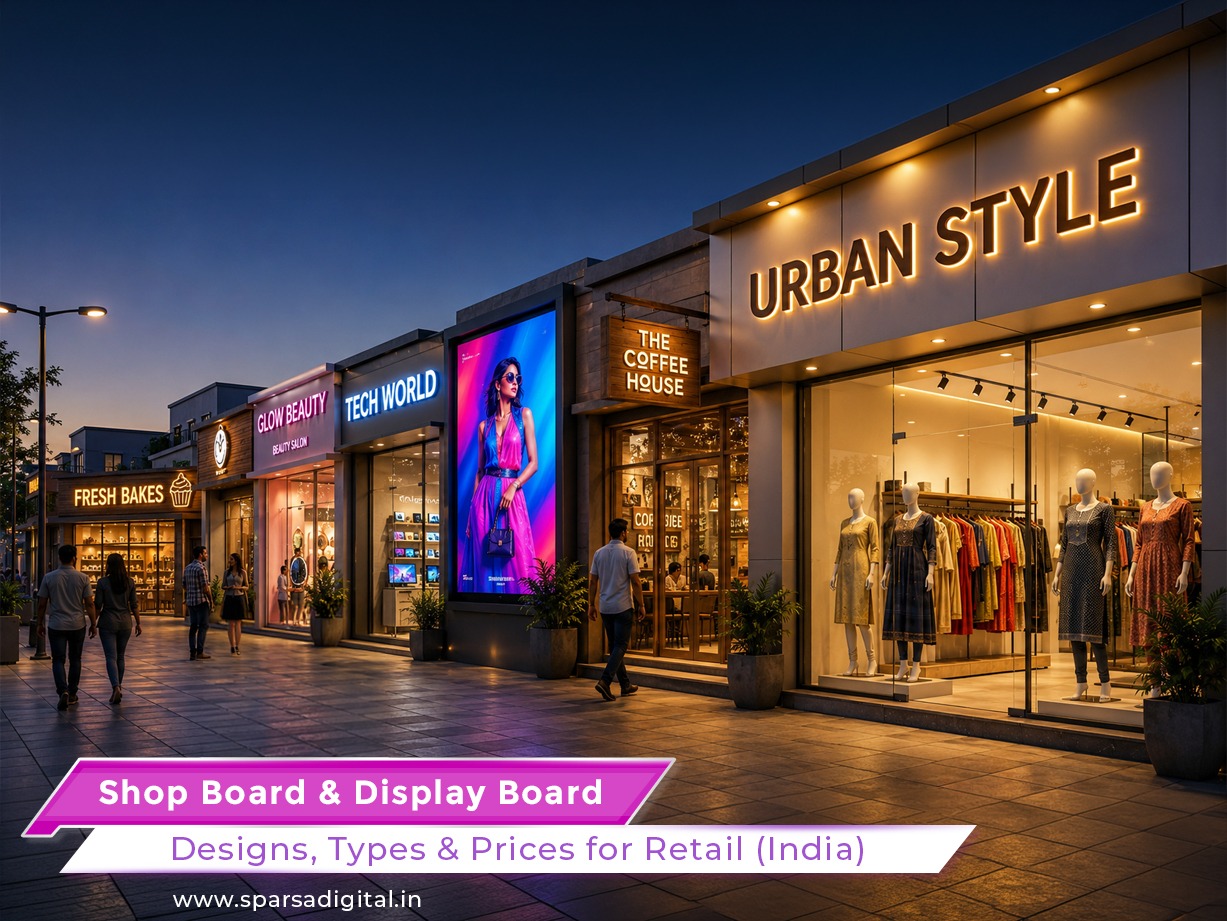
Your shop board is the first conversation your business has with a potential customer, before they step inside, before they read a menu, before they speak to anyone. In India’s densely packed retail landscape, where ten shops can line a single street, a well-designed board is often the difference between being noticed and being invisible.
This guide covers everything a retail owner, restaurant operator, or small business needs to know: the types of shop boards available in India, how LED compares to neon and digital options, realistic pricing, design ideas, and how to place a custom order without getting overcharged.
Types of Shop Boards in India
The Indian signage market has matured significantly. What was once a choice between painted wood and basic flex printing has expanded into a wide range of materials, lighting technologies, and installation formats. Here are the most common types you’ll encounter.
Flex and Vinyl Boards
The most widely used shop board type across India, from kirana stores in small towns to beauty salons in metro cities. Flex boards are made by printing your design on a PVC flex material, which is then stretched over a metal frame or mounted on a wall. They’re affordable, fast to produce, and work in any size.
Best for: Grocery shops, local service providers, small retailers, temporary promotions Lifespan: 2-4 years with UV-resistant inks
ACP (Aluminium Composite Panel) Boards
ACP boards use a sandwich of two aluminium sheets bonded to a polyethylene core. The surface is coated or printed with your branding and can be paired with acrylic lettering, LED channel letters, or backlit elements. ACP is the preferred material for upscale retail, banks, and franchise outlets.
Best for: Boutiques, salons, showrooms, banks, franchise stores Lifespan: 7-12 years
Acrylic Boards and Lettering
Acrylic (also called PMMA or Plexiglas) is the glossy, solid-coloured material you see in premium shop fascias. It can be cut into custom letter shapes, backlit with LED, or used as full panels. Acrylic gives a clean, premium look that photographs well and holds up against weather.
Best for: Jewellery shops, electronics stores, cafes, salons Lifespan: 5-8 years
LED Channel Letter Boards
Individual 3D letters fabricated from aluminium or acrylic, each containing its own LED strip lighting inside. Channel letters are wall-mounted and glow from within, creating high visibility at night. You’ll see them on the facades of major retail chains, hospitals, and hotels across India.
Best for: Restaurants, clothing showrooms, hospitals, hotels, branded retail Lifespan: 8-10 years (LED modules replaceable)
Glow Sign Boards
A glow sign board is a backlit box, typically ACP or acrylic on the front with a fluorescent or LED light source inside. The entire face of the board illuminates evenly when the light is on. These are one of the most popular formats for shops that need visibility at night without a large budget.
Best for: Pharmacies, clinics, sweet shops, gift stores, auto showrooms Lifespan: 5-8 years
Wooden and Chalkboard-Style Boards
Popular among cafes, bakeries, artisan stores, and boutique hotels, rustic wooden boards or chalkboard-painted panels create a warm, handcrafted aesthetic that appeals to a design-conscious customer. These can be static or updated regularly with hand-written text.
Best for: Cafes, bakeries, homestays, bookshops, craft stores
Neon and LED Neon Signs
Traditional glass neon uses gas-filled tubes shaped into letters or designs. Modern LED neon uses flexible silicone tubing that mimics the warm glow of glass neon at lower power and cost. Both are popular for creating mood-driven atmospheres in bars, cafes, and boutiques.
Best for: Bars, lounges, concept cafes, beauty studios, Instagram-focused retail
LED vs Neon vs Digital Shop Board
Three of the most commonly compared formats, and frequently misunderstood. Here’s how they actually differ.
LED Shop Boards
LED boards cover everything from simple backlit flex with LED strips to full-colour RGB video panels. The term is broad, but in common Indian retail usage it usually refers to LED glow sign boards or LED channel letter boards.
Pros: Energy-efficient (up to 70% less power than fluorescent), long lifespan (50,000+ hours), bright enough for daylight, low maintenance, wide variety of formats Cons: Upfront cost higher than basic flex boards; advanced RGB setups require content management
Typical power consumption: 15-40 watts per sqm (LED backlit)
Neon Shop Boards
Traditional glass neon is handmade by bending gas-filled glass tubes, giving it a soft, warm glow that is genuinely difficult to replicate digitally. It’s been making a comeback in premium cafes and lifestyle brands.
Pros: Distinctive aesthetic, unique handmade feel, good low-light ambience Cons: Fragile, harder to repair in smaller cities, higher power draw than LED, custom shapes take longer to produce, can’t display changing content
Modern alternative: LED neon flex offers 80% of the visual effect at lower cost and with better durability.
Digital Shop Boards (LED Video Displays)
A digital shop board is essentially a small outdoor or indoor LED display screen, the same technology as a video wall, scaled down for a single retail storefront. Content can be changed remotely, scheduled, and animated.
Pros: Dynamic content (offers, promotions, menus), remote management via app or software, no printing costs for updates, high attention-grabbing potential Cons: Higher upfront cost, requires content creation, needs power and connectivity management
When to choose digital: If your shop runs daily promotions, changes menus often, or operates in a high-footfall location like a mall or market, a digital display board pays for itself quickly in saved printing and flex costs.
Quick Comparison Table
| Feature | LED Glow Sign | Neon Sign | Digital Board |
| Upfront Cost | Moderate | Moderate-High | High |
| Running Cost | Low | Medium | Medium |
| Durability | High | Low-Medium | High |
| Updateable Content | No | No | Yes |
| Aesthetic | Professional | Warm/Artsy | Modern/Dynamic |
| Best Environment | Any retail | Bars, cafes | Malls, high-traffic retail |
Shop Board Design Ideas (with Examples)
Good design is not about spending more. It’s about making deliberate choices. Here are practical design directions with real-world examples you can adapt.
1. Minimal Backlit Acrylic: The Premium Retail Look
Think white acrylic lettering on a dark ACP background, illuminated with warm white LED from behind. This is the go-to for jewellery stores, premium fashion boutiques, and skincare brands. Brands like Tanishq, Malabar Gold, and W for Woman use variations of this approach across their franchise outlets.
Design tip: Use no more than two fonts. One for the brand name, one for the tagline or category. Keep the colour palette to two or three colours.
2. Channel Letters on Exposed Brick: The Cafe/Artisan Look
Individually mounted acrylic or aluminium channel letters fixed directly onto a natural brick or stone facade. No backboard, no box, just letters that glow against texture. Popular with specialty coffee shops and boutique bakeries.
Design tip: Warm amber or soft white LED works better than cool white for this aesthetic.
3. Full-Facade ACP Cladding with Logo Cutout: The Corporate Look
The entire facade is clad in ACP (typically black, grey, or navy), with the logo either printed on or cut out as a lightbox. Banks, telecom stores, and automobile showrooms favour this for its clean, branded look.
Design tip: Pair with ground-level spotlights or overhead ambient lighting to make the facade work during the day when the lightbox isn’t needed.
4. Chalkboard Menu Boards: The F&B Street Cred Look
A painted chalkboard panel (or a commercial chalkboard surface) with hand-lettered menu items, chalk illustrations, and daily specials. Works well outdoors on A-frame boards or mounted beside the entrance.
Design tip: Hire a chalk lettering artist for the initial setup. The investment is small (₹2,000-₹8,000) and the result is far more polished than DIY.
5. LED Neon Quote Sign: The Social Media Look
A custom-shaped LED neon phrase- “Good Coffee, Good Mood”, “Eat Well, Live Well”, or your brand slogan, mounted on a dark or white wall. These are designed to be photographed and shared, which means every customer becomes a promoter.
Design tip: Position the neon sign at eye level with a clean background and good lighting. If customers are photographing it, make sure your brand name is visible in frame.
6. Vertical Banner Boards (Kiosk Style)
For shops with narrow frontages, common in older markets like Chandni Chowk or Linking Road; vertical banner boards use height rather than width. These can be retractable fabric banners or rigid ACP panels.
Design tip: Lead with the most important message at eye level (an offer, the shop category, or the brand name). Don’t try to fit everything.
Display Board for Restaurants & Cafes
For F&B businesses, the display board does double duty: it draws people in from the street and guides their ordering decisions once they’re inside. Getting this right can directly increase average order value.
Exterior Display Boards
Your exterior board should answer three questions instantly: What do you serve? What does it cost (roughly)? Are you open? High-contrast backgrounds with clear typography work best. Avoid overly decorative fonts for menu categories- legibility always wins over style.
A well-lit exterior board with your top 3-5 dishes, pricing, and a hero image of food performs better than a comprehensive menu mounted outside. Let the full menu live inside.
Interior Menu Display Boards
Backlit Menu Boards: Common in QSRs (quick service restaurants) and cafes. LED backlit panels with printed or digitally displayed menus offer good visibility in dim interiors and can be updated when needed.
Magnetic Menu Boards: Whiteboard or chalkboard surfaces with magnetic tiles allow daily updates without replacement costs. Popular in small cafes, tiffin centres, and lunch spots.
Digital Menu Boards: Small commercial displays (32-55 inch) or dedicated LED panels showing rotating content: dish photos, offers, new arrivals. Research consistently shows that digital menu boards increase impulse purchases and reduce perceived wait time.
Practical Tips for Restaurant Display Boards
- Group items by category with clear visual separation
- Use food photography wherever possible- images drive orders more than text
- Highlight best-sellers and chef’s specials with visual callouts
- Keep pricing clear- hidden or small pricing frustrates customers
- If you have a happy hour or daily special, make it the most visible element at that time
Menu Board for Shops: What Works Best
Beyond restaurants, many retail shops use menu-style display boards like for pharmacies listing services, salons showing treatment prices, tailors displaying rates. The same principles apply.
Static vs. Digital: The Core Decision
A static menu board (printed vinyl, ACP panel, or chalk) works well when your prices and offerings are stable. It’s cheaper upfront, requires no technology, and is easy to read.
A digital menu board is worth the investment when you update content frequently, run time-sensitive offers, or operate in a competitive location where standing out matters. Many salon chains, pharmacy franchises, and QSRs in India have made this shift over the past few years.
Layout Best Practices
Rule of three: Organise menu items in groups of three or four per category. Cognitive research shows customers process menus more easily when choices are grouped in small clusters.
The golden triangle: Customers’ eyes tend to move to the top-right corner first, then the top-left, then the centre. Place your highest-margin or best-selling items in these zones.
Price placement: Don’t right-align prices in a column. This makes customers mentally compare prices down the list rather than evaluating the value of each item. Integrate the price into the item description instead.
Font size: At a counter or queue distance of 1.5-3 metres, category headers should be at minimum 36pt and item names at minimum 24pt.
Shop Board Price in India
Pricing varies significantly by material, size, city, and whether you’re ordering from a local fabricator or a branded signage company. These are approximate market rates for 2024-2025.
Price by Board Type (Common Sizes)
| Board Type | Size | Approx. Price Range |
| Flex/Vinyl Board | 4ft x 2ft | ₹500 – ₹1,500 |
| Flex/Vinyl Board | 8ft x 4ft | ₹1,200 – ₹3,500 |
| ACP Glow Sign Board | 6ft x 3ft | ₹5,000 – ₹12,000 |
| Acrylic LED Glow Sign | 4ft x 2ft | ₹4,000 – ₹9,000 |
| LED Channel Letters | Per sqft | ₹800 – ₹2,500 |
| LED Neon Sign | Custom shape (2-3ft) | ₹3,500 – ₹10,000 |
| Digital Display Board | 32-inch commercial | ₹18,000 – ₹35,000 |
| Digital Display Board | 55-inch commercial | ₹35,000 – ₹65,000 |
| Wooden/Rustic Board | 3ft x 2ft | ₹2,000 – ₹8,000 |
| Outdoor LED Video Panel | Per sqm | ₹30,000 – ₹65,000 |
What Affects the Price?
City: Fabrication costs in Mumbai and Delhi are typically 20-40% higher than in smaller cities. Online ordering has narrowed this gap somewhat.
Material quality: Import-grade acrylic and LED modules cost more but last significantly longer. Cheap flex printing may fade in 12-18 months.
Design complexity: Custom shapes, multi-colour acrylic, and 3D effects all add to fabrication time and cost.
Installation: Wall drilling, height access (scissor lifts, ladders), and electrical wiring for illuminated boards add ₹500-₹5,000 depending on complexity.
GST: 18% GST applies on fabrication and supply of signage boards in India. Always confirm whether quoted prices are inclusive or exclusive of GST.
How to Order a Custom Shop Board
The process is simpler than most shop owners expect. Here’s how to do it efficiently and avoid common mistakes.
Step 1: Define Your Requirements
Before approaching any vendor, have clarity on: the size of your board (measure the available wall or fascia space), whether you need lighting, what your brand colours and fonts are, and your budget range. The more specific you are, the faster and cheaper the process.
Step 2: Get Your Design Ready
You have two options: provide your own design file (ideally in AI, CDR, or high-resolution PDF format) or ask the vendor to design it. Most local fabricators offer basic design for free or at ₹500-₹2,000. For a more polished result, hire a graphic designer separately; platforms like Fiverr, DesignCrowd, or local freelancers on Urban Company can deliver a print-ready design for ₹1,500-₹6,000.
Step 3: Get Multiple Quotes
Don’t settle for the first quote. For any board above ₹5,000, get at least three quotes from different vendors- one local fabricator, one online platform, and one branded signage company if available in your city. Compare not just price but material specifications, warranty, and installation inclusion.
Step 4: Confirm the Specs in Writing
Before paying any advance, confirm in writing: exact size, material (brand/grade of ACP, acrylic thickness, LED brand), whether installation is included, timeline, and warranty period. Reputable vendors will have no issue with this.
Step 5: Approve a Proof
Always ask for a digital mockup or proof before production begins. This shows how your board will look on your actual shopfront. Most vendors provide this as part of the process. Review it on a screen at the correct size ratio before approving.
Step 6: Installation and Handover
On installation day, ensure the board is level, electrical connections are properly insulated (for illuminated boards), and the vendor demonstrates the on/off function if applicable. Retain all warranty documents and the vendor’s contact details for future maintenance.
Where to Order Online
Platforms like IndiaMART, TradeIndia, and UrbanClap connect you with local signage makers. For smaller boards and flex printing, JioMart Business, PrintMango, and VistaPrint India offer online ordering with doorstep delivery.
FAQs
Q1: What is the most durable material for a shop board in India?
ACP (Aluminium Composite Panel) is the most durable option for long-term outdoor use. It resists warping, fading, and moisture better than flex or wood. For illuminated boards, pairing ACP with quality LED modules extends lifespan to 8-12 years.
Q2: How long does it take to make a custom shop board?
A basic flex board can be ready in 24-48 hours. ACP glow sign boards typically take 5-10 working days. Channel letter boards and complex acrylic fabrications can take 10-20 days. Factor this into your shop opening timeline.
Q3: Is permission required to install a shop board in India?
Yes, in most Indian municipalities you need a signage or hoarding licence from the local municipal body (BBMP, BMC, MCD, etc.) for external shop boards. Fees vary by size and city. Failure to obtain permission can result in fines or board removal. Your signage vendor can often help with the application process.
Q4: What is a glow sign board and how much does it cost?
A glow sign board is a box-format illuminated sign, typically ACP or acrylic on the face with LED or fluorescent lighting inside. For a standard 6ft x 3ft board, expect to pay ₹5,000-₹12,000 including installation. Premium materials and larger sizes cost more.
Q5: Can I update a digital menu board remotely?
Yes. Most commercial digital displays come with content management software (CMS) that allows you to update content via a web browser or mobile app. Some systems support scheduled content. For example, automatically switching to a breakfast menu in the morning and a dinner menu in the evening.
Q6: What size should a shop board be?
A common guideline is to make the board as wide as the shop frontage allows (or 80% of it) and 2-3 feet in height for a horizontal board. The text should be readable from across the street, for every 3 metres of viewing distance, your letters should be at least 2.5 cm tall.
Q7: What is the difference between a shop board and a display board?
A shop board typically refers to the exterior signage that identifies the shop- the fascia board or name board. A display board is broader and includes any board used to display information- menus, price lists, promotional offers, directions; and can be inside or outside the shop.
Q8: Are LED shop boards energy-efficient?
Yes. LED-illuminated shop boards consume significantly less power than fluorescent alternatives. A standard 6ft x 3ft LED glow sign board runs on 20-40 watts, roughly equivalent to a single LED bulb. Running costs are minimal even if kept on for 12 hours a day.
Q9: Can I get a shop board made with my own logo and brand colours?
Absolutely. Virtually all custom signage is made to your specifications. Provide your logo in a vector format (AI or EPS) and your brand colour codes (Pantone or CMYK/hex values) for accurate colour matching. If you don’t have brand guidelines, a good signage vendor or freelance designer can help you establish them.
Q10: What should I avoid when designing a shop board?
Avoid using too many colours (three is a safe maximum), decorative fonts that are hard to read at a distance, and cramming too much information into the board. A shop board is not a leaflet, its job is recognition and recall, not information delivery. Keep it simple, bold, and legible.