
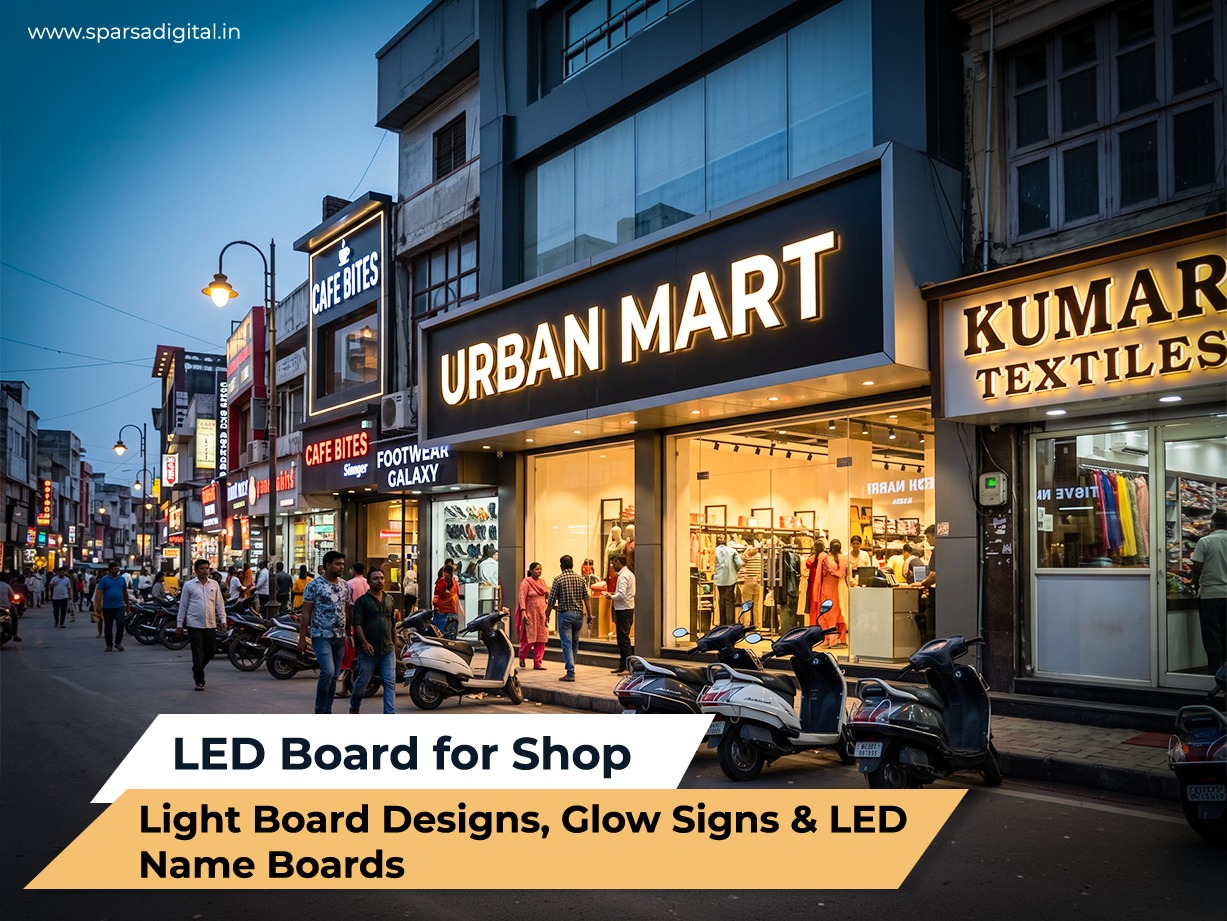
Walk down any market street in India and the shops that catch your eye first are almost never the quiet ones. They’re the ones with a bright, glowing sign out front.
An LED board for shop fronts isn’t just decoration anymore. It’s often the first thing a potential customer notices, sometimes before they even read what the shop sells. A well-designed board pulls eyes from across the street, works day and night, and quietly builds brand recall every single day it’s switched on.
But “LED board” isn’t one single product. There are light boards, glow sign boards, name boards, acrylic boards, and neon-style LED boards, and each one fits a different budget and shop style. Some are meant to run for years without any changes, while others are built to update content on the fly through a connected app or software panel.
Choosing the right one comes down to a mix of budget, shop location, footfall pattern, and how much your signage needs to change over time. A busy highway-facing store has very different requirements from a small boutique tucked inside a shopping lane.
LED Board for Shop: Types & Options
Before you order anything, it helps to know what’s actually out there. Shop signage generally falls into a few clear categories.
1. Acrylic LED Sign Boards These use an acrylic sheet with LED modules mounted behind or around it. Light spreads evenly across the surface, giving a clean, professional glow. They’re the most common choice for retail shops, clinics, and offices.
2. LED Flex Boards A flex banner material is backlit with LED strips. These are more affordable and work well for temporary setups, promotional boards, or budget-conscious shop owners.
3. Glow Sign Boards Similar to acrylic LED boards but typically use fluorescent or LED tube lighting behind translucent vinyl or acrylic sheets. They give a soft, uniform glow rather than sharp brightness.
4. LED Name Boards Compact boards focused purely on displaying the shop’s name and logo, often mounted directly above the entrance. These can be acrylic, metal-backed, or channel letter style.
5. Channel Letter LED Signs Individual 3D letters, each fitted with LED lighting, mounted directly on the wall or a backing panel. These give a premium, high-visibility look, popular with brand showrooms and franchise outlets.
6. LED Neon Sign Boards Flexible LED strips shaped to mimic traditional glass neon signs, without the fragility or high power draw of real neon. Popular for cafes, salons, and boutique stores wanting a modern, trendy look.
Each type has a different price point, lifespan, and visual impact. A grocery store might be fine with a simple flex board, while a salon or café might benefit more from an LED neon sign that photographs well for social media.
Light Board Design Ideas for Shops
Design matters as much as the technology behind the board. A poorly designed board, even with the brightest LEDs, won’t do much for your shop.
Here are some design directions worth considering:
Keep the shop name the hero. Your board’s main job is instant recognition. Avoid cluttering it with taglines, offers, or too many icons. The name should be readable from across the street within two seconds.
Match your brand colours. If your shop’s branding uses specific colours, carry them into the LED board. Consistent colour use builds recognition over time, especially for shops with multiple branches.
Use contrast wisely. Light text on a dark background, or vice versa, always reads better at night than mid-tone combinations. Test how your design looks after sunset, not just in daylight.
Consider the viewing distance. A board meant to be seen from 50 metres away on a main road needs bigger, bolder lettering than one meant for a narrow shopping lane where people walk right up to it.
Add icons only if they help. A small icon (a cup for a café, a wrench for a repair shop) can help people recognise your business type at a glance, especially useful if your shop name doesn’t immediately explain what you sell.
Think about board shape. Rectangular boards are standard, but circular, arch-shaped, or custom-cut acrylic boards can help a shop stand out among a row of straight rectangular signs.
Don’t ignore daytime visibility. LED boards look great at night, but they need to look good switched off too, since they’ll be seen in daylight just as often.
LED Name Board: Customisation Options
An LED name board is usually the simplest product in this category, but it still comes with several customisation choices that affect both cost and impact.
Size and shape. Standard rectangular boards are the default, but many manufacturers offer custom cutouts to match your shop’s frontage or branding shape.
Font style. Bold, sans-serif fonts tend to read best from a distance. Script or decorative fonts can work for boutique or lifestyle brands, but only if the board is meant to be read up close.
Lighting colour. Warm white gives a cosy, inviting look, popular for cafés and restaurants. Cool white or daylight tones feel more clinical and modern, often used for pharmacies, electronics shops, and offices. Multi-colour or RGB options are available for shops wanting a more playful, attention-grabbing look.
Material of the base board. Acrylic is lightweight and gives a smooth, even glow. ACP (aluminium composite panel) is more rigid and weather-resistant, often used as a backing for channel letters. Metal-backed boards suit a more premium, industrial aesthetic.
Mounting style. Boards can be flush-mounted directly to the wall, raised on standoffs for a shadow-gap effect, or hung perpendicular to the shop front so they’re visible from both directions along the street.
Logo integration. Most manufacturers can incorporate your existing logo file directly into the board design, keeping your name board consistent with your other branding materials.
Glow Shine Board vs LED Board
Shop owners often use “glow sign board” and “LED board” interchangeably, but there are real differences worth understanding before you order.
Lighting source. Traditional glow sign boards typically use fluorescent tube lights or older LED strip technology behind a printed vinyl or acrylic sheet. Modern LED boards use dedicated LED modules designed specifically for even, directional light distribution.
Brightness and clarity. LED boards generally produce sharper, more even brightness across the entire surface. Older-style glow boards can sometimes show visible hot spots or uneven lighting, especially as the tubes age.
Power consumption. LED technology draws significantly less power than fluorescent tube-based glow boards, which matters if your board runs for 10-12 hours a day, every day.
Lifespan. LED modules typically last far longer before needing replacement, often rated for tens of thousands of hours of use. Fluorescent tubes tend to dim and need replacement sooner.
Cost. Older glow sign boards can sometimes be cheaper upfront, but the higher power consumption and shorter component lifespan often make LED boards more cost-effective over a few years of use.
Maintenance. LED boards generally need less frequent servicing. Glow boards with tube lighting may need periodic tube replacement to maintain even brightness.
For most new installations today, LED boards have largely replaced traditional glow sign boards, mainly due to lower running costs and better visual consistency. Older glow boards still exist across many markets simply because they were installed years ago and haven’t needed full replacement yet.
LED Light Board Price in India
Pricing for LED boards varies widely based on size, material, lighting type, and design complexity. Here’s a general sense of what shop owners typically encounter, based on common market rates:
| Board Type | Typical Price Range (per sq. ft.) | Notes |
| LED Flex Board | ₹150 – ₹400 | Budget-friendly, good for short-term or promotional use |
| Acrylic LED Sign Board | ₹350 – ₹800 | Most common choice for retail shopfronts |
| Glow Sign Board (tube-lit) | ₹250 – ₹550 | Older technology, still available in many markets |
| LED Name Board (basic) | ₹300 – ₹700 | Depends on material and lighting density |
| Channel Letter LED Signs | ₹800 – ₹2,500+ | Premium 3D look, higher labour and material cost |
| LED Neon Sign Board | ₹1,000 – ₹3,000+ | Trendy aesthetic, priced per linear foot in many cases |
A few things that push the price up or down:
- Size: Larger boards cost more overall but often work out cheaper per square foot due to bulk material use.
- Design complexity: Multiple colours, custom shapes, and layered acrylic add to fabrication time and cost.
- Outdoor vs indoor use: Outdoor boards need weatherproofing, which adds to the cost compared to indoor-only signage.
- Installation: Height, wall type, and electrical work required can all affect the final quote.
- Warranty and after-sales support: Vendors offering longer warranties or on-site repair support may price slightly higher, but this often pays off over the board’s lifespan.
Always ask for a written, itemised quote covering the board, LED modules, installation, and any warranty terms before finalising your order. Prices can vary meaningfully between vendors for what looks like the same specification on paper.
How to Design the Perfect Shop Board
Getting a shop board right involves more than picking a font and a colour. Here’s a simple process to follow:
1. Define the goal first. Is the board mainly for brand recognition, driving footfall, or displaying offers? The answer shapes everything else.
2. Measure your space accurately. Take exact measurements of the area where the board will be mounted, including any obstructions like pipes, meter boxes, or overhangs.
3. Check local visibility conditions. Note how much direct sunlight the spot gets, how far away people typically view it from, and whether nearby buildings or trees block the sightline at certain times of day.
4. Shortlist two or three design concepts. Ask your vendor for mockups showing your shop name in the actual proposed size and colours, ideally against a photo of your actual shopfront.
5. Test readability at a distance. Print a rough mockup at scale, or view the digital design from as far away as your target customer would typically stand.
6. Confirm electrical requirements early. Make sure your shop’s electrical setup can support the board’s power draw, and check if a separate switch or timer is needed.
7. Plan for maintenance access. Boards mounted very high or in awkward positions can be difficult to service later. Factor this into the mounting decision.
8. Get the final design signed off in writing. Confirm size, colours, font, lighting type, and mounting details in writing before production begins, so there’s no ambiguity later.
Where to Order in India
India has a large and fragmented signage market, ranging from small local fabricators to established digital signage companies with in-house design and installation teams.
When shortlisting a vendor, look for a few key things:
- Portfolio of past work, ideally shops similar in size or category to yours
- Clear pricing, either published online or provided as a detailed written quote
- Warranty terms on both the board and the LED components
- Installation and after-sales support, including how quickly they respond if something needs repair
- Turnaround time, especially if you’re working toward a launch date
Established digital signage companies, such as Sparsa Digital, work across a wide range of business types, from small shops to hospitals and hotels, and offer both hardware and remote content management for boards that need to display changing content. For a simple static name board, a local signage fabricator in your city may be a faster and more budget-friendly option. For a board that needs to update automatically, such as digital price boards or promotional displays, a vendor offering a CMS-based solution is usually the better long-term choice.
Whichever route you choose, get quotes from at least two or three vendors, compare warranty terms carefully, and ask to see photos or a site visit of a similar board they’ve installed before.
FAQs
1. What is the average lifespan of an LED board?
Most quality LED boards last 5 to 8 years with normal daily use, though the LED modules themselves are often rated for tens of thousands of hours before noticeable dimming occurs.
2. Is an LED board for shop fronts expensive to run?
No. LED lighting consumes far less power than older fluorescent tube-based glow boards, making it a more economical choice for boards that run long hours daily.
3. Can I get a custom-shaped LED name board instead of a rectangle?
Yes. Most manufacturers can cut acrylic or ACP into custom shapes, including circles, arches, or shapes that match your logo, though custom shapes usually cost more than standard rectangles.
4. What’s the difference between an LED board and a glow sign board?
LED boards use dedicated LED modules for even, energy-efficient lighting, while traditional glow sign boards often rely on older fluorescent tube lighting, which uses more power and needs more frequent maintenance.
5. How long does it take to get an LED board made and installed?
Simple boards can often be ready within 5 to 10 days, while larger or more complex custom designs, like channel letters or multi-panel boards, can take two to three weeks depending on the vendor’s workload.
6. Do LED boards need a lot of maintenance?
Generally no. LED boards need minimal upkeep beyond occasional cleaning and checking wiring connections, especially compared to tube-lit glow boards that need periodic bulb replacement.
7. Can LED boards be used outdoors in direct sunlight and rain?
Yes, as long as the board is built with weatherproof materials and sealed properly. Always confirm with your vendor that the board is rated for outdoor use before installation.
8. What size LED board is right for a small shop?
It depends on your shopfront width and viewing distance, but for most small shops, a board roughly 3 to 6 feet wide offers good visibility without overwhelming the frontage. A vendor can recommend exact sizing after seeing your shop’s dimensions.
9. Is it better to buy a static LED board or one with a digital content management system?
A static board is more affordable and works well if your shop name and branding rarely change. A CMS-based digital board is better suited to shops that regularly update offers, pricing, or promotional content.
10. How much does a basic LED name board cost for a small shop?
Basic acrylic LED name boards typically start in the range of ₹300 to ₹700 per square foot, though the final cost depends on size, lighting density, and design complexity. Always request a written quote for an accurate estimate.
