

Table of contents
When shopping for a screen, whether for your living room, hotel lobby, or retail store. The term tv display comes up constantly. But not all displays are created equal. Two of the most common options you’ll encounter are LED TVs and LED display screens, and while both use LED (Light Emitting Diode) technology, they serve very different purposes.
Understanding the difference can save you thousands of rupees and ensure you get the right screen for your specific need. In this guide, we break down everything from core technology to price, size, use case, and more.
LED TV vs LED Display: Core Differences
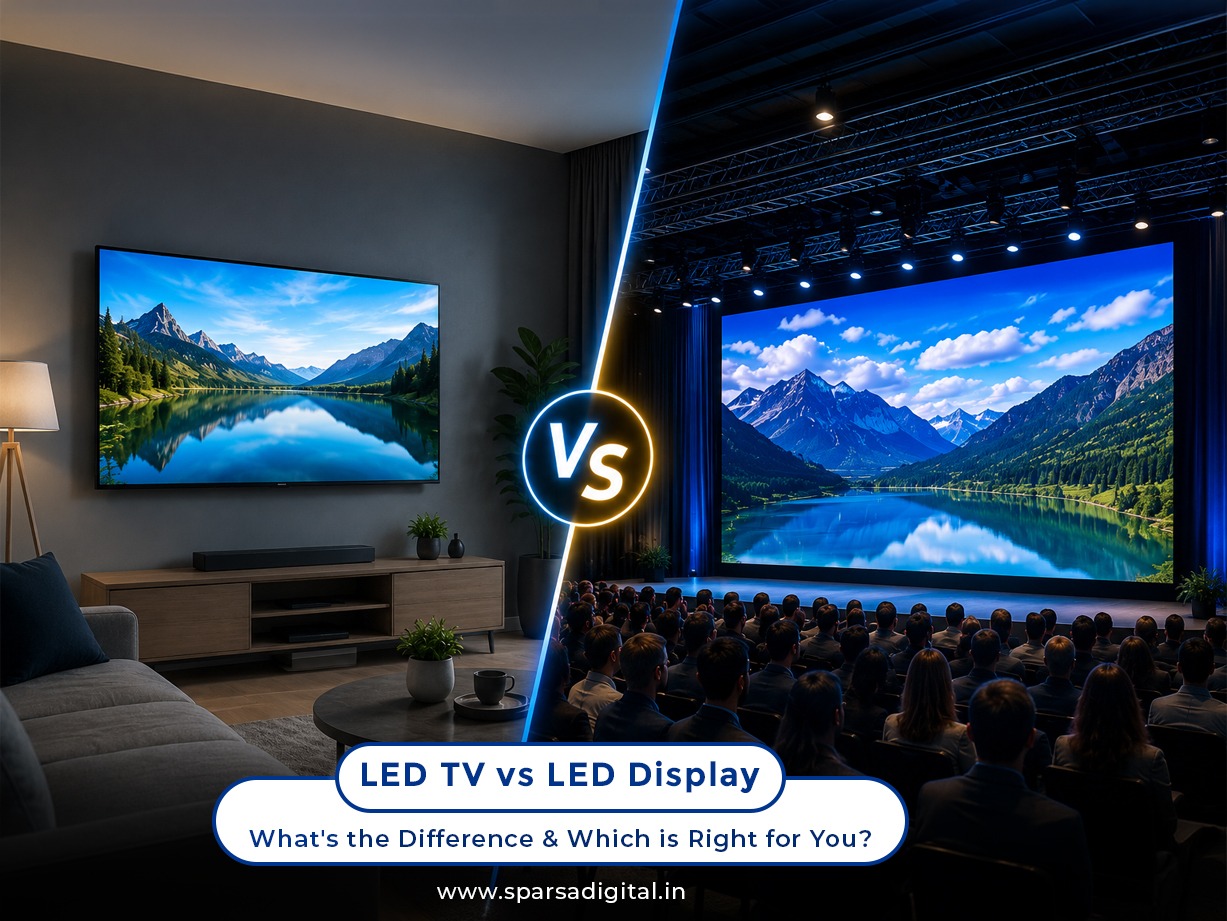
At a surface level, both an LED TV and an LED display panel use LED backlighting or direct LED technology. However, their design philosophy, intended audience, and technical specifications are fundamentally different.
An LED TV is designed primarily for home entertainment. It is optimized for content consumption: movies, TV shows, gaming, and streaming; and typically features a built-in tuner, speakers, smart OS (like Android TV, Tizen, or webOS), and user-friendly remote controls.
An LED display screen (also called a commercial LED display or digital signage display) is engineered for professional, commercial, or public environments. It is built to run continuously, often 16 to 24 hours a day; and is designed for visibility in high-ambient-light settings like retail stores, airports, hotels, and corporate spaces.
| Feature | LED TV | LED Display Screen |
| Primary Use | Home entertainment | Commercial / professional signage |
| Operating Hours | 4-8 hours/day | 16-24 hours/day |
| Built-in Tuner | Yes | Usually No |
| Smart Features | Yes (Android TV, etc.) | Limited or via media player |
| Brightness (nits) | 250-500 nits | 700-2500+ nits |
| Typical Lifespan | 30,000-60,000 hrs | 60,000-100,000 hrs |
| IP Rating | Not rated | Often IP65 (weatherproof) |
| Viewing Angle | ~178° | Up to 180° |
| Warranty | 1-3 years | 3-5 years (commercial) |
When to Use an LED TV
An LED TV is your best bet when the use case is primarily personal viewing and entertainment. Here are the most common scenarios where an LED TV makes perfect sense as your tv display solution:
Home Entertainment
If you are setting up a living room, bedroom, or home theatre, an LED TV is the ideal choice. It comes pre-loaded with apps like Netflix, Prime Video, YouTube, and Disney+ Hotstar. The built-in speakers, smart remote, and intuitive interface make it plug-and-play simple.
Gaming Setups
Modern LED TVs offer low input lag (some as low as 1ms in game mode), high refresh rates (120Hz–144Hz), and compatibility with technologies like AMD FreeSync and NVIDIA G-Sync. If you play console or PC games casually or competitively at home, an LED TV fits the bill perfectly.
Small Offices & Meeting Rooms
For a small team meeting room or a personal office where the screen will be used for video calls, presentations, and casual media playback, an LED TV works well, especially if your usage doesn’t exceed 8 hours a day.
Budget-Conscious Buyers
LED TVs are significantly more affordable than commercial LED display panels of similar sizes. If budget is a concern and your usage is light-to-moderate, an LED TV gives you more value for money.
Key indicators that you need an LED TV:
- You primarily watch content at home
- Usage is less than 8 hours per day
- You need built-in smart features and apps
- Budget is a primary concern
- You want simple setup with remote control
When to Use an LED Display Screen
A commercial LED display screen is built for demanding environments where reliability, brightness, and continuous operation are non-negotiable. Here are the scenarios where a dedicated LED display is the smarter choice:
Retail & Advertising
Retail stores, shopping malls, and outdoor advertising hoardings require displays that remain clearly visible in bright sunlight and high-ambient-light conditions. Commercial LED displays with 1500-5000 nit brightness are specifically designed for this. An LED TV would appear washed out and would fail within months under such conditions.
Hotels, Restaurants & Hospitality
Hotels need displays that run 24×7 in lobbies, conference rooms, restaurants, and guest rooms (for hospitality TV). Commercial displays in public areas handle constant operation, resist dust and humidity, and integrate seamlessly with content management systems (CMS) for centralized control.
Corporate Offices & Conference Rooms
Large corporate boardrooms, video walls, and wayfinding displays in office complexes need the reliability of commercial-grade LED display screens. These environments demand precise colour accuracy, wide viewing angles, and the ability to display content without degradation over years.
Outdoor & Semi-Outdoor Use
Any display installed outdoors, be it a digital billboard, bus shelter ad display, or stadium scoreboard, must be IP-rated, weatherproof, and capable of delivering ultra-high brightness to cut through direct sunlight. Only commercial LED displays meet these requirements.
Key indicators that you need an LED display screen:
- Display will run more than 12 hours daily
- Located in a high-ambient or outdoor environment
- Part of a multi-screen or video wall setup
- Requires remote content management (CMS)
- Installed in a hotel, mall, airport, or public space
Size Comparison Table
One of the most practical considerations when choosing between a tv display option is the available size range. Here is a comparison of typical size availability:
| Size Range | LED TV | Indoor LED Display | Outdoor LED Display | LED Video Wall |
| Small (< 43″) | ✔ Available | ✔ Available | Limited | Not typical |
| Mid (43″-75″) | ✔ Most popular | ✔ Available | ✔ Available | ✔ Available |
| Large (75″-110″) | Limited options | ✔ Available | ✔ Available | ✔ Available |
| Extra Large (>110″) | Very limited | ✔ Available | ✔ Available | ✔ Modular (any size) |
| Custom Sizes | Not available | Available | Available | ✔ Fully custom |
LED display screens, particularly modular LED video walls, have a clear advantage in scalability. They can be tiled together to create massive display surfaces of virtually any dimension, something no LED TV can match.
Price Comparison
Price is often the deciding factor for many buyers. Here is a realistic breakdown of what you can expect to pay in the Indian market:
| Screen Size | LED TV (Approx.) | Indoor LED Display (Approx.) | Outdoor LED Display (Approx.) |
| 32″-43″ | ₹18,000-₹50,000 | ₹60,000-₹1,20,000 | ₹90,000-₹2,00,000 |
| 55″-65″ | ₹40,000-₹1,20,000 | ₹1,20,000-₹3,00,000 | ₹2,00,000-₹5,00,000 |
| 75″-85″ | ₹80,000-₹3,00,000 | ₹3,00,000-₹7,00,000 | ₹5,00,000-₹12,00,000 |
| 98″-110″ | ₹3,00,000-₹8,00,000 | ₹6,00,000-₹15,00,000 | ₹10,00,000+ |
| Video Wall (custom) | Not applicable | ₹5,00,000-₹50,00,000+ | ₹10,00,000-₹1 Cr+ |
Note: Prices vary based on brand, resolution, brightness, and additional features. Commercial LED displays cost more upfront but offer a significantly longer operational lifespan, better warranties, and lower total cost of ownership over 5-10 years.
Which One for Hotels & Businesses?
If you manage a hotel, restaurant, mall, corporate campus, or any commercial space, the right tv display choice is almost always a commercial LED display screen, and here is why:
Operational Durability
Hotels run their lobby displays, restaurant menu boards, and conference room screens virtually non-stop. Commercial LED displays are rated for 60,000 to 100,000 hours of operation. An LED TV used in the same role would overheat, suffer burn-in, and fail in a fraction of the time.
Centralized Content Management
Commercial LED displays integrate with Digital Signage Software (DSS) platforms, allowing hotel managers and business owners to update content across dozens, even hundreds of screens from a single dashboard. This is invaluable for promotional content, wayfinding, menu updates, and event information.
Aesthetic & Brand Presentation
Businesses require displays that enhance their brand image. Commercial LED displays offer ultra-slim bezels, seamless video wall configurations, and crisp visuals at any viewing distance, giving your space a premium, professional look that LED TVs simply cannot match.
Hospitality-Grade TV Displays
For guest room tv display needs in hotels, hospitality LED TVs (a hybrid category) are available from brands like Samsung LYNK, LG Pro:Centric, and Philips MediaSuite. These are commercial-grade televisions specifically engineered for hotel use, featuring property management system (PMS) integration, welcome screen customization, and energy management features.
Which One for Home?
For home use, an LED TV is undoubtedly the right choice in almost every situation. Here is a quick guide to help you pick the best home tv display:
Living Room (Primary Screen)
Go for a 55″ to 75″ LED TV with 4K resolution, HDR support (HDR10+, Dolby Vision), and a 120Hz panel. Brands like Sony Bravia, Samsung QLED, LG OLED, and Mi TV offer excellent options across various budgets.
Bedroom Screen
A 32″ to 43″ LED TV with Full HD or 4K resolution is perfect for a bedroom. Look for a model with a good built-in speaker or HDMI ARC for soundbar compatibility.
Home Theatre
If you are serious about a cinematic home experience, consider an 85″+ LED TV or step up to a 4K laser projector paired with a screen. At this size, the immersion rivals commercial displays at a fraction of the price.
Gaming
For gaming at home, prioritize low input lag, Variable Refresh Rate (VRR), and HDMI 2.1 support over screen size. A well-chosen LED TV will serve you far better than a commercial LED display in a home gaming setup.
Quick home tv display buying checklist:
- Choose screen size based on room dimensions (rule of thumb: viewing distance × 0.55 = ideal screen size in inches)
- Opt for 4K resolution for any screen above 43 inches
- Ensure HDR support (HDR10 minimum; Dolby Vision preferred)
- Look for at least 2 HDMI 2.0+ ports (4 is better)
- Consider a smart TV platform you are comfortable with
- Check power consumption for long-term savings
FAQs
Q1: Can I use an LED TV as a commercial display?
Technically yes, but it is not recommended. LED TVs are designed for 4-8 hours of daily use. Using them commercially (12-24 hours/day) will dramatically reduce lifespan, increase risk of screen burn-in, and void your warranty. For commercial use, always opt for a commercial-grade LED display.
Q2: What is the difference between LED TV and OLED TV?
An LED TV uses LED backlighting behind an LCD panel, while an OLED TV uses organic LEDs that emit their own light per pixel. OLED offers superior contrast, deeper blacks, and wider viewing angles, but LED TVs are brighter and typically more affordable. Both are types of tv display technology but serve different preferences and budgets.
Q3: Are LED display screens suitable for outdoor use?
Yes, but you need to specifically choose outdoor-rated LED display screens with high brightness (2000+ nits), IP65 or higher weatherproofing, and tempered glass protection. Standard indoor LED displays and LED TVs are not suitable for outdoor installation.
Q4: What size LED display is right for a hotel lobby?
For a hotel lobby, a 65″ to 98″ standalone commercial display or a custom video wall (starting from 2×2 configuration) works well depending on the space. The key is ensuring the display is commercial-grade, runs 24×7, and integrates with your content management system.
Q5: Which LED TV brand is best in India in 2025?
Top LED TV brands in India include Samsung (QLED range), LG (NanoCell and OLED), Sony (Bravia XR range), TCL (C and P series), and Xiaomi (Mi TV 5X series). The best choice depends on your budget, required features, and after-sales service availability in your city.
Q6: How do I maintain an LED display screen?
Commercial LED display screens require periodic cleaning with a soft, lint-free cloth (no liquid cleaners directly on screen), regular firmware updates, and annual inspection by a certified technician. Ensure adequate ventilation around the display, especially in enclosed installations.
Q7: Can LED displays be used as tv display replacements in conference rooms?
Absolutely. In fact, commercial LED displays are often preferred in conference rooms over projectors because they offer better brightness in lit environments, no bulb replacement costs, and instant-on capability. A 65″ to 86″ commercial display is ideal for most boardrooms and meeting spaces.
Q8: What is a direct-view LED display?
A direct-view LED display uses individual LED modules that emit light directly (not backlighting behind an LCD). This technology is used in high-end video walls, large-format commercial displays, and outdoor advertising boards. It offers exceptional brightness, contrast, and longevity compared to traditional LCD-LED displays.
Conclusion
Choosing between an LED TV and an LED display screen ultimately comes down to three questions: Where will it be used? How many hours per day? And what is your budget?
For personal and home use, an LED TV is the clear, cost-effective winner, packed with smart features, great picture quality, and ease of use. For commercial environments like hotels, retail, corporate offices, and public spaces; a commercial LED display screen is the right investment, offering superior brightness, durability, and the ability to run 24×7 without compromise.
Understanding these differences ensures you invest in the right tv display solution that serves you well for years to come. Whether you are upgrading your home entertainment system or outfitting a commercial space, matching the display type to its intended environment is the key to maximum value and performance.