
Table of contents
- LED Screens for Events: What Are Your Options?
- Common Event Use Cases in India
- Hire vs Buy: Cost Comparison
- LED Screen Hire Costs in India (2024-2025 Estimates)
- LED Screen Purchase Costs in India (2024-2025 Estimates)
- The Break-Even Calculation
- Hire makes more sense when:
- Buying makes more sense when:
- Outdoor LED Display Screen Types
- Pixel Pitch for Outdoor vs Indoor
- How Pixel Pitch Affects Viewing Distance
- Outdoor vs Indoor: Key Differences Beyond Pixel Pitch
- Event LED Screen Setup Guide
- Top Event LED Screen Suppliers in India
- AV Rental Companies with LED Inventory
- What to Ask Any Supplier
- FAQs
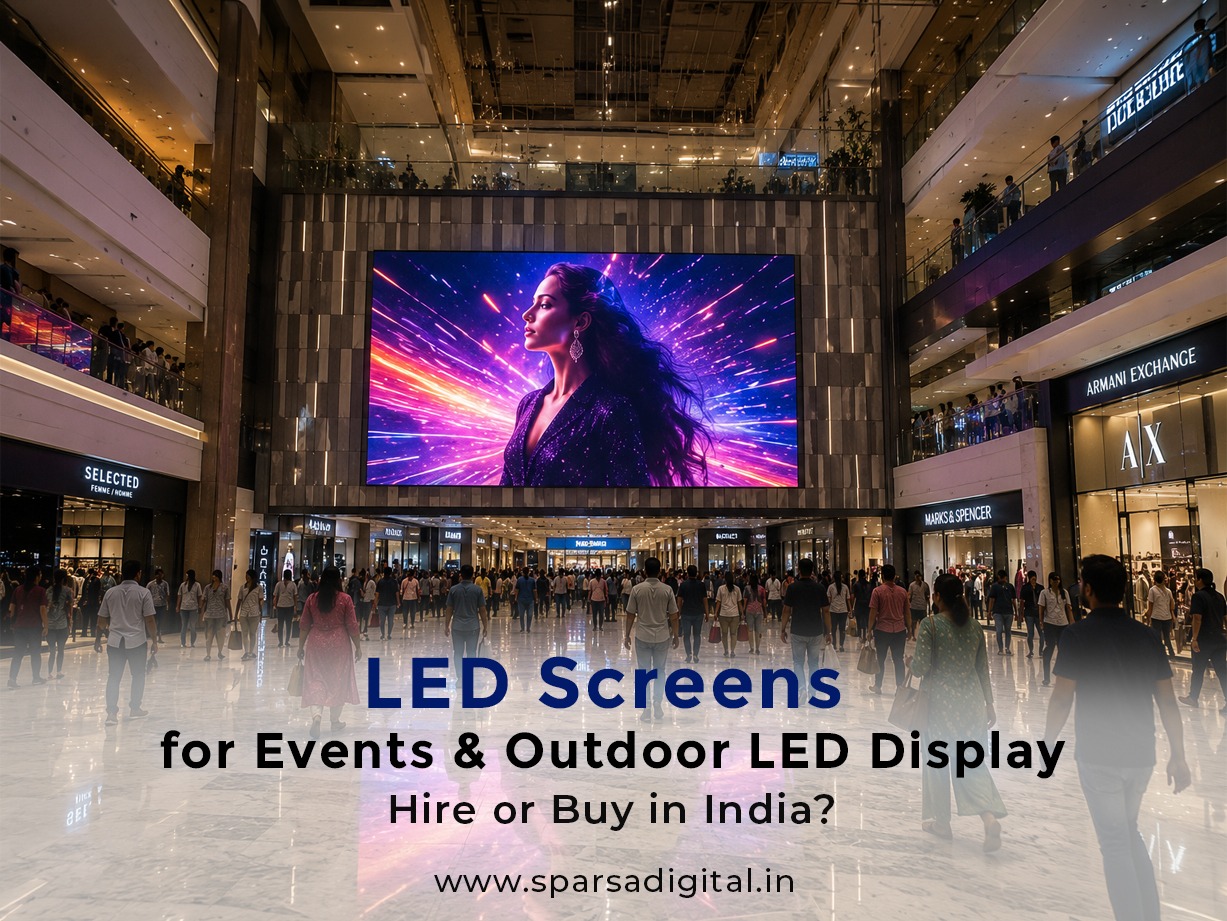
Whether you’re organising a corporate summit in Mumbai, a music festival in Delhi, or a wedding reception in Jaipur, LED screens for events have become as essential as the sound system itself. But one question keeps coming up for organisers, AV companies, and venue owners alike: should you hire or buy?
LED Screens for Events: What Are Your Options?
The Indian events industry has grown rapidly over the past decade, and so has the variety of LED display solutions available. Before comparing costs, it helps to understand what’s actually on the market.
Main Categories of Event LED Screens
Indoor LED Displays are designed for controlled-light environments like conference halls, banquet halls, and auditoriums. They typically feature tighter pixel pitches (P2-P4) for crisp close-up viewing and are built into slim, lightweight cabinet panels that can be assembled quickly.
Outdoor LED Displays are weather-resistant, significantly brighter (measured in nits), and built to handle Indian summers, monsoon humidity, and direct sunlight. They’re commonly seen at outdoor concerts, political rallies, sports events, trade fairs, and melas.
Flexible and Curved LED Panels are a newer category gaining traction at high-budget weddings and product launches. These can wrap around pillars, form cylinders, or create immersive backdrops.
LED Video Walls are the modular panel systems you see at stage backdrops. They are the most popular format at corporate events, music concerts, and expos. Panels clip together to form any custom screen size you need.
Transparent LED Screens allow audiences to see through the display, making them ideal for retail activations, glass stage sets, and premium brand launches.
Common Event Use Cases in India
- Wedding receptions and sangeet nights
- Corporate conferences, product launches, and AGMs
- Political rallies and public address events
- Music concerts and cultural festivals
- Sports events and IPL fan zones
- Trade exhibitions like Auto Expo and India International Trade Fair
- Religious events and public celebrations (Diwali, Navratri, Durga Puja)
The right screen type depends on your venue size, ambient light, viewing distance, and budget, all of which feed directly into the hire vs. buy decision.
Hire vs Buy: Cost Comparison
This is the central question, and the honest answer is: it depends on how often you use screens. Here’s a structured breakdown to help you decide.
LED Screen Hire Costs in India (2024-2025 Estimates)
| Screen Type | Size | Approximate Daily Hire Cost |
| Indoor LED (P3-P4) | 10ft x 8ft | ₹15,000 – ₹30,000 |
| Outdoor LED (P6-P8) | 16ft x 10ft | ₹25,000 – ₹60,000 |
| Large Outdoor (P10) | 20ft x 12ft | ₹50,000 – ₹1,20,000 |
| LED Video Wall (P2.5) | Per sqm/day | ₹3,000 – ₹8,000 |
Hire costs typically include delivery, installation, a technician on-site, and dismantling. Some vendors include basic content playback; custom content management systems may cost extra.
LED Screen Purchase Costs in India (2024-2025 Estimates)
| Screen Type | Pixel Pitch | Approximate Price Per Sqm |
| Indoor LED | P2 | ₹90,000 – ₹1,50,000 |
| Indoor LED | P3 | ₹55,000 – ₹85,000 |
| Outdoor LED | P6 | ₹40,000 – ₹65,000 |
| Outdoor LED | P8–P10 | ₹28,000 – ₹45,000 |
A 20 sqm outdoor LED setup at P8 could cost ₹6-9 lakhs to purchase outright, including controllers, mounting, and installation.
The Break-Even Calculation
If you’re hiring a screen for ₹40,000 per event and you do 20 events a year, that’s ₹8 lakhs in annual hire spend. A comparable owned setup might cost ₹7-10 lakhs to buy, meaning you could break even in 12-15 months, before factoring in maintenance and storage.
Hire makes more sense when:
- You organise 1-5 events per year
- Your venue or screen size requirements change event to event
- You don’t have storage, transport, or maintenance capacity
- You need a large, specialised display (transparent LED, curved panel) occasionally
Buying makes more sense when:
- You run a venue, event company, or AV rental business
- You organise 15+ events annually
- You need a permanent installation (hotel lobby, stadium, showroom)
- You want to generate rental income from other organisers
Outdoor LED Display Screen Types
India’s outdoor event landscape demands screens that can perform in extreme conditions. Here are the most widely used outdoor LED display formats.
Fixed Outdoor LED Billboards
These are permanent structures installed on rooftops, facades, or standalone poles. Popular in metro cities for advertising, they use robust P8-P16 modules with high brightness (5,000-8,000 nits) and are designed to run 18-24 hours a day.
Mobile LED Vans and Trailers
A hugely popular format for political campaigns, roadshows, and rural events across India. These are truck-mounted or trailer-mounted screens ranging from 10-20 sqm that can be driven to any location. They’re especially effective for Tier 2 and Tier 3 city outreach.
Rental Outdoor LED Panels
Modular cabinet systems (typically P5, P6, or P8) assembled on truss structures at the event site. These are the go-to for concerts, fairs, and sports events. They’re lightweight (some cabinets under 6 kg/sqm), quick to install, and easy to transport in flight cases.
Curved and Creative Outdoor LED
Premium events are increasingly using wrap-around LED structures, arches, and 3D LED to create visually striking stage backdrops. These are almost always hired rather than bought due to their high cost and single-event nature.
Semi-Permanent Outdoor Screens
Used at stadiums, cricket grounds, race tracks, and permanent entertainment zones. These combine the durability of fixed installations with modular panel systems that allow for maintenance access.
Pixel Pitch for Outdoor vs Indoor
Pixel pitch- the distance in millimetres between the centre of two adjacent LED pixels, is one of the most misunderstood specs in the industry. Getting it right prevents you from overpaying for resolution you don’t need, or ending up with a blurry display.
How Pixel Pitch Affects Viewing Distance
The general rule: minimum viewing distance (in metres) = pixel pitch (in mm) × 1.5 to 2.
| Pixel Pitch | Minimum Viewing Distance | Best For |
| P1.5 – P2 | 1.5 – 3 metres | Small indoor screens, studios, boardrooms |
| P2.5 – P3 | 3 – 5 metres | Conference halls, banquet backdrops, indoor stages |
| P4 – P5 | 5 – 8 metres | Large indoor arenas, exhibition booths |
| P6 | 6 – 10 metres | Outdoor stages, medium outdoor events |
| P8 – P10 | 8 – 15 metres | Large outdoor concerts, rallies, sports events |
| P10 – P16 | 15+ metres | Roadside billboards, long-distance outdoor viewing |
Outdoor vs Indoor: Key Differences Beyond Pixel Pitch
Brightness: Outdoor screens need 4,000-8,000 nits to remain visible in direct sunlight. Indoor screens work fine at 800-2,000 nits.
IP Rating: Outdoor screens should carry at least an IP65 rating (dust-tight and water jet resistant). Indoor screens typically have IP20-IP40.
Refresh Rate: A higher refresh rate (≥1,920 Hz) prevents flickering in video content and is especially important for broadcast events.
Cabinet Material: Outdoor cabinets use die-cast aluminium or steel for weather resistance. Indoor cabinets often use lightweight magnesium alloy or plastic for easy handling.
Heat Dissipation: Indian summers can push temperatures above 45°C. Quality outdoor LED cabinets include active cooling systems and thermal management circuits.
Event LED Screen Setup Guide
Getting your LED screen setup right is as important as choosing the right screen. Poor rigging, bad cabling, or incorrect content resolution can undermine an otherwise excellent display. Here’s a practical step-by-step guide.
Step 1: Determine Your Screen Size and Placement
Start with the venue layout. The standard formula for screen width: screen width = viewing distance ÷ 6 to 8. For an audience 30 metres away, a 4–5 metre wide screen is a reasonable baseline. For stadium-scale events, go bigger.
Consider also: stage height, sightlines for seated audiences, and whether you need side IMAG (image magnification) screens alongside a main backdrop.
Step 2: Plan Your Structural Support
LED video walls are heavy. A 40 sqm outdoor LED setup can weigh 800-1,200 kg. You’ll need:
- Certified truss structures (box truss or goal-post truss)
- Ground support towers or rigging points from the venue ceiling
- A structural engineer’s sign-off for large outdoor builds
Never mount large LED walls on temporary scaffolding without load calculations.
Step 3: Plan Your Power Requirements
LED screens consume roughly 400-800 watts per sqm (peak). A 20 sqm wall may need 8-16 kW of dedicated power. Always run separate power circuits for LED screens and avoid sharing circuits with audio equipment to prevent interference.
Step 4: Configure Your Video Processing
You’ll need a sending card (inside the screen cabinet) and a receiving card, plus a video processor or scaler. Common brands used in India include NovaStar, Colorlight, and Brompton. Ensure your content resolution matches the actual pixel count of your screen; a mismatch causes stretched or blurry output.
Step 5: Content Preparation
LED screens display best with content at native resolution. Standard formats are MP4, MOV, and live SDI or HDMI feed. Always provide a backup file on a USB in case the primary source fails. Avoid white-heavy slides on outdoor screens at night, they can be blinding for front-row audiences.
Step 6: Pre-Event Testing
Run a full test 2-4 hours before doors open. Check for dead pixels, colour consistency across panels, brightness calibration, and input switching. Have a technician on-site throughout the event for rapid troubleshooting.
Top Event LED Screen Suppliers in India
India has a robust ecosystem of LED screen manufacturers, rental companies, and integrators. Here are some well-regarded names across different segments.
Manufacturers and Suppliers
Planar Systems India / Absen India : International brands with Indian distribution networks, popular for high-end corporate and broadcast setups.
Linsn LED / NovaStar (India partners) : These Chinese LED giants have extensive authorised dealer networks across India supplying both panels and video processing systems.
Xtreme Media : A Mumbai-based manufacturer offering outdoor fixed and rental LED solutions widely used at Indian events and installations.
BEG India (Broadview Electronics Group) : Known for indoor fine-pitch LED used in control rooms, studios, and corporate environments.
AV Rental Companies with LED Inventory
- DNA Entertainment Networks (Mumbai, Pan-India)- large-scale concert and event AV
- Encompass India (Bengaluru)- corporate events and exhibitions
- Wizcraft International (Mumbai)- premium brand events and entertainment
- Impact Events (Delhi/NCR)- political and public events
- Ananya Events (Chennai)- South India weddings and corporate events
Many regional AV companies in cities like Hyderabad, Pune, Kolkata, Ahmedabad, and Kochi maintain sizable LED rental inventory. Always verify IP ratings, cabinet age, and include technical support before signing a hire contract.
What to Ask Any Supplier
- What is the pixel pitch, brightness (nits), and refresh rate?
- How old are the cabinets, and how many hours of runtime?
- Is on-site technical support included in the hire price?
- What is the dead pixel threshold policy?
- Do they carry backup panels on-site?
FAQs
Q1: What is the minimum budget for hiring an LED screen for a small event in India?
For a basic indoor LED backdrop (around 10ft x 8ft) at a corporate or social event, you can expect to pay ₹15,000-₹30,000 per day including setup and a technician. Costs rise with screen size, resolution, and whether it’s indoor or outdoor.
Q2: How much does a 20ft x 12ft outdoor LED screen cost to buy in India?
A 20ft x 12ft outdoor LED setup (approximately 22 sqm) using P8 modules would cost roughly ₹7-10 lakhs including panels, video processor, controller, steel cabinet frames, and basic installation. Import duties and GST apply to foreign-manufactured panels.
Q3: What pixel pitch should I choose for a wedding reception?
For a banquet hall wedding where guests are seated 5-15 metres from the screen, P3 or P4 is ideal; sharp enough for photo slideshows and live feed, without the premium cost of P2 fine-pitch panels.
Q4: Are outdoor LED screens safe during monsoon?
Quality outdoor LED panels carry IP65 or IP66 ratings, making them resistant to rain and dust. However, structural safety during high winds is a separate concern. Always ensure your truss and mounting system is rated for local weather conditions and anchored properly.
Q5: Can I use indoor LED panels for an outdoor event?
Not recommended. Indoor panels are not weatherproof, have insufficient brightness for daylight viewing, and can be permanently damaged by moisture. Always use outdoor-rated (IP65+) panels for any event in an open or semi-open environment.
Q6: How long does it take to set up a large LED video wall?
A 40 sqm modular LED video wall typically takes a trained crew of 4-6 technicians and 4-8 hours to install, including truss erection, panel hanging, cabling, and calibration. Larger builds or complex structures may require a full day.
Q7: Is GST applicable on LED screen hire in India?
Yes. LED screen hire (supply of service) typically attracts 18% GST. If you’re purchasing LED panels, GST at 18% applies under HSN code 8531 or 8528. Always confirm with your supplier and seek a proper GST invoice for input credit eligibility.
Q8: What’s the difference between LED and LCD for events?
LED video walls (modular panels) have no bezels between tiles, can be built to any custom size, and are far brighter than LCD video walls. LCD panels have bezels that create visible grid lines and are generally limited to fixed screen sizes. For events, LED video walls are the industry standard for stage backdrops and large displays.
Q9: Can I buy a used or refurbished LED screen to save money?
Yes, and this can be a smart option if you’re building out a rental inventory. Check the cabinet age (LED modules degrade over time), pixel uniformity, and brightness calibration. Buy only from reputable dealers who offer a warranty. Avoid screens with more than 20-30% dead pixels or significant colour shift across panels.
Q10: What content format works best on event LED screens?
1080p or native-resolution MP4/MOV files at 30-60fps work well for pre-recorded content. For live feeds, use HDMI or SDI input from a camera or laptop. Always match your content resolution to the actual pixel count of the screen to avoid scaling artefacts.
