

Table of contents
- What is Digital Signage?
- Electronic Signage vs Digital Signage: Is There a Difference?
- Digital Signage vs Traditional Advertising
- Types of Digital Signage Displays
- Electronic Signage for Retail, Hospitality & Transport
- Digital Signage Price in India
- Top Digital Signage Companies in India
- Digital Signage CMS and Software Companies
- Indian System Integrators and Solution Providers
- How to Get Started
- FAQs
- Final Thoughts
Walk into any modern airport, retail store, hotel lobby, or metro station in India today, and one thing immediately stands out – screens. Not TVs playing the news, not static banners, but dynamic, purpose-built electronic signage delivering targeted content in real time. A menu board updating prices automatically. A display at a pharma outlet showing a running offer. A video wall at a corporate headquarters cycling through brand messaging and live KPI dashboards.
India’s digital signage market is on a sharp growth curve. Fuelled by falling display hardware costs, affordable high-speed internet, and a retail and hospitality sector hungry for differentiation, electronic signage has moved from a premium luxury to a mainstream business tool. Whether you are a business owner, a marketing manager, or an AV integrator exploring the landscape, this complete guide covers everything you need to know in 2026, from what digital signage actually is, to what it costs, to which companies can help you deploy it.
What is Digital Signage?
Digital signage is a network of electronic displays- screens, video walls, LED boards, or interactive kiosks, used to show dynamic content such as images, videos, animations, live data feeds, or interactive menus. Unlike a static poster or a printed banner, digital signage content can be updated remotely, scheduled to change at specific times, and personalized based on audience or context.
At its core, a digital signage system has three layers:
1. The Display Hardware This is the physical screen- an LCD panel, an LED display, a video wall, or a transparent display. It is what the audience sees.
2. The Media Player A small computing device (either built into the display or attached externally) that stores and plays the content on schedule. Think of it as the engine behind the screen.
3. The Content Management System (CMS) The software that allows you to create, schedule, and push content to one screen or thousands of screens simultaneously, from anywhere in the world via a browser or app.
Together, these three elements form a complete electronic signage solution. The real power lies in the CMS; it is what separates a digital signage network from a screen simply playing a looped USB drive.
Electronic Signage vs Digital Signage: Is There a Difference?
The terms are often used interchangeably, and for most practical purposes, they mean the same thing. “Electronic signage” is the broader, more technical term that includes any electronically powered sign, from a simple LED scrolling ticker to a sophisticated multi-screen video wall. “Digital signage” has become the more commonly used term in the industry and typically implies a networked, software-managed display system. In this guide, we use both terms to mean the same thing.
Digital Signage vs Traditional Advertising
If you are still on the fence about whether electronic signage is worth the investment, a direct comparison with traditional advertising methods makes the case clear.
Cost Per Update
With a printed banner or poster, every content change requires a reprint, logistics, and manual installation- costing time and money each time. With digital signage, changing a message across all your locations takes minutes and costs nothing additional per update. Over a 3-5 year horizon, the total cost of ownership of a digital signage network is typically lower than equivalent print production and distribution costs.
Engagement and Recall
Research consistently shows that dynamic digital content outperforms static signage on attention and recall. Moving visuals, bold colours, and timely messaging capture attention in a way a printed flex banner simply cannot, particularly in high-traffic, visually busy environments like shopping malls or transit hubs.
Flexibility and Timeliness
Electronic signage allows you to respond to the real world in real time. A restaurant can switch from a breakfast menu to a lunch menu automatically at 11:00 AM. A retail store can flash a flash sale announcement the moment it starts. A hotel can display today’s weather and local events on its lobby screen. This level of responsiveness is impossible with traditional static signage.
Environmental Impact
Digital signage eliminates the need for repeated printing on vinyl, flex, or paper. For businesses with a sustainability mandate, this is a meaningful reduction in material waste, particularly for organisations that previously updated printed in-store signage weekly or monthly.
Comparison Table
| Factor | Traditional Signage | Electronic Signage |
| Content update cost | High (reprint + install) | Near zero (remote update) |
| Update speed | Days to weeks | Minutes |
| Visual impact | Static | Dynamic, animated |
| Audience targeting | One message for all | Schedulable, contextual |
| Long-term cost | Ongoing print costs | One-time hardware + SaaS |
| Environmental impact | High (print waste) | Low |
| Interactivity | None | Optional (touchscreen) |
Types of Digital Signage Displays
Electronic signage is not a one-size-fits-all solution. Different environments call for different display technologies. Here is a breakdown of the main types used in India:
1. LCD / LED-Backlit Displays
The most common type for indoor digital signage- the same technology found in commercial TVs and monitors, but built to commercial-grade specifications for 16/7 or 24/7 operation. These are ideal for retail, corporate, healthcare, and hospitality environments.
Typical sizes: 32″ to 98″ Best for: Indoor use, controlled lighting environments
2. Direct View LED (dvLED) Displays
Unlike LCD panels, direct view LED displays are built from individual LED modules that tile together to form a seamless display of any size or shape. They offer extremely high brightness, wide viewing angles, and no bezels, making them ideal for large-format video walls and outdoor installations.
Typical sizes: Scalable from 1.5m² to 100m² and beyond Best for: Outdoor signage, large indoor video walls, airport displays, stadium screens
3. Outdoor Electronic Signage
Outdoor digital signage requires displays built for harsh conditions. High ambient brightness (2,500 to 10,000+ nits), weatherproofing (IP65 or higher), and thermal management. LED billboards and outdoor LCD totems fall in this category.
Best for: Petrol stations, building facades, roadside advertising, outdoor retail entrances
4. Video Walls
Multiple LCD or LED panels arranged in a grid to form one large, seamless display surface. Video walls are a high-impact statement piece for lobbies, command centres, retail flagships, and broadcast studios.
Common configurations: 2×2, 3×3, 4×4 panel arrays
5. Interactive Touchscreen Displays
Displays with capacitive or infrared touch overlays that allow users to interact with content, browsing a product catalogue, navigating a building map, or playing an engagement game. Widely used in retail, museums, and corporate environments.
6. Digital Menu Boards
A specialised form of electronic signage designed for food service environments. Usually deployed in sets of two or three screens above a counter, displaying menu items, prices, offers, and promotional videos. Integrated with POS systems in advanced setups.
7. Transparent LED Displays
A relatively newer category gaining traction in retail and exhibition settings. The LED structure allows light to pass through, creating a “floating image” effect on glass surfaces. Used in retail window displays and showrooms for a premium visual experience.
8. Narrow Pixel Pitch LED (Fine Pixel LED)
Indoor LED displays with very small pixel gaps, typically 1.2mm to 2.5mm, delivering extremely sharp image quality suitable for close viewing distances. Common in corporate boardrooms, broadcast studios, and high-end retail environments.
Electronic Signage for Retail, Hospitality & Transport
Three of India’s most active sectors for electronic signage deployment are retail, hospitality, and transportation. Here is how each uses the technology:
Retail
India’s organised retail sector, from hypermarkets and malls to fashion boutiques and electronics chains, is one of the biggest adopters of digital signage.
At the entrance: Large-format LED or LCD displays grab attention and promote current offers as customers enter. An entrance display has proven to increase footfall conversion significantly across global retail data.
In the aisle: Shelf-edge digital displays and small-format screens at product gondolas highlight specific product promotions, compare features, or play demonstration videos. Particularly effective in electronics, appliances, and pharmacy retail.
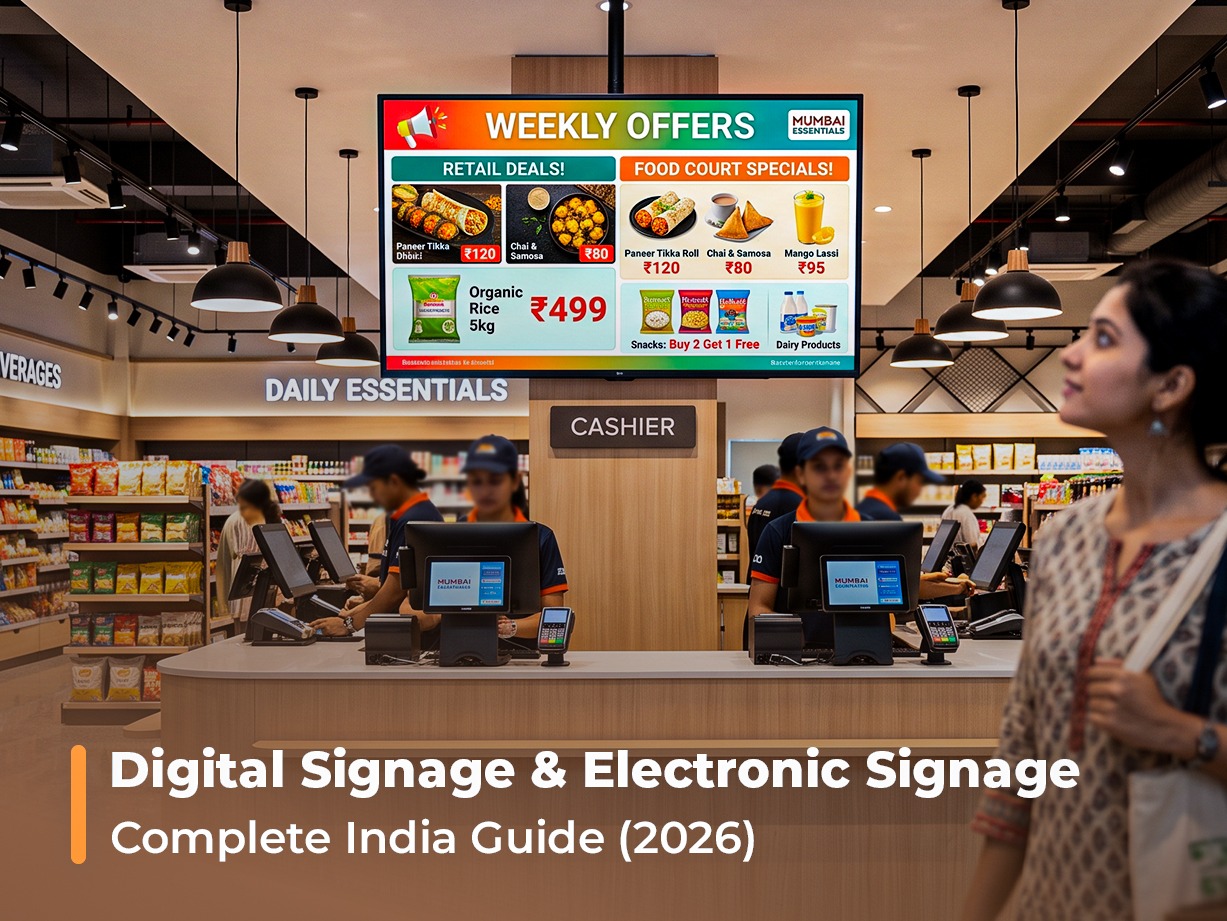
At the checkout: Digital signage near billing queues promotes impulse buys, loyalty programmes, and upcoming events; converting otherwise idle waiting time into a marketing touchpoint.
Branded zone displays: Electronics brands (Samsung, LG, Apple, Dyson) sponsor branded electronic signage within multi-brand retail stores to maintain their visual identity at the point of decision.
Window displays: Transparent LED or high-brightness LCD window displays visible from outside the store are increasingly popular in premium retail locations in Delhi, Mumbai, and Bengaluru.
Hospitality
Hotels, resorts, restaurants, and event venues use electronic signage across the entire guest journey.
Lobby and reception: A large video wall or single display showing the hotel’s brand story, local weather, attractions, and F&B offers creates a premium first impression and reduces perceived wait time during check-in.
Wayfinding: Multi-floor signage systems guide guests to rooms, meeting halls, restaurants, pools, and facilities; particularly important in large convention hotels and resorts.
Meeting room displays: Small displays outside meeting rooms show room names, schedules, and current booking status. Integrated with room booking software, these update in real time and eliminate scheduling conflicts.
Restaurant menu boards: QSR restaurants, hotel restaurants, and coffee shops use digital menu boards to manage menus dynamically- updating prices, adding seasonal items, or removing sold-out dishes without any physical effort.
Event signage: Digital displays at event venues show event schedules, sponsor logos, live social media feeds, and real-time updates- far more flexible than printed event programmes.
Transport
India’s transport infrastructure- airports, metro rail, bus stations, and railways; is one of the most visible deployment environments for electronic signage.
Airports: India’s modernised airports (Terminal 3 Delhi, Chhatrapati Shivaji Mumbai T2, Kempegowda Bengaluru T2) are showcase environments for electronic signage, from flight information display systems (FIDS) to advertising displays to wayfinding totems.
Metro rail: All major metro networks- Delhi Metro, Namma Metro (Bengaluru), Mumbai Metro, Hyderabad Metro use electronic signage for passenger information, advertising, and real-time service updates.
Railways: Indian Railways has deployed digital information boards at major junctions, and platform display screens are now common across A1 and A category stations under the station redevelopment programme.
Bus stations: State transport corporations and private bus terminals in Pune, Chennai, and Hyderabad have deployed departure/arrival boards and passenger information displays.
Digital Signage Price in India
Pricing for digital signage in India varies based on display type, size, environment (indoor vs outdoor), and software requirements. Here is a practical pricing guide for 2026:
Display Hardware Prices
| Display Type | Size / Spec | Price Range (INR) |
| Commercial LCD Display (indoor) | 43″ | ₹28,000 – ₹55,000 |
| Commercial LCD Display (indoor) | 55″ | ₹45,000 – ₹90,000 |
| Commercial LCD Display (indoor) | 75″ | ₹80,000 – ₹1,80,000 |
| Outdoor High-Brightness Display | 55″ | ₹1,50,000 – ₹3,50,000 |
| Indoor LED Module (per sqm) | P2.5 pixel pitch | ₹45,000 – ₹80,000 per m² |
| Outdoor LED Billboard (per sqm) | P6-P10 | ₹30,000 – ₹60,000 per m² |
| Video Wall Panel (LCD) | 55″ narrow bezel | ₹60,000 – ₹1,20,000 per panel |
| Digital Menu Board Bundle | 3 × 43″ with player | ₹90,000 – ₹2,00,000 |
| Interactive Touchscreen | 65″ | ₹1,20,000 – ₹2,80,000 |
Media Player Prices
A dedicated media player is needed when the display does not have a built-in player (SoC – System on Chip). External media players range from ₹4,000 for basic Android players to ₹25,000+ for enterprise-grade Windows players with 4K output and remote management.
Digital Signage Software (CMS) Pricing
Most CMS platforms in India are offered on a SaaS subscription model:
| Software Tier | Features | Monthly Cost (per screen) |
| Basic | Template-based, scheduling, 1 user | ₹500 – ₹1,200 |
| Mid-range | Multi-user, zone layouts, reporting | ₹1,200 – ₹2,500 |
| Enterprise | API integrations, analytics, white-label | ₹2,500 – ₹6,000+ |
Total Cost of Ownership (Example)
For a retail store deploying 3 screens with a commercial-grade 55″ LCD, external media player, and mid-range CMS:
- Hardware (3 × 55″ display + players): ₹1,80,000 – ₹3,00,000
- Installation and cabling: ₹15,000 – ₹30,000
- CMS subscription (per month): ₹3,600 – ₹7,500
- Annual maintenance: ₹15,000 – ₹25,000
Total first-year cost: approximately ₹2,50,000 – ₹4,50,000 for a 3-screen indoor retail deployment.
Top Digital Signage Companies in India
India has a growing ecosystem of digital signage providers, from global hardware brands with local distribution to homegrown software companies and full-service AV integrators. Here are the key players across categories:
Display Hardware Manufacturers and Distributors
Samsung India : Samsung’s commercial display division (QM, QH, and QE series) is the most widely deployed brand in India’s corporate and retail digital signage space. Their SmartSignage platform includes built-in media players across most models.
LG Electronics India : LG’s commercial OLED, UHD, and outdoor displays are popular in premium retail, hospitality, and broadcast environments. Their webOS-based signage platform is well-regarded.
Philips Professional Displays (distributed by MMD) : Strong presence in corporate and healthcare digital signage, with a range of 24/7-rated commercial displays across sizes.
Wacom / ViewSonic : Growing presence in interactive display and education-focussed signage.
Leyard and Unilumin : Chinese LED manufacturers with distribution in India, popular for large-format indoor and outdoor LED video walls at competitive price points.
Digital Signage CMS and Software Companies
Scala (now part of Stratacache)– One of the longest-established CMS platforms globally, with enterprise deployments in Indian retail and banking.
Novisign and Yodeck – Cloud-based CMS platforms popular with small and mid-sized businesses for ease of setup and affordable pricing.
Navori Labs– Enterprise-grade CMS with a strong base in Indian airports and large retail chains.
Ditto (formerly known as Rise Vision in India)– Cloud digital signage platform used extensively in education and corporate settings.
Indian System Integrators and Solution Providers
Pyramid AV– Mumbai-based integrator with strong experience in hospitality, corporate, and retail deployments across India.
Barodawala AV Solutions– One of India’s established AV and digital signage integrators with pan-India project experience.
Sumadhura Group AV Division, Kramer India, Extron India -Strong in corporate AV and digital signage control systems for large installations.
Tessco Technologies, Vantage AV– Active in retail, hospitality, and airport digital signage integration.
When choosing a digital signage partner in India, evaluate not just price but their post-installation support network, software update policy, and whether they have deployed projects of similar scale in your industry.
How to Get Started
Deploying electronic signage for the first time can feel overwhelming given the number of choices. This step-by-step approach will help you plan and execute a successful rollout.
Step 1: Define Your Objective
Before specifying any hardware, be clear on what you want your digital signage to achieve. Drive more impulse purchases? Reduce perceived wait time? Improve wayfinding? Promote a seasonal offer? Different objectives lead to different display types, placements, and content strategies.
Step 2: Map Your Locations and Environments
Walk every location where you are considering a display. Note the ambient light levels, the viewing distance, whether the location is indoor or outdoor, available wall space, and proximity to power and internet points. This assessment directly determines the right display type and size.
Step 3: Choose Your Display Hardware
Based on your environment assessment, select the appropriate display technology. For most indoor retail and corporate applications, a 43″-65″ commercial-grade LCD from Samsung, LG, or Philips will serve well. For outdoor or high-ambient-light environments, step up to a high-brightness display or LED.
Avoid using consumer-grade TVs for permanent signage installations. They are not rated for extended-hours commercial use and will degrade faster, voiding any warranty.
Step 4: Select a CMS Platform
Test at least two or three CMS platforms before committing. Most offer free trials. Key things to evaluate during a trial:
- How easy is it to upload content and create a playlist?
- Can you schedule content by time of day or day of week?
- Does it support the integrations you need (POS, weather, social media)?
- How does the CMS handle screen monitoring and alerts if a screen goes offline?
Step 5: Plan Your Content Strategy
The most common mistake in digital signage deployments is treating the screen as a set-and-forget tool. Screens that show the same content for weeks start to be ignored. Build a content calendar, rotate promotions regularly, and use the scheduling features of your CMS to keep content fresh and relevant.
Step 6: Get Professional Installation
Secure wall mounting, cable management, and network configuration are not DIY tasks for a permanent commercial installation. Use a certified installer or the integration services offered by your hardware vendor.
Step 7: Monitor and Optimise
Use your CMS dashboard to track screen uptime, content performance, and any remote alerts. Regularly review whether the signage is meeting your original objective and adjust content, placement, or scheduling accordingly.
FAQs
Q1. What is the difference between a commercial display and a consumer TV for digital signage?
Commercial displays are built for 16/7 or 24/7 operation with higher-grade internal components, better heat dissipation, and built-in management features like remote monitoring and content locking. Consumer TVs are rated for 4-6 hours of daily home use and lack these features. Using a consumer TV for permanent digital signage typically leads to early failure and voids the warranty.
Q2. Can I manage digital signage content without technical knowledge?
Yes. Modern cloud-based CMS platforms are designed for non-technical users. Most use drag-and-drop interfaces, pre-built templates, and simple scheduling calendars. If you can use a smartphone, you can manage basic digital signage content.
Q3. Does electronic signage work without an internet connection?
Displays can play pre-loaded content without internet access. However, remote content updates, real-time data integrations (live pricing, weather, social feeds), and screen monitoring all require an active internet connection. A 4G/LTE backup SIM is a common solution for locations with unreliable broadband.
Q4. How much electricity does a digital signage display consume?
A typical 55″ commercial LCD display consumes approximately 100-150 watts. Running 10 screens for 12 hours per day adds roughly 18 kWh of electricity consumption daily, about ₹120-₹180 per day at average Indian commercial electricity tariffs. LED displays of equivalent size consume significantly less.
Q5. What resolution should I use for digital signage content?
For most modern commercial displays, Full HD (1920×1080) is the minimum recommended resolution. If you are deploying 4K displays or large-format video walls, create content at 3840×2160. For LED billboard content viewed from a distance, lower resolutions are acceptable.
Q6. Is GST applicable on digital signage hardware and software in India?
Yes. Display hardware typically attracts 18% GST. Installation services are also typically taxed at 18%. SaaS-based CMS subscriptions attract 18% GST. Businesses with GSTIN can claim input tax credit on these purchases.
Q7. How long does a commercial LCD display last?
A quality commercial display rated for 24/7 operation typically lasts 50,000 to 60,000 hours, equivalent to roughly 6-8 years of continuous use. LED displays generally have longer lifespans, rated at 80,000 to 100,000 hours.
Q8. Can digital signage display live content like news, cricket scores, or stock prices?
Yes. Most enterprise CMS platforms support live data widgets. RSS news feeds, live sports scores via APIs, financial market data, weather feeds, and social media integrations- that can be embedded into your signage playlists alongside your own branded content.
Q9. What is the typical lead time for a digital signage installation in India?
For a standard indoor installation with off-the-shelf commercial displays and a cloud CMS, 2-4 weeks from order to go-live is typical. Larger projects involving custom LED walls, extensive cabling, or software customisation can take 2-4 months.
Q10. Do I need a licence to display advertising on digital signage visible from a public road?
Yes. Outdoor electronic signage visible from a public road falls under the jurisdiction of local municipal authorities (municipal corporations, NHAI for highways). A hoarding or outdoor advertising licence is required. Regulations vary by city- Mumbai, Delhi, Bengaluru, and Chennai each have their own outdoor advertising policies.
Final Thoughts
Electronic signage in India in 2026 is no longer a question of whether to invest, but where, how, and with whom. The technology has matured, costs have dropped, and the gap between print advertising and digital signage in terms of value-for-money has never been wider in digital signage’s favour.
For businesses at any scale- a single-outlet restaurant wanting to upgrade its menu boards, a retail chain looking to unify its in-store communication, or a large enterprise deploying hundreds of screens across branches; the fundamentals are the same. Start with a clear objective. Choose hardware suited to your environment. Pick a CMS you will actually use. Keep your content fresh. And partner with a vendor who will be there after the screens are installed.
India’s screen revolution is already underway. The question is whether your business will be part of it.
