

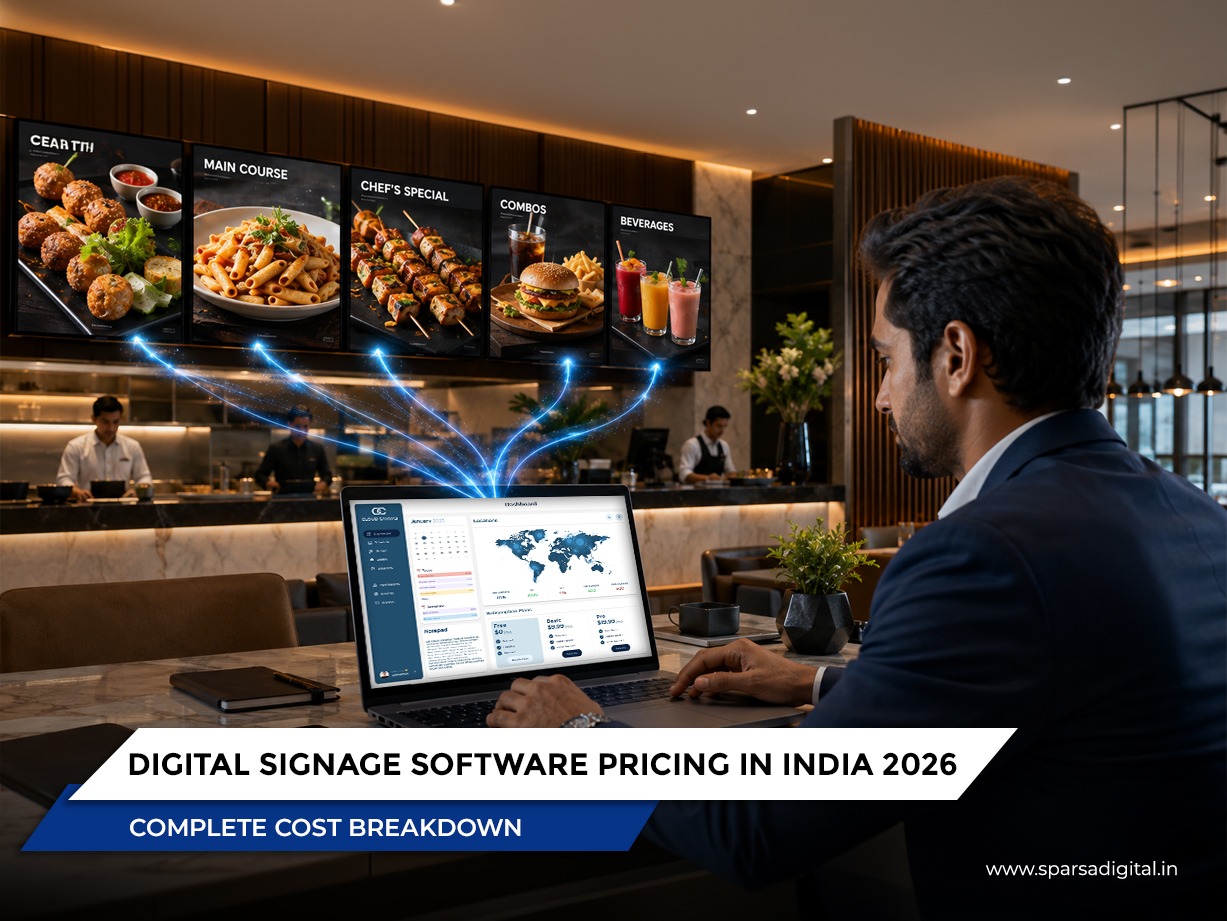
Shopping around for digital signage software? You’ve probably noticed the prices don’t line up. One vendor quotes ₹500 per screen a month. Another won’t tell you anything until you’ve been on a 40-minute sales call.
That’s not random. Sometimes it reflects real differences in what’s bundled in. Sometimes it’s just a tactic to keep you talking to sales for longer than you need to.
What Actually Drives the Price?
A few things push the number up or down:
- Screen count and licensing. Most platforms charge per screen, per month, so cost scales with your rollout. Cross 20-50 screens and many vendors start offering volume discounts.
- Cloud vs. on-premise. Cloud CMS costs less upfront and bills predictably. On-premise software means a bigger initial license fee, plus your own servers and IT time. For most Indian businesses, whether it is retail, restaurants, corporate offices; cloud wins out over a 3-year horizon simply because there’s no infrastructure to babysit.
- How deep the features go. Basic scheduling and templates are cheap. API integrations, role-based access, and analytics cost more. If all you’re doing is swapping images on a timer, you don’t need the enterprise tier.
- Support level. Dedicated account managers, uptime SLAs, and priority tickets all cost extra over community or email support.
- Content complexity. Live data feeds, POS integration, multi-zone layouts, personalization- all of it needs more backend work, so it pushes you toward the top of whatever tier you’re in.
Knowing which of these you actually need is the fastest way to avoid paying for an “affordable” plan that’s secretly built for an enterprise deployment you don’t have.
Pricing Tiers, Roughly
Indian CMS pricing tends to fall into three bands, per screen per month:
Basic Plan: ₹500 to ₹1,200 Template-based content, basic scheduling, single-user access. Good fit for a small retailer, a single-location restaurant, or a clinic running one or two screens with nothing fancy going on.
Mid-range Plan: ₹1,200 to ₹2,500 Multi-user access, zone-based layouts (splitting a screen into separate content areas), reporting, and screen-health monitoring. This is where most Indian retail chains, hotels, and corporate offices running multi-screen networks land.
Enterprise Plan: ₹2,500 to ₹6,000+ API integrations (POS, CRM, ERP), advanced analytics, white-labeling, dedicated account management, priority support. Built for national retail chains, hospital networks, airport signage, the places where uptime and centralized control matter more than the monthly bill.
Which tier you need has less to do with your industry and more to do with how much of the platform you’ll actually use. A single café doesn’t need API integrations. A 40-store chain probably does. And since most platforms let you upgrade later without a painful migration, starting lean is usually the safer bet, and not the riskier one.
What’s Included, and What Isn’t
The plan name tells you less than the fine print.
Usually included:
- Content scheduling and playlists
- Basic templates
- Remote content push
- Cloud storage, up to a set limit
- Standard reporting
- Email or ticket support
Usually billed separately:
- Advanced analytics dashboards
- Extra user seats
- API access for integrations
- White-labeling / custom branding
- Dedicated onboarding or training
- Premium support with faster SLAs
- Storage beyond your quota
Three things trip people up because they sound like they should be standard but often aren’t: multi-zone layouts, proof-of-play reporting (worth checking if you’re selling ad space), and offline playback for spotty-internet locations. If you need any of these, confirm they’re in the base plan before you sign.
Sparsa vs. Planar: A Quick Comparison
These two aren’t really playing the same game.
Sparsa publishes clear, India-benchmarked pricing across all three tiers, which is per-screen, per-month, no sales call required just to see a number. You can build a real budget in a few minutes and compare it against your needs before talking to anyone.
Planar is primarily a hardware company. LED video walls, direct-view LED, large-format commercial displays. It usually pairs its screens with third-party CMS platforms (like 22Miles) rather than selling its own software at a listed price. Getting a number means getting on a call, and the pricing tends to reflect premium enterprise AV positioning rather than a transparent rate card.
The practical difference: One lets you self-serve a decision with real numbers. The other makes you talk to sales before you know if it’s even in budget. If you’re deploying hundreds of screens with complex integrations and global support needs, a quote-based model can make sense. For most Indian retail, hospitality, and corporate rollouts, transparent tiered pricing gets you to a decision faster, and with less risk of scope creep along the way.
Hidden Costs People Forget to Budget For
The subscription price is never the whole story. Watch for:
- Setup/onboarding fees– common for multi-screen or multi-location rollouts
- Content creation– the CMS manages your content, it doesn’t make it for you
- Media player hardware– if your display doesn’t have a built-in player (SoC), budget ₹4,000-₹25,000 for an external Android or Windows player
- Installation and cabling – ₹15,000-₹30,000 for a multi-screen setup, depending on site complexity
- GST – CMS subscriptions, hardware, and installation generally attract 18% GST; check whether the quoted price already includes it
- Overage charges– go over your storage, seats, or screen count mid-cycle and you may see prorated charges you didn’t expect
None of this is a reason to skip digital signage. It’s just what belongs in your total budget instead of showing up as a surprise later.
A Simple Way to Calculate ROI
1. Add up what you’re spending now. For print signage: design, printing, installation labor, usually multiplied by how often you update it.
2. Add up the digital cost. Hardware (one-time) + CMS subscription (annualized) + content creation, divided by expected usage (most commercial displays run 6-8 years).
3. Estimate the upside. Harder to pin down exactly, but reasonable proxies: better footfall conversion from entrance displays, shorter perceived wait times, faster turnaround on promotions, less print waste.
4. Compare payback period. Most Indian retail and hospitality deployments break even within 12-24 months once print savings and even modest engagement gains are counted, though this varies a lot by scale and how often you were updating content before.
Quick gut-check: if you’re updating printed signage more than once a month, or across more than one location, digital signage usually pays for itself on cost alone, before you even factor in engagement.
Free Trial & Demo Options
Most Indian CMS providers, Sparsa included, offer a free trial or live demo. Use it properly, not as a box-ticking exercise.
During the trial, test:
- How fast you can upload and schedule content without calling support
- Whether the multi-zone tools actually match your screen setup
- What happens when a screen goes offline
- Whether the reporting tells you anything you’ll actually use
If a vendor won’t give you a trial or demo before asking for a signature, that’s worth weighing against everything else you’ve learned about them.
FAQs
- How much does digital signage cost for a small business in India?
For 1-3 screens at a single location, expect ₹500-₹1,200 per screen/month on the Basic tier, plus one-time hardware (display, media player, installation), usually ₹1.5-3 lakh for a commercial-grade setup.
- Is “affordable” digital signage software actually affordable, or is it a bait-and-switch?
Genuinely affordable options exist for simple use cases. Single screens, templates, no integrations. The bait-and-switch shows up when a low price excludes things most real deployments need anyway (multi-zone layouts, decent storage, real support). Read the feature list, not just the number.
- Does the software price include hardware?
No. Displays, media players, mounting, and installation are separate, whether you buy them bundled from the CMS vendor or source them yourself.
- Can I switch tiers later without a new contract?
Most cloud-based Indian CMS platforms allow mid-cycle upgrades, prorated for the rest of the billing period. Downgrades are sometimes locked until the cycle ends, but you can confirm this during your trial.
- Is annual billing actually cheaper?
Usually, yes. Typically 10-20% off monthly rates. But it’s only a good trade if you’re confident in the platform after a trial. Committing a year to an unproven CMS to save a bit isn’t worth it if you end up needing to switch.