
Typically, buying an LED screen is an exciting process that ends with a headache. P2. 5 is stated in one quote, P1. 8 in another, and “nits” and “refresh rate” are added in a third without any further explanation.
Once it’s explained in simple terms, none of this is difficult.
LED displays- Decoded
Thousands of tiny light-emitting diodes are arranged in a grid to create an LED screen.
One pixel is made up of each diode or small cluster of diodes. An image is created when enough pixels are combined. That’s the entire concept. Everything else, including brightness, resolution, and color accuracy, simply varies depending on the number of diodes, how they are powered, and how they are controlled.
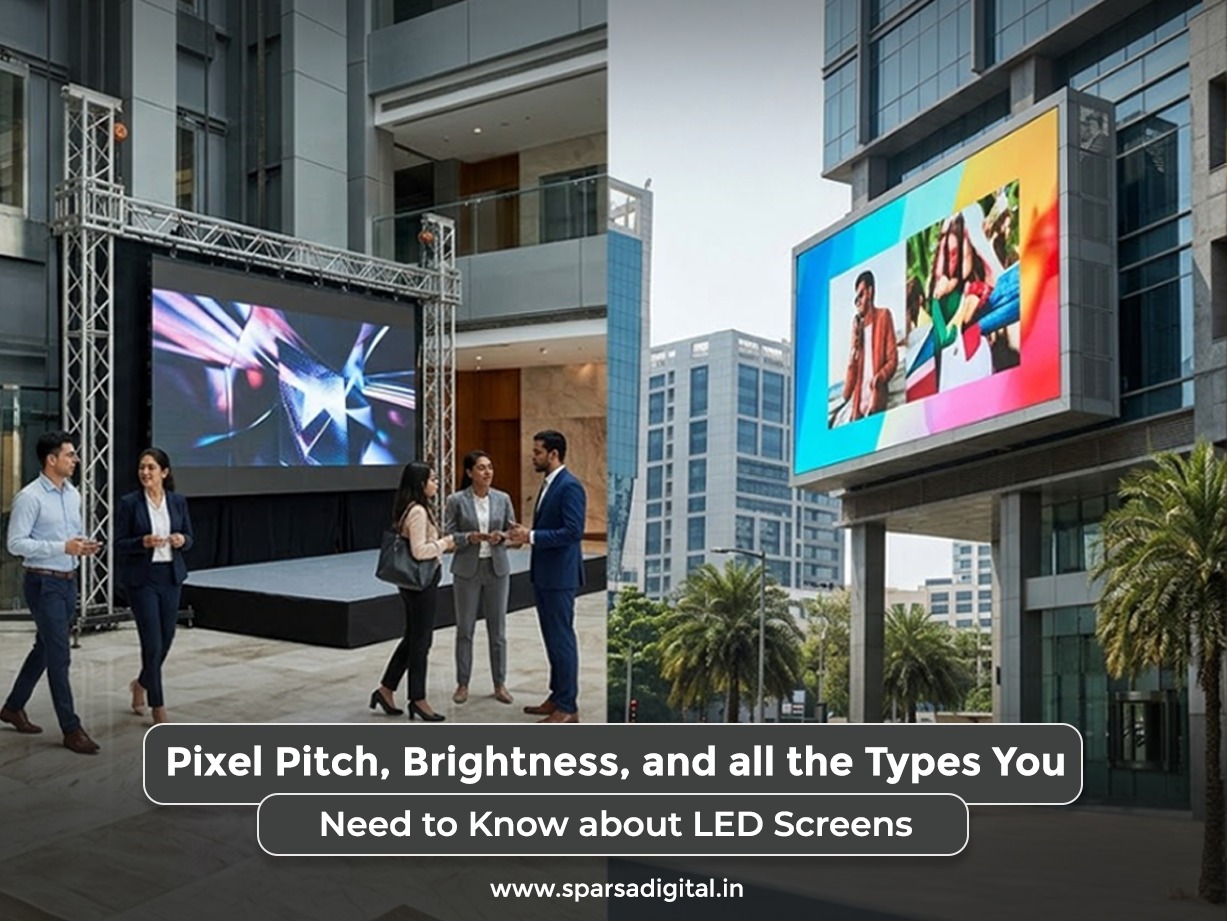
LED displays are modular. They are constructed from smaller tiles or cabinets, typically measuring between 500 and 1000 mm on each side, that lock together like puzzle pieces rather than one enormous panel. Because of this, an LED wall display can be constructed in practically any shape or size, ranging from a tiny indoor standee to a huge outdoor billboard that covers an entire building face.
Every tile has a driver board, a receiving card that communicates with a central control system, and its own LEDs. A video wall is more than just a grid of lights because of its control system.
Every tile is synchronized so that the entire surface appears to be a single image. Prior to anything else, it is important to understand the following three general categories. LEDs with fine pitch are designed for close-up viewing, such as in control rooms or retail displays.
Malls, lobby areas, and event spaces use standard indoor LED lighting. Outdoor LEDs are designed to withstand temperature fluctuations, sunlight, and rain. In reality, every specification sheet you encounter merely describes a panel’s position and performance within these three categories. The rest of the terminology no longer seems like jargon after that realization.
The Most Important Specification is Pixel Pitch.
Make it pixel pitch if you can recall just one term from the entire article.
The distance, expressed in millimeters, between the centers of two LED pixels is known as pixel pitch. The letter “P” is followed by a number, such as P2. 5 or P10. The millimeter gap is that figure. Smaller numbers, tighter pixels, and a sharper image up close are the simple rules:
| Pixel Pitch | Best Minimum Viewing Distance | Common Use Case |
| P1.2 – P1.8 | 1.5 – 2.5 metres | Control rooms, boardrooms, luxury retail |
| P2.5 – P3 | 2.5 – 4 metres | Retail stores, lobbies, indoor stages |
| P4 – P6 | 4 – 8 metres | Large indoor halls, exhibition centres |
| P8 – P10 | 8 – 15 metres | Outdoor billboards, stadium screens |
| P10+ | 15+ metres | Highway billboards, large building facades |
Selecting a pixel pitch that is tighter (and more expensive) than they actually require is a common error made by first-time purchasers. A hyper-fine P1. 8 panel is a waste of money if your screen is ten meters above a busy road.
Adapt your pitch to the proximity of your target audience.
Types: Rental, Outdoor, and Indoor.
Not all LED panels are constructed in the same way, and one of the most frequent (and costly) errors made by consumers is to use the incorrect type in the incorrect setting.
LED screens used indoors are designed for controlled settings. Since they are never in direct sunlight, they operate at lower brightness levels, are typically lighter, and don’t require weatherproofing. Because viewers typically stand closer, indoor panels typically offer tighter pixel pitches as well.
An entirely different construction is used for outdoor LED screens. They are designed to withstand temperature fluctuations, run at a much higher brightness to remain visible in direct sunlight, and are sealed against dust and moisture (rated IP65 or higher on the front face).
Because outdoor panels must endure years of weather exposure and wind load, they are also more resilient physically.
A particular subset of LED panels designed for temporary installations, events, and exhibitions is called rental LED panels. Fast assembly and disassembly, lightweight cabinets, and packaging that fits in a flight case are the top priorities for these panels.
Although they can be moved, reused, and set up in a matter of hours as opposed to days, they are not necessarily less expensive per square foot.
Semi-outdoor panels, which are used in covered spaces like store verandas, metro platforms, or covered walkways, are another expanding middle category. These do not require complete outdoor-grade weatherproofing, but they do require greater brightness than pure indoor screens.
Ask yourself this before placing an order. Will the sun or rain ever come into contact with this screen? Does it require frequent relocation or configuration? What is the usual distance between people? The answers typically make the choice between indoor, outdoor, and rental properties simple.
A Clear Explanation of Brightness and Viewing Distance.
Nits are a unit of brightness measurement. The light from one candle spread across one square meter is approximately equivalent to one nit. In bright ambient light, the screen is more visible when the nit count is higher. This serves as a general standard:
| Environment | Recommended Brightness |
| Indoor, low ambient light (control room) | 300 – 600 nits |
| Indoor, retail or lobby with windows | 600 – 1,200 nits |
| Semi-outdoor, covered but bright | 1,500 – 3,000 nits |
| Full outdoor, direct sunlight | 4,000 – 7,500+ nits |
If installed outside, an indoor panel operating at just 500 nits will appear dim and washed out.
If an outdoor-rated panel operating at 5,000 nits is used indoors without adequate brightness control, it may be uncomfortably harsh.
Brightness and viewing distance cooperate rather than operate independently. When viewed up close, a screen that is both bright and fine-pitched may actually strain eyes. Don’t just look at the largest number on the spec sheet.
The Brief Version of LED vs. LCD.
Liquid crystal display panels, which resemble televisions, are connected in a grid to create LCD video walls. Each panel has obvious bezels, or seams, that are typically a few millimeters wide.
For a fixed size, LCD walls are typically less expensive; however, the bezels slightly distort the image and make resizing and reshaping difficult. LED walls can be constructed in nearly any size or aspect ratio and have no visible seams because they are constructed from individual pixels rather than fixed panels.
Additionally, for larger installations or longer operating hours, LEDs typically operate brighter and more robustly. This is the condensed version that consumers truly require:
| Factor | LED | LCD |
| Seams between panels | None | Visible bezels |
| Custom sizing | Very flexible | Limited to panel multiples |
| Brightness | Higher, better for bright rooms or outdoors | Lower, best for controlled indoor lighting |
| Cost for smaller installs | Usually higher | Usually lower |
| Best for | Large walls, outdoor use, seamless visuals | Smaller budget-conscious indoor displays |
LED is nearly always the best choice for projects involving large format walls, seamless brand statements, or outdoor spaces. LCD can still make sense if you’re on a tighter budget and have a smaller interior space where a thin bezel line isn’t a deal-breaker.
The Real Factor Influencing the Cost.
The cost of an LED screen in India varies greatly, and the brand name on the quote rarely matters. The majority of the work is done by a few actual factors.
The largest lever is pixel pitch. More LEDs are crammed into a smaller space with tighter pitch, which raises the cost of materials and production. The cost per square foot can almost double when switching from P4 to P2. 5.
Simply put, panel size and overall area are important; more square footage equates to more cabinets, modules, and labor for assembly and mounting.
The cost varies greatly between indoor and outdoor construction. In comparison to an indoor-only panel of the same size, the cost is increased by outdoor-rated weatherproofing, structural mounting, and higher-output LED chips.
Durability and image quality are both impacted by refresh rate and chip quality. Better chip quality (from reputable manufacturers) tends to hold color and brightness consistency longer, and higher refresh rates reduce camera flicker, which is important for broadcast or event use.
Frequently, control systems and software are undervalued. A full content management system that enables remote scheduling, multi-zone content, and real-time updates is far more expensive than a simple controller that only shows a static image.
For large or structurally challenging sites, such as outdoor billboards requiring steel framing or curved walls requiring custom cabinet shaping, installation complexity quickly mounts.
Pricing is also influenced by warranty duration and after-sales assistance. Generally speaking, a vendor with a 3-year on-site warranty and committed technical support will charge more than one with a minimum 1-year warranty.
Invest or Rent?
If: then renting makes sense. For a single event, exhibition, or brief campaign, you require a screen. Over time, the screen will be utilized in various settings. You should test a large-format display before making a long-term purchase. Instead of being locked into a fixed asset, your budget must remain adaptable.
Purchasing makes sense if… For years, the screen will run every day in a fixed location. You must have complete control over branding, content, and long-term ROI.
You rely on advertising or signage as a continuous source of income for your business. Rather than paying for a screen each time you need one, you would prefer to pay once (plus maintenance).
FAQs
- For a display in a retail establishment, what pixel pitch is ideal?
A pixel pitch between P2. 5 and P4 typically provides a good balance of image quality and cost for the majority of retail settings where customers stand a few meters away.
- For an outdoor LED screen, how many nits of brightness are required?
To remain clearly visible during the day, outdoor LED screens that are exposed to direct sunlight typically require brightness levels between 4,000 and 7,500+ nits.
- Are LEDs superior to LCDs for video walls?
Since LEDs are brighter and have no visible bezels, they are typically better suited for large, seamless, or outdoor installations. For smaller indoor displays where a thin seam line is not a major concern, LCD can still be a good, more cost-effective option.
- Are LED screens in need of extra care?
Compared to older display technologies, LED screens typically require very little maintenance other than the occasional cleaning and routine inspections of the wiring and control system. Due to weather exposure, outdoor panels may require more frequent inspections.
