
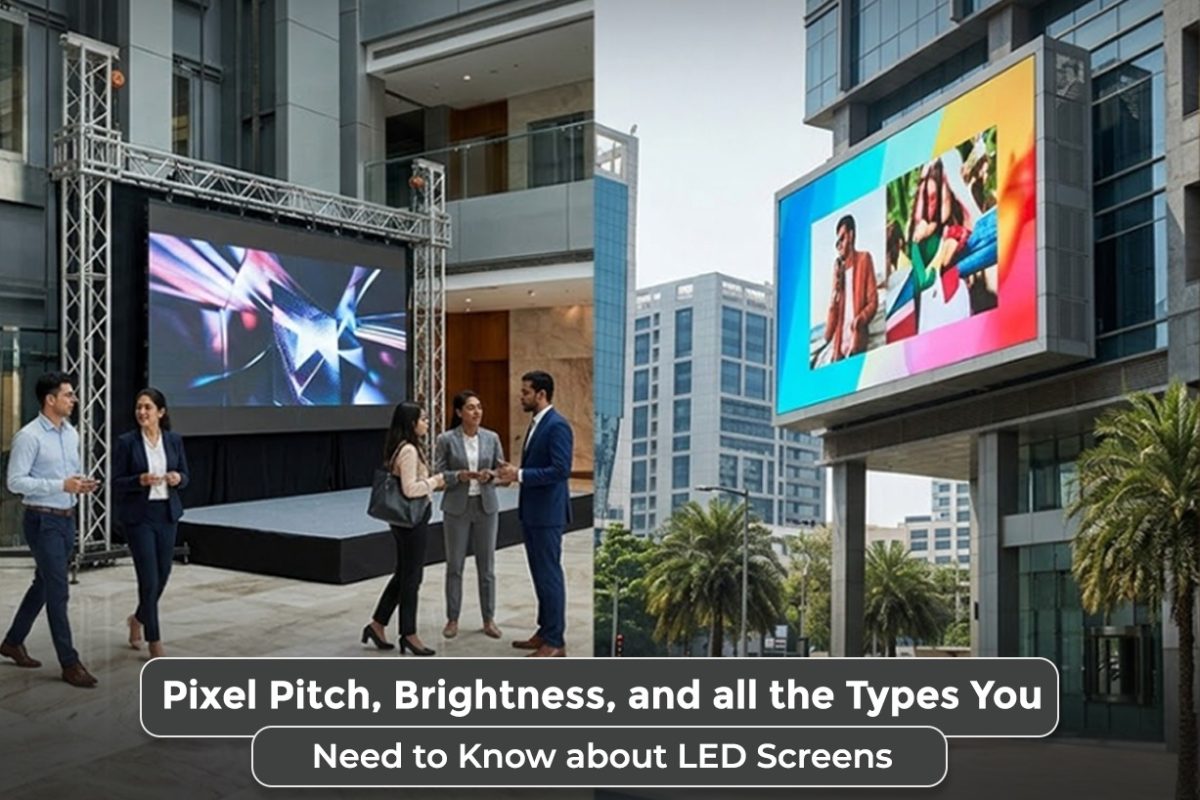
Pixel Pitch, Brightness, and all the Types You Need to Know about LED Screens

Pixel Pitch, Brightness, and all the Types You Need to Know about LED Screens

Typically, buying an LED screen is an exciting process that ends with a headache. P2. 5 is stated in one quote, P1. 8 in another, and “nits” and “refresh rate” are added in a third without any further explanation.

Once it’s explained in simple terms, none of this is difficult.

LED displays- Decoded

Thousands of tiny light-emitting diodes are arranged in a grid to create an LED screen.

One pixel is made up of each diode or small cluster of diodes. An image is created when enough pixels are combined. That’s the entire concept. Everything else, including brightness, resolution, and color accuracy, simply varies depending on the number of diodes, how they are powered, and how they are controlled.

LED displays are modular. They are constructed from smaller tiles or cabinets, typically measuring between 500 and 1000 mm on each side, that lock together like puzzle pieces rather than one enormous panel. Because of this, an LED wall display can be constructed in practically any shape or size, ranging from a tiny indoor standee to a huge outdoor billboard that covers an entire building face.

Every tile has a driver board, a receiving card that communicates with a central control system, and its own LEDs. A video wall is more than just a grid of lights because of its control system.

Every tile is synchronized so that the entire surface appears to be a single image. Prior to anything else, it is important to understand the following three general categories. LEDs with fine pitch are designed for close-up viewing, such as in control rooms or retail displays.

Malls, lobby areas, and event spaces use standard indoor LED lighting. Outdoor LEDs are designed to withstand temperature fluctuations, sunlight, and rain. In reality, every specification sheet you encounter merely describes a panel’s position and performance within these three categories. The rest of the terminology no longer seems like jargon after that realization.

The Most Important Specification is Pixel Pitch.

Make it pixel pitch if you can recall just one term from the entire article.

The distance, expressed in millimeters, between the centers of two LED pixels is known as pixel pitch. The letter “P” is followed by a number, such as P2. 5 or P10. The millimeter gap is that figure. Smaller numbers, tighter pixels, and a sharper image up close are the simple rules:

Pixel PitchBest Minimum Viewing DistanceCommon Use Case
P1.2 – P1.81.5 – 2.5 metresControl rooms, boardrooms, luxury retail
P2.5 – P32.5 – 4 metresRetail stores, lobbies, indoor stages
P4 – P64 – 8 metresLarge indoor halls, exhibition centres
P8 – P108 – 15 metresOutdoor billboards, stadium screens
P10+15+ metresHighway billboards, large building facades

Selecting a pixel pitch that is tighter (and more expensive) than they actually require is a common error made by first-time purchasers. A hyper-fine P1. 8 panel is a waste of money if your screen is ten meters above a busy road.

Adapt your pitch to the proximity of your target audience.

Types: Rental, Outdoor, and Indoor.

Not all LED panels are constructed in the same way, and one of the most frequent (and costly) errors made by consumers is to use the incorrect type in the incorrect setting.

LED screens used indoors are designed for controlled settings. Since they are never in direct sunlight, they operate at lower brightness levels, are typically lighter, and don’t require weatherproofing. Because viewers typically stand closer, indoor panels typically offer tighter pixel pitches as well.

An entirely different construction is used for outdoor LED screens. They are designed to withstand temperature fluctuations, run at a much higher brightness to remain visible in direct sunlight, and are sealed against dust and moisture (rated IP65 or higher on the front face).

Because outdoor panels must endure years of weather exposure and wind load, they are also more resilient physically.

A particular subset of LED panels designed for temporary installations, events, and exhibitions is called rental LED panels. Fast assembly and disassembly, lightweight cabinets, and packaging that fits in a flight case are the top priorities for these panels.

Although they can be moved, reused, and set up in a matter of hours as opposed to days, they are not necessarily less expensive per square foot.

Semi-outdoor panels, which are used in covered spaces like store verandas, metro platforms, or covered walkways, are another expanding middle category. These do not require complete outdoor-grade weatherproofing, but they do require greater brightness than pure indoor screens.

Ask yourself this before placing an order. Will the sun or rain ever come into contact with this screen? Does it require frequent relocation or configuration? What is the usual distance between people? The answers typically make the choice between indoor, outdoor, and rental properties simple.

A Clear Explanation of Brightness and Viewing Distance.

Nits are a unit of brightness measurement. The light from one candle spread across one square meter is approximately equivalent to one nit. In bright ambient light, the screen is more visible when the nit count is higher. This serves as a general standard:

EnvironmentRecommended Brightness
Indoor, low ambient light (control room)300 – 600 nits
Indoor, retail or lobby with windows600 – 1,200 nits
Semi-outdoor, covered but bright1,500 – 3,000 nits
Full outdoor, direct sunlight4,000 – 7,500+ nits

If installed outside, an indoor panel operating at just 500 nits will appear dim and washed out.

If an outdoor-rated panel operating at 5,000 nits is used indoors without adequate brightness control, it may be uncomfortably harsh.

Brightness and viewing distance cooperate rather than operate independently. When viewed up close, a screen that is both bright and fine-pitched may actually strain eyes. Don’t just look at the largest number on the spec sheet.

The Brief Version of LED vs. LCD.

Liquid crystal display panels, which resemble televisions, are connected in a grid to create LCD video walls. Each panel has obvious bezels, or seams, that are typically a few millimeters wide.

For a fixed size, LCD walls are typically less expensive; however, the bezels slightly distort the image and make resizing and reshaping difficult. LED walls can be constructed in nearly any size or aspect ratio and have no visible seams because they are constructed from individual pixels rather than fixed panels.

Additionally, for larger installations or longer operating hours, LEDs typically operate brighter and more robustly. This is the condensed version that consumers truly require:

FactorLEDLCD
Seams between panelsNoneVisible bezels
Custom sizingVery flexibleLimited to panel multiples
BrightnessHigher, better for bright rooms or outdoorsLower, best for controlled indoor lighting
Cost for smaller installsUsually higherUsually lower
Best forLarge walls, outdoor use, seamless visualsSmaller budget-conscious indoor displays

LED is nearly always the best choice for projects involving large format walls, seamless brand statements, or outdoor spaces. LCD can still make sense if you’re on a tighter budget and have a smaller interior space where a thin bezel line isn’t a deal-breaker.

The Real Factor Influencing the Cost.

The cost of an LED screen in India varies greatly, and the brand name on the quote rarely matters. The majority of the work is done by a few actual factors.

The largest lever is pixel pitch. More LEDs are crammed into a smaller space with tighter pitch, which raises the cost of materials and production. The cost per square foot can almost double when switching from P4 to P2. 5.

Simply put, panel size and overall area are important; more square footage equates to more cabinets, modules, and labor for assembly and mounting.

The cost varies greatly between indoor and outdoor construction. In comparison to an indoor-only panel of the same size, the cost is increased by outdoor-rated weatherproofing, structural mounting, and higher-output LED chips.

Durability and image quality are both impacted by refresh rate and chip quality. Better chip quality (from reputable manufacturers) tends to hold color and brightness consistency longer, and higher refresh rates reduce camera flicker, which is important for broadcast or event use.

Frequently, control systems and software are undervalued. A full content management system that enables remote scheduling, multi-zone content, and real-time updates is far more expensive than a simple controller that only shows a static image.

For large or structurally challenging sites, such as outdoor billboards requiring steel framing or curved walls requiring custom cabinet shaping, installation complexity quickly mounts.

Pricing is also influenced by warranty duration and after-sales assistance. Generally speaking, a vendor with a 3-year on-site warranty and committed technical support will charge more than one with a minimum 1-year warranty.

Invest or Rent?

If: then renting makes sense. For a single event, exhibition, or brief campaign, you require a screen. Over time, the screen will be utilized in various settings. You should test a large-format display before making a long-term purchase. Instead of being locked into a fixed asset, your budget must remain adaptable.

Purchasing makes sense if… For years, the screen will run every day in a fixed location. You must have complete control over branding, content, and long-term ROI.

You rely on advertising or signage as a continuous source of income for your business. Rather than paying for a screen each time you need one, you would prefer to pay once (plus maintenance).

FAQs

  1. For a display in a retail establishment, what pixel pitch is ideal?

A pixel pitch between P2. 5 and P4 typically provides a good balance of image quality and cost for the majority of retail settings where customers stand a few meters away.

  1. For an outdoor LED screen, how many nits of brightness are required?

To remain clearly visible during the day, outdoor LED screens that are exposed to direct sunlight typically require brightness levels between 4,000 and 7,500+ nits.

  1. Are LEDs superior to LCDs for video walls?

Since LEDs are brighter and have no visible bezels, they are typically better suited for large, seamless, or outdoor installations. For smaller indoor displays where a thin seam line is not a major concern, LCD can still be a good, more cost-effective option.

  1. Are LED screens in need of extra care?

Compared to older display technologies, LED screens typically require very little maintenance other than the occasional cleaning and routine inspections of the wiring and control system. Due to weather exposure, outdoor panels may require more frequent inspections.

How Much Does an LED Video Wall Cost in 2026

How Much Does an LED Video Wall Cost in 2026

The price of an LED video wall in 2026. If you ask three vendors to quote for the same size LED wall, you’ll likely receive three very different quotes. For what appears to be the same screen on paper, one might return for ₹2 lakh, another for ₹5 lakh, and a third for ₹9 lakh.

Vendors aren’t attempting to pull a fast one. The term “LED video wall” encompasses a wide range of components, build quality, and specifications, and a single figure rarely captures the whole picture.

Why Do Quotes Differ So Much?

The majority of that spread is typically caused by a few factors.

  1. Origin and build quality of the panel. By far, this is the most important factor. For true quality control, long-lasting LED chips, and reliable color calibration, low-cost imported panels are far less expensive than those made by reputable manufacturers. On the first day, both panels will display a picture, but after three years, only one of them still looks good.
  2. Pitch of pixels. Compared to a coarser pitch, a finer pitch packs several times as many LEDs into the same space, which directly raises the cost of materials.
  3. Indoors versus. outside. To withstand sun, rain, and temperature fluctuations, outdoor panels require stronger cabinets, weatherproof sealing, and increased brightness, things that indoor panels do not have to deal with.
  4. Warranty and Brand. A well-known LED chip brand with an on-site warranty of two to three years will nearly always be more expensive than unbranded parts with an ambiguous or shortened warranty. That is typically a fair trade.
  5. What is contained in the quote? Certain quotes are limited to panels. Others include mounting, cabling, installation, control systems, and even content design. If you place an all-inclusive quote next to a panels-only quote, the former will appear incredibly inexpensive.
  6. Order scale and volume. Because fixed costs like the control system are spread across more panels, larger walls typically receive a better rate per square foot.

As you work through the numbers below, bear these six in mind. Depending on where a particular vendor falls on each range, each one changes.

Cost according to Pixel Pitch

Pixel PitchTypical Price (per sq. ft, indoor)Best Viewing Distance
P1.5 – P1.8₹9,000 – ₹18,000+1.5 – 3 m
P2.5₹6,000 – ₹10,0002.5 – 4 m
P3₹5,000 – ₹8,0003 – 5 m
P4₹3,500 – ₹6,0004 – 8 m
P5 – P6₹2,500 – ₹5,0006 – 10 m

A quick sanity check: if the cost of a P2. 5 indoor wall is significantly less than ₹5,000 per square meter. Feet, inquire about the brand of panel, rate of refresh, and duration of warranty. A trade-off, typically in component quality or after-sales support, is almost always concealed by exceptionally low pricing at a fine pitch.

Additionally, it’s important to fight the impulse to overbuy on pitch. When viewed from six meters away, a P4 wall appears nearly identical to a P2. 5 wall, but it may be thirty to forty percent less expensive. Instead of choosing the number that sounds most impressive on the spec sheet, match the pitch to your actual room and typical viewing distance.

Screen size-based pricing

The rate per square foot is determined by pixel pitch. The total bill is determined by size. A mid-range P2. 5 or P3 indoor build, panels only, typically comes in the following sizes.

Wall SizeAreaEstimated Cost (Panels Only)
6 ft x 4 ft24 sq. ft.₹1.2 – ₹2 Lakh
10 ft x 6 ft60 sq. ft.₹3 – ₹4.8 Lakh
12 ft x 8 ft96 sq. ft.₹5 – ₹7.7 Lakh
16 ft x 9 ft144 sq. ft.₹7.2 – ₹11.5 Lakh
20 ft x 10 ft200 sq. ft.₹10 – ₹16 Lakh

These figures do not include installation, structural mounting, or CMS software; they only cover panels and a basic control system.

Since fixed costs like the sending card and processor don’t scale in a straight line with size, larger walls are frequently slightly less expensive per square foot. However, larger installations also result in higher logistical and structural costs, which can reduce that savings, particularly on non-standard surfaces or above ground.

Costs associated with installation and structure

Because installation is frequently quoted separately or not at all until much later in the process, this is where many buyers fall victim.

  • The surface is the only factor that affects structural mounting. It is simple to build a solid, flat interior wall. Real material and labor costs are increased by curved surfaces, false ceiling mounts, and outdoor billboards requiring steel framing.
  • Dedicated wiring, breakers, and occasionally a separate power distribution unit for larger or outdoor walls drawing substantial power are all included in electrical work.
  • Every panel is linked to the control system via data infrastructure. This may also require running cables through walls or ceilings for large or multi-room projects, which would require additional labor time.
  • Anything mounted at a height is subject to rigging and safety regulations, especially large indoor walls in public areas or outdoor billboards, which may require certified rigging and safety sign-off.
  • Wall size and site complexity are correlated with labor and crew size. It could require two technicians per day to complete a small indoor wall. With a larger crew and specialized lifting equipment, a large outdoor wall can become a multi-day task. Installation and structural work typically increase the cost of panels by 15–30%, with additional costs for outdoor or structurally challenging locations.

In order to see exactly what you’re paying for, always request installation as a separate, itemized line rather than combined into a single, ambiguous total.

Frequently, the quote is omitted

The panels themselves are not the source of some of the biggest budget surprises. They originate from what was not stated in the first quote. software that manages content.

Many quotes only include hardware and a simple controller. Verify whether a CMS license is included or charged separately, usually as a recurring subscription, if you want remote updates, scheduling, or multi-screen management. content production.

Content is displayed in panels, but it still needs to be designed. Budget for an ongoing content service or a one-time design fee if you don’t have an internal team.

Annual Maintenance Contract, or AMC. For a predetermined amount of time, component failure is covered under basic warranty.

Preventive inspections, routine cleaning, and recalibration are typically covered by a separate yearly contract rather than being provided automatically. extra panels.

It’s typical to have one or two extra panels for large outdoor walls on hand for prompt replacement. Sometimes this is mentioned at all, and other times it is quoted separately.

Transportation and site entry. Costs that are never included in a standard quote may be added for remote locations or installations requiring cranes or special access equipment.

GST and other levies. Verify whether tax is included in the quoted amount; if it isn’t, this could cause the final figure to change by nearly a fifth.

Ask directly, “What’s not included in this number?” before signing off. Vendors who can provide a clear, written response to this question are typically more reliable than those who only discuss round, all-inclusive figures.

Obtaining a Precise Estimate

Giving vendors enough information to provide accurate quotes and then comparing those quotes on equal terms is the only dependable way to arrive at a figure you can genuinely plan around.

Give precise measurements and location information. The suggested pitch and brightness, and consequently the price, depend on a number of factors, including indoor or outdoor, wall type, height off the ground, and ambient light.

Decide on your main viewing distance. This is the quickest way to avoid overspending on a more polished pitch than you truly require.

Request an itemized quote. panels, control system, mounting, labor for installation, software, and AMC instead of a single combined figure.

Obtain the panel’s brand and warranty details in writing rather than just orally. This is frequently where two quotes that appear similar actually differ from one another.

Before making a decision, especially for outdoor or structurally challenging projects, request site photos or a visit.

One of the most frequent causes of a final bill exceeding the estimate is unexpected site conditions. Obtain a minimum of two or three quotes for the same specification.

Finding the lowest number is only one aspect of the process; another is identifying what one vendor included that another did not, which typically provides more information than just the price. The best way to make LED video wall quotes truly comparable rather than a guessing game is still to have a well-prepared brief that you share with each vendor you approach.

FAQs

  1. How much should an LED video wall cost on average for a small business in India?

A small indoor wall at P2. 5 or P3 that is between 24 and 60 square feet in size will typically cost between ₹1. 2 lakh and ₹4. 8 lakh for the panels alone, plus additional costs for installation and software.

  1. For a retail store, is P2. 5 or P3 a better value?

P3 looks nearly as good as P2. 5 in most retail settings where patrons aren’t standing directly in front of the screen, and it does so at a significantly lower cost. For the majority of stores, it is therefore a better option.

  1. Does the cost of installation add to the cost of the panel?

Yes, it does. Installation, structural mounting, and electrical work typically increase the base panel cost by an additional 15-30%, depending on how complex the site is.

  1. Why do some quotes appear so much less expensive than others?

Lower-grade panels, a shorter warranty, or missing line items like software and installation that would be included in a more comprehensive quote are frequently indicated by a lower number on paper. The content of each quote, not just the sum at the bottom, is what truly compares.

  1. How much is an outdoor wall more expensive than an indoor wall?

At the same pixel pitch, anticipate about 20-40% more. This premium is used for stronger construction to withstand outdoor conditions, increased brightness, and weatherproofing.

  1. Is a CMS required, or does the wall come with one?

Vendors differ in this regard. Some quotes only include a basic controller, leaving scheduling and remote management as separate expenses that are sometimes set up as subscriptions. Before you sign anything, make sure you understand.

  1. How can one obtain a large wall at a lower cost without compromising quality?

Instead of choosing the best option on the price list, choose a pixel pitch based on how far away people will actually be. Without making the situation worse, that one choice contributes more to cost control than nearly anything else.

  1. How long do LED video walls last before requiring significant upkeep?

    Excellent panels are designed to last for tens of thousands of hours, or about 8 to 10 years when used every day. Outdoor units are an exception, as their exposure to the weather necessitates more frequent inspections.
Digital Standee vs LED Video Wall Which Is Better for Advertising.jpg (1)

Digital Standee vs LED Video Wall: Which Is Better for Advertising?

Choosing the right display can directly impact your marketing results.

If you’re comparing digital standee vs LED video wall, you’re likely deciding where to invest your budget. Both options are powerful, but they serve different purposes.

A digital standee is a floor-standing LCD screen.
An LED video wall is a large modular display made of LED panels.

So, which one is better for advertising in 2026?

This guide will help you:

  • Compare cost, features, and use cases
  • Understand where each works best
  • Make a confident buying decision

What is a Digital Standee?

A digital standee is a vertical LCD display mounted on a floor stand, used for indoor advertising.

It is commonly used in:

  • Retail stores
  • Showrooms
  • Hotels
  • Corporate offices

👉 It replaces printed standees with dynamic content.

What is an LED Video Wall?

An LED video wall is a large display made of multiple LED panels, creating a seamless screen.

It is ideal for:

  • Outdoor advertising
  • Shopping malls
  • Events and concerts
  • Large corporate spaces

👉 It delivers high brightness and large-scale visibility.

Digital Standee vs LED Video Wall

📊 Overview Table

FeatureDigital StandeeLED Video Wall
Display TypeLCDLED Panels
SizeSmall to mediumLarge to very large
CostAffordableExpensive
BrightnessModerateVery high
Best UseIndoorIndoor + Outdoor
InstallationEasyComplex
MaintenanceLowMedium to High

Digital Signage vs LED Display: Key Differences

When comparing digital signage vs LED display, the main difference is scale and technology.

🔍 Digital Signage (Standee)

  • LCD-based display
  • Fixed size
  • Plug-and-play setup
  • Ideal for close viewing

🔍 LED Display (Video Wall)

  • Modular panels
  • Custom size
  • High brightness
  • Ideal for long-distance viewing

👉 Simple takeaway:
Digital signage = targeted indoor marketing
LED display = mass visibility advertising

LED Video Wall vs LCD Standee: Detailed Comparison

Let’s break this down further 👇

1. 💰 Cost Comparison

Cost is one of the biggest deciding factors.

Digital Standee Cost

  • ₹25,000 – ₹1,50,000
  • Budget-friendly
  • Low setup cost

LED Video Wall Cost

  • ₹2,00,000 – ₹20,00,000+
  • Depends on size and pixel pitch
  • High installation cost

👉 lcd standee vs led video wall price comparison:
Digital standees are 5x to 10x cheaper than LED walls.

2. 📏 Size & Viewing Experience

Digital Standee

  • 32-65 inches
  • Best for close viewing (3-10 feet)

LED Video Wall

  • 100+ inches
  • Visible from long distances

👉 Choose based on viewing distance.

3. 🔆 Brightness & Visibility

Digital Standee

  • 250-500 nits
  • Suitable for indoor lighting

LED Video Wall

  • 1000-5000+ nits
  • Works in sunlight

👉 LED walls win in brightness.

4. 🛠️ Installation Complexity

Digital Standee

  • Plug & play
  • No structural changes

LED Video Wall

  • Requires mounting structure
  • Professional installation needed

5. 🎯 Advertising Impact

Digital Standee

  • Personalized messaging
  • Great for in-store promotions

LED Video Wall

  • High impact visuals
  • Ideal for branding and awareness

6. 🔄 Content Flexibility

Both support:

  • Videos
  • Images
  • Slides

But:

  • Digital standees → easier content updates
  • LED walls → better for large-scale visuals

Digital Standee Benefits (Why Businesses Prefer It)

Here are key digital standee benefits 👍

✅ Cost-effective

Lower investment compared to LED walls.

✅ Easy to install

No technical setup required.

✅ Perfect for indoor use

Works well in controlled lighting.

✅ Space-saving

Slim and compact design.

✅ Quick ROI

Ideal for retail promotions.

LED Video Wall Advantages

🚀 High visibility

Can be seen from long distances.

🚀 Outdoor compatibility

Works in sunlight and weather.

🚀 Large display size

Perfect for branding.

🚀 Premium appeal

Creates a strong visual impact.

Digital Standee vs LED Screen for Retail

Retail stores often struggle with this choice.

🏬 Digital Standee for Retail

Best for:

  • Product promotions
  • Offers & discounts
  • Inside store engagement

🏬 LED Video Wall for Retail

Best for:

  • Storefront attraction
  • Mall advertising
  • Brand visibility

👉 Which is better digital standee or led wall for retail?

  • Small store → Digital standee
  • Large showroom/mall → LED wall

Best Display for Indoor Advertising

Let’s answer this clearly!

👉 For indoor advertising, digital standees are usually the best choice.

Why?

  • Affordable
  • Easy to manage
  • Perfect viewing size

LED walls are better only if:

  • Space is large
  • Budget is high

LED Wall vs Digital Signage Cost (Detailed View)

📊 Cost Breakdown Table

Cost FactorDigital StandeeLED Video Wall
Initial CostLowHigh
InstallationMinimalExpensive
MaintenanceLowMedium
Power ConsumptionLowHigh

👉 Digital signage is more economical overall.

When Should You Choose a Digital Standee?

Choose a standee if you want:

  • In-store advertising
  • Budget-friendly solution
  • Quick installation
  • Easy content updates

👉 Ideal for:

  • Retail shops
  • Clinics
  • Restaurants

When Should You Choose an LED Video Wall?

Choose LED wall if you need:

  • Large-scale visibility
  • Outdoor advertising
  • High brightness display

👉 Ideal for:

  • Malls
  • Airports
  • Billboards

Use Case Comparison

📍 Scenario 1: Clothing Store

👉 Digital standee is better

📍 Scenario 2: Shopping Mall Entrance

👉 LED video wall is better

📍 Scenario 3: Restaurant Menu Display

👉 Digital standee works best

📍 Scenario 4: Highway Billboard

👉 LED video wall is required

Installation & Maintenance Comparison

Digital Standee

  • Setup time: 1-2 hours
  • Maintenance: Minimal

LED Video Wall

  • Setup time: Several days
  • Maintenance: Regular

ROI Comparison (Return on Investment)

Digital Standee

  • Low cost
  • Fast ROI

LED Video Wall

  • High cost
  • Long-term ROI
  • AI-powered advertising
  • Smart content targeting
  • Integration with mobile apps
  • Cloud-based display management

FAQs

1. Which is better for indoor advertising: standee or LED wall?

A digital standee is better for indoor use because it is affordable, compact, and easy to install.

2. Is digital standee cheaper than LED video wall?

Yes. A digital standee costs significantly less than an LED video wall.

3. Where should you use digital standee?

You should use digital standees in:

  • Retail stores
  • Offices
  • Restaurants
  • Clinics

4. Can digital standee be used outdoors?

No. Most digital standees are designed for indoor use only.

5. Which is better– digital standee or led wall?

It depends on your needs:

  • Budget + indoor → Digital standee
  • Large scale + outdoor → LED wall

6. What is the best display for indoor advertising?

A digital standee is the best option for most indoor advertising needs.

Final Conclusion: Which One Should You Choose?

There’s no one-size-fits-all answer.

👉 Digital standee vs LED video wall depends on your goal, budget, and space.

💡 Choose Digital Standee if:

  • You want affordable advertising
  • You need indoor display
  • You prefer easy setup

💡 Choose LED Video Wall if:

  • You need high visibility
  • You want outdoor advertising
  • You have a large budget

📌 Bottom Line

  • Digital standee = cost-effective + targeted marketing
  • LED video wall = high-impact + large-scale advertising

👉 Make your decision based on where your audience is.

Because the best display is the one that gets seen and drives action 🚀

Top 7 Businesses That Should Use LED Video Walls for Advertising

Top 7 Businesses That Should Use LED Video Walls for Advertising

In today’s highly competitive marketplace, businesses need advertising solutions that are dynamic, eye-catching, and capable of delivering real-time content. Traditional banners and printed signage are slowly being replaced by digital technologies that provide greater flexibility and visual impact. One of the most powerful tools in this transformation is the LED video wall.

Across industries, companies are investing in LED displays to enhance brand visibility, improve customer engagement, and modernize their marketing strategies. From retail stores to corporate offices, LED video walls are becoming a key component of modern advertising infrastructure.

If you are wondering which industries can benefit the most from this technology, this guide explores the top 7 businesses that should use LED video wall solutions for advertising and marketing. It also explains how these displays improve customer engagement, brand recall, and overall marketing performance.

Why LED Video Walls Are Powerful Advertising Tools

Before exploring the industries that benefit the most, it is important to understand why businesses are adopting LED displays at such a rapid pace.

1. High Visual Impact

LED video walls offer bright, vibrant visuals that capture attention instantly, even in high-traffic environments.

2. Dynamic Content

Businesses can display videos, animations, promotions, or live updates on the same screen.

3. Long-Term Cost Efficiency

Although the initial investment may be higher than traditional signage, LED displays reduce recurring printing costs.

4. Flexible Advertising

Content can be updated remotely within seconds using digital signage software.

5. Scalability

LED video walls are modular, allowing businesses to expand display size based on space and requirements.

These benefits make LED displays one of the best LED wall for advertising solutions available today.

1. Retail Stores and Shopping Malls

Retail stores are among the biggest adopters of LED display technology because visual merchandising plays a major role in attracting customers.

How LED Video Walls Help Retail Businesses

Retailers use LED displays to:

  • Promote new product launches
  • Highlight seasonal discounts
  • Display brand campaigns
  • Showcase product videos
  • Improve store ambience

A LED display wall for retail stores can be installed near entrances, inside showrooms, or in window displays to attract customers.

LED Video Wall for Shopping Mall Advertising

Shopping malls benefit significantly from large LED video walls placed in high-traffic zones such as:

  • Atriums
  • Escalator areas
  • Entrance halls
  • Food courts

A LED video wall for shopping mall advertising allows mall management to promote multiple brands and events simultaneously. Retailers inside the mall can also run targeted promotions.

Example Use Case

A fashion retailer installs a 3m × 2m LED video wall near the store entrance. The display plays product videos and promotions, drawing customers into the store.

2. Corporate Offices and Reception Areas

Modern corporate offices are increasingly adopting LED displays to enhance communication and branding.

LED Wall for Corporate Office Reception

Reception areas are the first touchpoint for visitors. Installing a LED wall for corporate office reception helps create a professional and innovative brand image.

Common content displayed includes:

  • Company introduction videos
  • Brand storytelling
  • Corporate achievements
  • Live data dashboards
  • Event announcements

These displays not only enhance aesthetics but also improve internal and external communication.

Benefits for Corporate Marketing

A commercial LED screen for advertising in corporate offices helps:

  • Reinforce brand identity
  • Communicate company vision
  • Impress visitors and clients
  • Deliver real-time updates

Large enterprises and tech companies frequently use LED video walls to create modern digital workspaces.

3. Restaurants and Food Chains

Restaurants and quick-service food outlets are increasingly adopting LED displays to modernize their marketing.

LED Video Wall for Restaurants Marketing

A LED video wall for restaurants marketing can be used for:

  • Digital menu boards
  • Food promotions
  • Combo deals
  • Brand storytelling
  • Entertainment content

Restaurants can showcase high-quality food visuals, which significantly influence customer purchasing decisions.

Advantages for Restaurants

LED displays help restaurants:

  • Update menus instantly
  • Promote limited-time offers
  • Improve order efficiency
  • Enhance dining atmosphere

Fast food chains and premium restaurants often install LED video walls near the entrance or behind the counter.

4. Event Venues and Entertainment Industry

Events, concerts, exhibitions, and conferences rely heavily on large displays to deliver immersive experiences.

LED Video Walls for Event Advertising

Event organizers use LED displays for:

  • Stage backdrops
  • Sponsor promotions
  • Live event broadcasting
  • Brand advertisements

The LED video wall for digital signage in event venues helps attract sponsors and deliver impactful visual experiences.

Why Events Need LED Displays

Events benefit from LED video walls because they:

  • Provide large-scale visibility
  • Enhance audience engagement
  • Display high-resolution visuals
  • Support live video feeds

For large concerts or exhibitions, LED video walls can reach sizes of 10 meters or more.

5. Real Estate Developers and Property Showrooms

Real estate companies rely heavily on visual marketing to showcase projects.

LED Display Wall for Business Marketing in Real Estate

Developers install LED video walls in sales offices and property showrooms to display:

  • 3D walkthroughs
  • Property highlights
  • Location advantages
  • Investment benefits

This immersive presentation improves buyer understanding and confidence.

Advantages for Real Estate Marketing

LED video walls help real estate companies:

  • Create impactful presentations
  • Visualize large-scale projects
  • Attract walk-in clients
  • Improve sales conversions

Large developers frequently use commercial LED screens for advertising in property exhibitions and sales offices.

6. Airports, Transportation Hubs, and Public Spaces

Airports, metro stations, and railway stations are ideal environments for LED advertising because of high footfall.

LED Video Wall for Digital Signage in Public Areas

LED displays in transportation hubs are used for:

  • Passenger information
  • Brand advertising
  • Event announcements
  • Public awareness campaigns

Brands use these spaces for high-impact advertising campaigns.

Why Transportation Hubs Are Ideal

Transportation hubs offer:

  • Massive audience reach
  • Long viewer dwell time
  • High brand visibility

This makes them perfect locations for LED display wall for business marketing.

7. Hotels and Hospitality Industry

Hotels and resorts are also adopting LED video walls to improve guest experiences and marketing.

How Hotels Use LED Displays

Hotels use LED video walls for:

  • Lobby displays
  • Event promotions
  • Conference signage
  • Wedding announcements
  • Entertainment visuals

A LED video wall for digital signage can enhance the overall luxury experience for guests.

Benefits for Hospitality Marketing

Hotels benefit from LED displays by:

  • Promoting hotel amenities
  • Advertising events and conferences
  • Providing guest information
  • Enhancing interior design

Luxury hotels often install LED video walls in lobbies, banquet halls, and conference areas.

Industries Using LED Video Walls: Summary

The adoption of LED video walls continues to grow across industries.

Here are the top industries using LED video walls:

  1. Retail stores and shopping malls
  2. Corporate offices
  3. Restaurants and food chains
  4. Event venues and entertainment companies
  5. Real estate developers
  6. Transportation hubs
  7. Hotels and hospitality businesses

Each of these industries benefits from the visual impact and flexibility of LED displays.

How Much Does LED Display Wall Advertising Cost?

One of the most common questions businesses ask is about pricing.

The LED display wall price for advertising usually depends on:

  • Screen size
  • Pixel pitch
  • Indoor or outdoor use
  • Installation complexity
  • Control system and software

Average Price Range in India

Approximate LED wall price per square meter:

Pixel PitchPrice Range
P2 – P2.5₹4,50,000 – ₹8,00,000
P3 – P4₹2,50,000 – ₹5,00,000
P6 – P10₹1,20,000 – ₹2,50,000

Businesses should consider both screen size and resolution when calculating investment.

Key Factors to Consider Before Installing an LED Video Wall

Before installing an LED display wall, businesses should evaluate several factors.

1. Viewing Distance

Pixel pitch should match the distance between viewers and the screen.

2. Screen Size

Larger spaces require bigger displays for maximum impact.

3. Content Strategy

Dynamic content increases advertising effectiveness.

4. Installation Environment

Indoor and outdoor displays have different brightness requirements.

5. Maintenance and Support

Regular maintenance ensures long-term performance.

These considerations help businesses choose the best LED wall for advertising.

The Future of LED Video Wall Advertising

LED display technology is evolving rapidly, bringing new possibilities for businesses.

Emerging trends include:

  • Transparent LED displays
  • Flexible LED panels
  • Interactive LED video walls
  • AI-powered content management
  • Ultra-fine pixel pitch displays

As digital marketing becomes more visual and immersive, LED displays will continue to play a major role in advertising strategies.

Conclusion

LED video walls have become one of the most powerful advertising tools for modern businesses. Their ability to deliver dynamic content, vibrant visuals, and real-time updates makes them far more effective than traditional signage.

From retail stores and shopping malls to corporate offices, restaurants, events, and hotels, many industries are adopting LED displays to attract customers and strengthen brand communication.

Businesses looking to improve visibility, enhance customer engagement, and modernize their marketing strategies should strongly consider installing LED displays. As technology continues to evolve, LED video walls will remain a key element of digital advertising and smart business marketing.

Frequently Asked Questions (FAQs)

Why do businesses use LED video walls?

Businesses use LED video walls because they offer high brightness, large display sizes, and dynamic content capabilities. These displays attract attention, improve brand visibility, and allow businesses to update marketing messages instantly.

Which industries benefit most from LED displays?

The industries that benefit most include:

  • Retail and shopping malls
  • Corporate offices
  • Restaurants and food chains
  • Real estate companies
  • Event venues
  • Transportation hubs
  • Hotels and hospitality businesses

These are some of the most common industries using LED video walls for advertising and communication.

Are LED video walls good for retail marketing?

Yes. A LED display wall for retail stores is highly effective because it attracts customers, promotes offers, and enhances visual merchandising. Retailers often use LED video walls near entrances or inside showrooms.

Is LED display better than traditional signage?

Yes, LED displays offer several advantages over traditional signage:

  • Dynamic video content
  • Remote content updates
  • Higher brightness and visibility
  • Long-term cost efficiency

These features make LED displays a powerful commercial advertising solution.

How long do LED video walls last?

High-quality LED video walls typically last 80,000 to 100,000 hours, depending on usage and maintenance.

Can small businesses use LED video walls?

Yes. LED displays are modular, which means businesses can install small LED walls or compact digital signage displays based on available space and budget.

What Size LED Video Wall Do You Need Complete Size & Price Guide

What Size LED Video Wall Do You Need? Complete Size & Price Guide

LED video walls are transforming modern advertising, retail stores, corporate offices, and event venues. Businesses are increasingly adopting LED displays to create immersive visual experiences that attract customers and improve communication. However, before installing a display, one of the most important decisions is selecting the right LED video wall size.

Choosing the wrong size can lead to poor visibility, wasted budget, or inefficient space usage. That is why businesses often look for a LED video wall size and price guide before planning installation.

Understanding LED Video Wall Size

An LED video wall is created by combining multiple LED display panels to form a single large screen. The overall display size depends on the number of panels, panel dimensions, and pixel pitch.

The size of an LED video wall is generally measured in width × height and sometimes also in square meters. For example:

  • 3m × 2m LED wall = 6 square meters
  • 4m × 3m LED wall = 12 square meters
  • 6m × 4m LED wall = 24 square meters

Many suppliers calculate LED wall price per square meter, which helps estimate the total cost based on the display size.

Understanding these measurements is essential when using a LED video wall size calculator or planning a commercial installation.

Why Choosing the Right LED Wall Size Matters

Selecting the correct display size impacts several factors:

1. Visibility

The screen must be large enough for viewers to clearly see the content from a distance.

2. Viewing Distance

The audience distance determines the required pixel pitch and screen size.

3. Content Impact

Larger screens create stronger visual impact for advertising and branding.

4. Budget Planning

The LED video wall price based on size increases as the display area grows.

5. Space Availability

The display should fit the installation location without overwhelming the environment.

Businesses planning LED display wall size for advertising must balance these elements carefully.

How to Calculate LED Video Wall Size

Many businesses use a LED video wall size calculator to determine the ideal display dimensions. However, the process can also be understood manually using a few basic steps.

Step 1: Measure the Installation Area

First, determine the available wall or structure space where the LED wall will be installed.

Example:

  • Wall width: 5 meters
  • Wall height: 3 meters

Maximum possible display size: 5m × 3m

However, the final display size may be smaller depending on viewing distance and budget.

Step 2: Determine Viewing Distance

Viewing distance plays a major role in selecting display size.

Typical recommendations:

Viewing DistanceRecommended Screen Width
3-5 meters2-3 meters
5-10 meters3-5 meters
10-20 meters5-8 meters
20+ meters8+ meters

This step is critical when deciding the LED screen size for advertising board installations.

Step 3: Select Pixel Pitch

Pixel pitch refers to the distance between LED pixels.

Common options include:

  • P1.5 – P2.5: Ultra-high resolution indoor displays
  • P2.5 – P4: Retail stores and corporate environments
  • P4 – P6: Advertising and showrooms
  • P8 – P10: Outdoor billboards

Smaller pixel pitch allows viewers to stand closer to the screen while maintaining clarity.

Step 4: Calculate Number of Panels

Most LED panels come in standard sizes such as:

  • 500mm × 500mm
  • 500mm × 1000mm

Example:

Desired screen size: 4m × 2m

Panel size: 500mm × 500mm

Calculation:

  • Width: 4m ÷ 0.5m = 8 panels
  • Height: 2m ÷ 0.5m = 4 panels

Total panels = 32 LED modules

This is the core principle behind a LED video wall size calculator.

Commercial LED Video Wall Size Guide

Businesses across industries use different screen sizes depending on their requirements. Below is a commercial LED video wall size guide for common applications.

1. Indoor LED Video Wall Size for Retail

Retail stores use LED displays to promote offers, showcase products, and enhance store ambience.

Typical indoor LED video wall size for retail includes:

  • 2m × 1.5m – Small boutiques
  • 3m × 2m – Medium retail stores
  • 4m × 2.5m – Large showrooms
  • 6m × 3m – Shopping malls

For high-end fashion stores and malls, larger LED walls create immersive shopping experiences.

2. Best LED Wall Size for Showroom Display

Showrooms require high visual impact to highlight products such as automobiles, electronics, or furniture.

Common sizes include:

  • 3m × 2m – Compact showrooms
  • 5m × 3m – Automobile showrooms
  • 6m × 4m – Premium experience centers

Choosing the best LED wall size for showroom display depends on showroom layout and viewing distance.

3. LED Video Wall Size for Stage Events

LED walls are widely used in concerts, corporate events, and conferences.

Popular LED video wall size for stage events includes:

  • 6m × 3m – Small events
  • 8m × 4m – Medium events
  • 12m × 6m – Large concerts
  • 20m+ – Stadium events

Event organizers prefer modular displays because they can adjust screen size based on stage design.

4. LED Screen Size for Advertising Boards

Outdoor advertising boards typically require large displays for maximum visibility.

Common LED screen size for advertising board installations:

  • 6m × 3m – Roadside advertising
  • 8m × 4m – Urban billboards
  • 12m × 6m – Highway advertising
  • 20m × 10m – Large digital billboards

Outdoor screens usually use larger pixel pitch because viewers watch from greater distances.

LED Video Wall Price Based on Size

The cost of an LED display is usually calculated per square meter. Therefore, the larger the display, the higher the overall investment.

Below is a general LED wall price per square meter in India:

Pixel PitchPrice Per Sq. Meter (Approx.)
P1.5₹8,00,000 – ₹10,00,000
P2₹6,00,000 – ₹8,00,000
P2.5₹4,50,000 – ₹6,00,000
P3₹3,50,000 – ₹5,00,000
P4₹2,50,000 – ₹3,50,000
P6₹1,80,000 – ₹2,50,000
P10 (Outdoor)₹1,20,000 – ₹1,80,000

These prices can vary based on manufacturer, brightness, installation complexity, and control systems.

LED Video Wall Price Guide Based on Size

Here is a simple LED video wall size and price guide using approximate pricing.

LED Wall SizeAreaEstimated Price Range
2m × 1.5m3 sq. m₹7L – ₹12L
3m × 2m6 sq. m₹15L – ₹30L
4m × 2.5m10 sq. m₹25L – ₹50L
6m × 3m18 sq. m₹45L – ₹90L
8m × 4m32 sq. m₹80L – ₹1.5Cr

This LED video wall price based on size helps businesses estimate budgets before contacting suppliers.

Factors That Affect LED Video Wall Price

Several factors influence the final cost beyond size.

1. Pixel Pitch

Smaller pixel pitch increases price due to higher resolution.

2. Indoor vs Outdoor Displays

Outdoor displays require waterproofing and higher brightness, increasing costs.

3. Installation Structure

Mounting frames, cabinets, and structural support add to expenses.

4. Content Control System

Media players, processors, and software are required to manage content.

5. Maintenance & Warranty

Service contracts and spare modules also impact total cost.

Understanding these elements helps businesses accurately plan the LED video wall size and price guide for their project.

Best Practices for Choosing LED Video Wall Size

To select the right display size, consider the following recommendations.

1. Prioritize Viewing Distance

A screen that is too small may not deliver the desired visual impact.

2. Match Pixel Pitch With Screen Size

High resolution is important for indoor environments where viewers are close.

3. Consider Content Type

Large video content may require wider screens.

4. Plan Future Expansion

Modular LED walls allow easy expansion later.

5. Balance Budget and Visibility

A slightly larger screen can significantly improve advertising effectiveness.

These strategies help businesses make informed decisions when using a commercial LED video wall size guide.

The LED display industry continues to evolve rapidly.

Emerging trends include:

  • Ultra-fine pixel pitch displays for indoor retail
  • Curved LED walls for immersive experiences
  • Transparent LED displays for storefronts
  • Massive LED billboards for DOOH advertising
  • Flexible LED panels for creative installations

These innovations are pushing the boundaries of traditional LED display wall size for advertising.

Conclusion

Selecting the right LED video wall size is one of the most important steps in planning a display installation. Businesses must consider viewing distance, installation space, pixel pitch, and budget before choosing a display.

Using a LED video wall size calculator, companies can easily estimate the number of panels required and determine the total display area. This also helps calculate the LED video wall price based on size.

From retail stores and showrooms to advertising billboards and stage events, the right display size ensures maximum visibility and engagement. By following this LED video wall size and price guide, businesses can confidently choose the ideal LED display that delivers both visual impact and long-term value.

Frequently Asked Questions (FAQs)

What is the standard size of an LED video wall?

There is no single standard size for LED video walls because they are modular. However, common installations include 3m × 2m for retail stores, 6m × 3m for events, and 8m × 4m or larger for advertising billboar

How do you calculate LED video wall size?

To calculate LED video wall size:
Measure the installation area.
Determine the viewing distance.
Select appropriate pixel pitch.
Divide the desired width and height by the LED panel size.
Many companies also use a LED video wall size calculator to simplify this process.

What size LED wall is best for retail stores?

The most common indoor LED video wall size for retail is 3m × 2m or 4m × 2.5m, depending on store size and viewing distance. Larger malls may use screens up to 6m × 3m for maximum visual impact.

Does a larger LED wall increase price?

Yes. LED displays are priced per square meter, so increasing the screen size directly increases the overall cost. Additionally, larger displays may require stronger mounting structures and higher power capacity.

What is the ideal LED screen size for advertising boards?

For roadside advertising boards, the typical LED screen size for advertising board ranges from 6m × 3m to 12m × 6m. Highways and large urban billboards may use even larger displays.

What factors influence LED wall price per square meter?

Several factors influence pricing, including:
Pixel pitch
Display brightness
Indoor or outdoor use
LED brand and technology
Installation structure and control systems

P2 vs P3 vs P4 LED Video Wall - Price & Pixel Pitch Comparison Guide

P2 vs P3 vs P4 LED Video Wall – Price & Pixel Pitch Comparison Guide

LED video walls have become a powerful visual communication tool for businesses, retail stores, corporate offices, malls, events, and digital advertising. However, one of the most common questions buyers ask before purchasing is which pixel pitch LED wall they should choose.

The comparison between P2, P3, and P4 LED video walls is especially important because pixel pitch directly affects image quality, viewing distance, and price.

If you are researching the p2 vs p3 vs p4 led video wall price, this guide will help you understand:

  • What pixel pitch means
  • The price difference between P2, P3, and P4 LED walls
  • Which LED wall works best for different commercial environments
  • How to choose the right pixel pitch for your project

Whether you are planning a retail showroom display, corporate installation, or DOOH advertising screen, this comparison will help you make the right investment decision.

What is Pixel Pitch in an LED Video Wall?

Before comparing prices, it is important to understand pixel pitch.

Pixel pitch refers to the distance between two adjacent LED pixels, measured in millimeters.

Examples:

  • P2 LED wall → 2mm distance between pixels
  • P3 LED wall → 3mm distance
  • P4 LED wall → 4mm distance

A smaller pixel pitch means higher resolution and sharper images, especially when viewed from a close distance.

Simple Rule of Thumb

Pixel PitchViewing DistanceImage Quality
P22-6 metersUltra sharp
P33-8 metersHigh quality
P44-12 metersGood quality

This is why pixel pitch is a key factor in commercial LED video wall pricing by pixel pitch.

LED Video Wall Pixel Pitch Comparison

Understanding the difference between these three pixel pitches is essential before looking at pricing.

P2 LED Video Wall

P2 LED walls are known for fine pixel pitch and premium image clarity.

Key Features

  • High pixel density
  • Ultra sharp visuals
  • Ideal for close viewing environments
  • Premium commercial display technology

Best Use Cases

  • Retail showrooms
  • Luxury brand stores
  • Corporate boardrooms
  • Control rooms
  • Broadcast studios

Many premium brands prefer P2 displays as commercial LED video walls because they provide the highest image clarity.

P3 LED Video Wall

P3 LED displays offer a balance between cost and visual quality.

Key Features

  • Medium pixel pitch
  • Excellent for indoor displays
  • Affordable compared to P2

Best Use Cases

  • Corporate lobbies
  • Conference halls
  • Churches
  • Auditoriums
  • Retail stores

This is why many businesses consider P3 when searching for LED video wall solutions that balance performance and price.

P4 LED Video Wall

P4 LED walls have a larger pixel pitch, making them ideal for larger viewing distances.

Key Features

  • Lower pixel density
  • Cost-effective solution
  • Suitable for larger screens

Best Use Cases

  • Shopping malls
  • Event venues
  • Digital billboards
  • Stage backdrops

For organizations planning large screens, P4 LED walls offer the most economical option.

P2 vs P3 vs P4 LED Video Wall Price Comparison

When comparing p2 vs p3 vs p4 led video wall price, pixel pitch has a direct impact on cost.

The smaller the pixel pitch, the higher the price, because more LEDs are used per square meter.

Below is a general price comparison in India.

Pixel PitchApprox Price per Sq FtCost Category
P2₹8,000 – ₹14,000Premium
P3₹6,000 – ₹10,000Mid-range
P4₹4,500 – ₹8,000Budget-friendly

These prices may vary depending on:

  • Brand quality
  • Installation complexity
  • Control system
  • Display size
  • Warranty

This pixel pitch led wall price difference is one of the main reasons businesses evaluate their viewing distance before choosing.

P2 LED Video Wall Price in India

P2 displays are typically the most expensive option among the three.

Average Pricing

  • P2 LED video wall price in India:
    ₹8,000 – ₹14,000 per sq ft

Example Cost

For a 10ft × 6ft LED wall (60 sq ft):

Approx cost:

₹4.8 lakh – ₹8.4 lakh

Why P2 Costs More

  • Higher LED density
  • Advanced driver ICs
  • Higher refresh rates
  • Premium display technology

Many luxury retail brands invest in P2 LED video wall price for showroom installations because visual quality directly impacts customer perception.

P3 LED Display Price India

P3 displays offer excellent value for commercial environments.

Average Pricing

  • P3 LED display price India:
    ₹6,000 – ₹10,000 per sq ft

Example Cost

For a 60 sq ft display:

₹3.6 lakh – ₹6 lakh

Why Businesses Choose P3

  • High-quality visuals
  • Lower cost compared to P2
  • Ideal for indoor environments

P3 is widely used in commercial LED video walls for offices, auditoriums, and retail stores.

P4 LED Video Wall Cost Per Sq Ft

P4 displays are typically the most economical LED video wall option.

Average Pricing

  • P4 LED video wall cost per sq ft:
    ₹4,500 – ₹8,000

Example Cost

For a 60 sq ft screen:

₹2.7 lakh – ₹4.8 lakh

Why P4 is Affordable

  • Lower pixel density
  • Suitable for longer viewing distances
  • Ideal for larger screens

For large venues and events, P4 LED walls provide cost-effective visual impact.

Pixel Pitch LED Wall Price Difference Explained

Many buyers ask why pixel pitch significantly affects pricing.

Here are the key factors.

1. LED Density

Smaller pixel pitch means more LEDs per square meter, increasing manufacturing costs.

2. Manufacturing Complexity

Fine pixel pitch displays require:

  • Advanced production technology
  • Higher quality control

3. Higher Resolution

More pixels mean better image clarity, which adds value.

4. Installation Precision

Fine pitch LED walls require more precise LED video wall installation.

Which Pixel Pitch LED Wall is Best for Retail?

Retail stores need high visual clarity because customers stand close to displays.

  • P2 LED video wall

Why P2 Works Best

  • Sharp product visuals
  • Premium brand presentation
  • Engaging in-store experience

Luxury showrooms, fashion brands, and car dealerships often invest in P2 LED video wall price for showroom installations.

However, P3 can also work well for medium-sized retail stores.

P2 LED Video Wall Price for Showroom Installations

Showrooms typically use LED video walls for:

  • Product highlights
  • Promotional campaigns
  • Brand storytelling

Typical Showroom LED Wall Sizes

Common installations include:

  • 8ft × 5ft
  • 10ft × 6ft
  • 12ft × 7ft

Estimated cost:

SizeP2 Price Range
8 × 5₹3.2L – ₹5.6L
10 × 6₹4.8L – ₹8.4L
12 × 7₹6.7L – ₹11.7L

Retailers often work with companies offering LED video wall solutions to customize these installations.

P3 vs P4 LED Wall for Church

Churches and religious institutions often install LED walls for:

  • Live sermon display
  • Song lyrics
  • Event broadcasts
Church SizeRecommended Pixel Pitch
Small churchP3
Medium churchP3 or P4
Large churchP4
  • Good clarity for indoor viewing
  • Affordable for community budgets

Many churches install P3 or P4 commercial LED video walls for large congregation areas.

How to Choose Pixel Pitch for LED Video Wall

Choosing the right pixel pitch depends on viewing distance, budget, and screen size.

Here are the main factors.

1. Viewing Distance

A simple formula:

Minimum Viewing Distance ≈ Pixel Pitch (mm) × 1 meter

Example:

  • P2 → Best from 2 meters
  • P3 → Best from 3 meters
  • P4 → Best from 4 meters

2. Screen Size

Large screens used for events or advertising may not require extremely fine pixel pitch.

Example:

  • Stage backdrop → P4
  • Conference hall → P3
  • Showroom display → P2

3. Budget

Fine pixel pitch significantly increases the budget.

Businesses should evaluate commercial LED video wall pricing by pixel pitch before deciding.

4. Content Type

If you display:

  • Detailed graphics
  • High-resolution videos
  • Product visuals

Then P2 or P3 is recommended.

Commercial LED Video Wall Pricing by Pixel Pitch

Below is a typical price breakdown used in commercial projects.

Pixel PitchCost LevelUse Case
P2PremiumLuxury retail, control rooms
P3Mid-rangeCorporate offices, churches
P4BudgetEvents, advertising

Companies offering LED video wall solutions usually recommend pixel pitch after evaluating the project site.

Additional Costs in LED Video Wall Installation

Apart from panel cost, other components affect the total project budget.

1. Mounting Structure

  • Wall mount
  • Frame structure
  • Custom cabinet design

2. Video Processor

Used to manage video signals and display resolution.

3. Media Controller

Used to upload and control content.

4. Cabling and Electrical Setup

Includes power distribution and signal cables.

5. Professional LED Video Wall Installation

Professional LED video wall installation ensures:

  • Proper alignment
  • Safe mounting
  • Long-term performance

These services are often included in complete LED video wall solutions packages.

P2 vs P3 vs P4 : Quick Comparison

FeatureP2P3P4
Pixel Pitch2mm3mm4mm
Visual QualityExcellentVery goodGood
Viewing Distance2-6m3-8m4-12m
PriceHighestMediumLowest
Best UseRetail, control roomsOffices, churchesEvents, advertising

This LED video wall pixel pitch comparison helps businesses choose the right display.

Why Businesses Are Investing in LED Video Walls

LED video walls have become a popular investment because they offer:

  • High brightness
  • Seamless display
  • Flexible screen sizes
  • Long lifespan

Modern commercial LED video walls are widely used in:

  • Retail stores
  • Corporate offices
  • Hotels
  • Airports
  • Control rooms
  • Event venues

When paired with the right pixel pitch, they deliver powerful visual experiences.

Choosing the Right LED Video Wall Provider

Selecting the right vendor is equally important.

Look for companies that provide:

  • Complete LED video wall solutions
  • Professional LED video wall installation
  • After-sales support
  • Warranty and maintenance services

Experienced providers help businesses choose the right pixel pitch, screen size, and installation method.

Conclusion

Choosing between P2, P3, and P4 LED video walls depends on three main factors: viewing distance, visual quality requirements, and budget.

To summarize:

  • P2 LED walls offer the highest image clarity and are ideal for showrooms and premium indoor spaces.
  • P3 LED displays provide a balance between performance and cost, making them perfect for offices and auditoriums.
  • P4 LED video walls are the most economical option and work best for large screens and longer viewing distances.

Understanding the p2 vs p3 vs p4 led video wall price helps businesses choose the right display technology without overspending.

If you are planning a digital display project, working with a provider offering LED video wall solutions, professional LED video wall installation, and customized commercial LED video wall systems ensures the best results.

FAQs

What is the difference between P2, P3, and P4 LED video walls?

The main difference is pixel pitch, which refers to the distance between LED pixels.

  • P2 → 2mm pitch (highest resolution)
  • P3 → 3mm pitch
  • P4 → 4mm pitch (lower resolution but cheaper)

Which pixel pitch LED wall is best for retail?

Retail stores usually prefer P2 LED video walls because customers view the screen from close distances and require high image clarity.

What is the P2 LED video wall price in India?

The P2 LED video wall price in India typically ranges between ₹8,000 to ₹14,000 per sq ft, depending on brand, installation, and display size.

What is the P3 LED display price in India?

The P3 LED display price India usually falls between ₹6,000 to ₹10,000 per sq ft.

What is the P4 LED video wall cost per sq ft?

The P4 LED video wall cost per sq ft generally ranges between ₹4,500 and ₹8,000, making it the most budget-friendly option.

How do I choose pixel pitch for an LED video wall?

To choose pixel pitch for LED video wall, consider:

  • Viewing distance
  • Screen size
  • Budget
  • Content quality requirements

Shorter viewing distances require smaller pixel pitch.

Indoor vs Outdoor LED Video Wall-Sparsa Digital

Indoor vs Outdoor LED Video Wall – Which One Should You Choose?

When investing in digital display technology, one of the biggest decisions businesses face is choosing between an indoor vs outdoor LED video wall. While both offer stunning visuals and high engagement, they are designed for very different environments and purposes.

If you’re planning a retail upgrade, corporate installation, or outdoor advertising setup, this guide will help you understand the key differences, benefits, pricing factors, brightness levels, and use cases; so you can confidently choose the right solution.

Let’s break it down in detail.

Understanding LED Video Walls

An LED video wall is a large-format display made up of modular LED panels seamlessly connected to form one unified screen. Unlike LCD displays, LED walls offer:

  • Seamless design (no bezels)
  • High brightness levels
  • Long lifespan
  • Customizable sizes and shapes
  • Better visibility in various lighting conditions

However, the real difference lies in whether the LED wall is built for indoor or outdoor use.

What Is an Indoor LED Video Wall?

An indoor LED video wall is designed specifically for controlled environments such as:

  • Retail stores
  • Shopping malls
  • Corporate offices
  • Conference rooms
  • Hotels
  • Control rooms
  • Exhibition halls

Indoor LED screens are optimized for closer viewing distances and moderate ambient lighting.

Indoor LED Video Wall Benefits

Let’s explore the key indoor LED video wall benefits:

1. Superior Image Clarity at Close Distance

Indoor LED walls usually have smaller pixel pitch (P1.2 to P3.9), meaning the pixels are placed closer together. This results in:

  • Higher resolution
  • Sharper text and graphics
  • Crisp visuals for close viewing

This is especially important in retail and office environments where viewers stand only a few feet away.

2. Lower Brightness Requirement

Indoor spaces don’t need extreme brightness. Most indoor LED walls operate between:

800 to 1500 nits

This reduces:

  • Power consumption
  • Heat output
  • Overall operating costs

3. Sleek and Lightweight Design

Indoor cabinets are:

  • Slim
  • Lightweight
  • Easy to mount on walls
  • Aesthetically refined

Perfect for luxury retail stores or premium office lobbies.

4. Ideal for Controlled Environments

Indoor LED screen applications typically include:

  • Brand storytelling
  • Digital signage
  • Corporate dashboards
  • Video conferencing backdrops
  • Product promotions
  • Interactive displays

For businesses asking “which LED wall is best for retail?”

 indoor LED walls are usually the top choice.

What Is an Outdoor LED Video Wall?

Outdoor LED walls are built for challenging environments such as:

  • Highways
  • Building facades
  • Stadiums
  • Transit hubs
  • DOOH advertising networks

They are engineered to withstand harsh weather and direct sunlight.

Outdoor LED Video Wall Advantages

Here are the major outdoor LED video wall advantages:

1. Extremely High Brightness

Outdoor screens operate between:

5000 to 8000+ nits

This ensures visibility even in direct sunlight.

When doing an LED wall brightness comparison, outdoor walls are significantly brighter than indoor versions.

2. Weatherproof Construction

Outdoor LED displays feature:

  • IP65 or higher protection rating
  • Waterproof casing
  • Dust resistance
  • UV-resistant coating

They are designed for India’s:

  • Heat
  • Monsoons
  • Dust conditions

3. Designed for Long Viewing Distance

Outdoor LED walls generally use larger pixel pitches (P4 to P16). This is suitable because viewers stand farther away, often 20 to 200 meters.

4. Ideal for DOOH Advertising

For businesses investing in digital billboards, the outdoor LED video wall for DOOH advertising is unmatched.

DOOH (Digital Out-of-Home) advertising allows:

  • Real-time content updates
  • Multiple advertisers on one screen
  • Higher revenue potential

If you’re looking for the best LED wall for advertising, outdoor LED displays are typically the answer for roadside and public campaigns.

Indoor vs Outdoor LED Video Wall: Core Differences

Now let’s directly compare indoor vs outdoor LED video wall systems.

Indoor LED WallOutdoor LED Wall:
Brightness Comparison800 – 1500 nits5000 – 8000+ nitsIn an LED wall brightness comparison, outdoor screens are 4-6 times brighter.
Why? Because sunlight washes out low-brightness displays.
Pixel Pitch DifferencesSmaller pixel pitch (P1.2 – P3.9)
Better for close viewing
Larger pixel pitch (P4 – P16)
Suitable for distance viewing
Smaller pitch = sharper visuals = higher cost.
Weather ProtectionNot waterproof
Not dust resistant
Fully sealed
Weather-resistant
Corrosion-protected
Using an indoor screen outdoors can permanently damage it.
Installation ComplexityWall-mounted
Ceiling-hung
Less structural reinforcement
Steel structures
Wind load calculations
Foundation support
Electrical weatherproofing
Outdoor setups are more complex and expensive to install.
Cost DifferencesIndoor LED walls generally cost less due to:
Lower brightness components
No weatherproofing
Lighter cabinets
Outdoor LED video walls cost more because of:
High brightness modules
IP-rated enclosures
Structural frameworks

Which LED Wall Is Best for Retail?

Retail spaces need:

  • High clarity
  • Close viewing resolution
  • Elegant design
  • Energy efficiency

For this reason, indoor LED video walls are typically the best option.

An indoor LED wall for retail store helps with:

  • Product launches
  • Brand storytelling
  • Window displays
  • Promotions
  • Interactive experiences

Retailers benefit from vibrant visuals without excessive brightness.

Indoor LED Wall for Corporate Offices

Corporate offices use LED walls for:

  • Reception branding
  • Boardroom backdrops
  • Data visualization
  • Company presentations
  • Live dashboards

An indoor LED wall for corporate offices delivers:

  • Professional aesthetics
  • Seamless video conferencing backdrop
  • Clear text readability

It enhances corporate image and communication efficiency.

Outdoor LED Video Wall for DOOH Advertising

Outdoor advertising demands:

  • Maximum visibility
  • 24/7 operation
  • High durability
  • Remote content control

An outdoor LED video wall for DOOH advertising is ideal for:

  • Highway billboards
  • Airport advertising
  • Metro stations
  • Stadiums

These systems can generate advertising revenue, making them strong ROI investments.

When Should You Choose Indoor LED Walls / Outdoor LED Walls ?

When Should You Choose Indoor LED Walls?When Should You Choose Outdoor LED Walls?
The screen will be inside a buildingThe display faces direct sunlight
Viewers are within 3–10 meters It’s installed on a building facade
Aesthetic appearance matters It’s used for public advertising
Content includes text-heavy visuals Long-distance visibility is required
Power efficiency is a concern It must withstand rain and dust

Common Mistakes to Avoid

  1. Choosing indoor screens for semi-outdoor areas
  2. Ignoring brightness requirements
  3. Overpaying for unnecessary pixel pitch
  4. Not considering maintenance access
  5. Focusing only on price instead of application

Understanding your use case is critical.

Cost vs Value Consideration

While indoor walls are cheaper upfront, outdoor LED walls can generate revenue through advertising.

So instead of asking:

“Which is cheaper?”

Ask:

“Which serves my business objective better?”

Maintenance and Lifespan

Indoor LED walls:Outdoor LED walls:
Lower exposure to environmental damageRequire periodic inspection
Generally longer lifespan with minimal maintenanceMay need weather-related maintenance

However, both can last 8-10 years with proper care.

Energy Consumption Comparison

Outdoor LED walls consume more power due to higher brightness.

Indoor walls:

  • Lower energy bills
  • Better suited for long operating hours indoors

Final Decision Guide

Ask yourself:

  1. Where will the screen be installed?
  2. What is the average viewing distance?
  3. Will it face direct sunlight?
  4. Is the goal branding or advertising revenue?
  5. What is your available budget?

Your answers will clearly point toward either indoor or outdoor LED video walls.

FAQs

1. What is the main difference between indoor vs outdoor LED video wall?

The primary difference is brightness and weatherproofing. Outdoor walls are much brighter and built to withstand environmental conditions.

2. Which LED wall is best for retail?

Indoor LED walls are best for retail stores due to high resolution and close viewing clarity.

3. Can indoor LED screens be used outdoors?

No. Indoor screens lack waterproofing and high brightness required for outdoor environments.

4. What are indoor LED screen applications?

Indoor LED screens are used in retail stores, corporate offices, malls, conference rooms, and exhibitions.

5. What are outdoor LED video wall advantages?

High brightness, weather resistance, long-distance visibility, and suitability for DOOH advertising.

6. What is the brightness difference between indoor and outdoor LED walls?

Indoor screens typically range from 800–1500 nits, while outdoor screens range from 5000-8000+ nits.

7. Which LED display is best for outdoor use?

An IP65-rated outdoor LED display with high brightness and durable structure is best for outdoor use.

Conclusion

Choosing between an indoor vs outdoor LED video wall comes down to environment, purpose, and audience distance.

If you need:

✔ High-resolution visuals for close viewing → Choose Indoor
✔ Maximum visibility under sunlight → Choose Outdoor
✔ Corporate branding solution → Indoor LED wall
✔ Revenue-generating billboard → Outdoor LED wall

Understanding the technical and functional differences ensures your investment delivers long-term value.

P1.8 Indoor LED Video Walls

P1.8 Indoor LED Video Walls: Features, Benefits & Use Cases

The digital display market is evolving rapidly, driven by technological advancements and the growing demand for high-quality, versatile display solutions. Among the most exciting innovations in this field are the P1.8 indoor active LED video wall and active LED screens. These technologies are redefining how we experience visual content, with applications spanning from commercial and retail spaces to entertainment venues and corporate environments.

In this blog, we will explore what makes P1.8 indoor active LED video walls and active LED screens so revolutionary. We will delve into their technical features, benefits, and practical applications, as well as their impact on various industries. Whether you’re a business owner looking to enhance your marketing strategy or a tech enthusiast curious about the future of display technology, this post will provide valuable insights into the world of advanced LED display solutions.

Understanding P1.8 Indoor Active LED Video Wall Technology

At the heart of this innovation is the P1.8 indoor active LED video wall. The term “P1.8” refers to the pixel pitch, which is the distance between the centers of two adjacent pixels on the LED screen. In this case, the pixel pitch is 1.8 millimeters, making it one of the finest pixel pitches available for indoor LED video walls. The smaller the pixel pitch, the higher the resolution and the clearer the image. This is especially important in environments where high-definition content is crucial, such as in retail displays, control rooms, and corporate presentations.

Indoor LED Video Wall

An “indoor” active LED video wall is specifically designed for use in indoor environments, where factors such as ambient light and space limitations need to be carefully considered. The active LED technology refers to the use of LEDs that can actively control each pixel’s brightness and color, offering more accurate and dynamic visuals compared to traditional passive displays.


Key Features of P1.8 Indoor Active LED Video Walls

  1. Ultra-high Resolution: With a pixel pitch of just 1.8mm, P1.8 LED video walls offer exceptionally sharp and clear visuals, even when viewed from up close. This makes them ideal for settings like trade shows, retail stores, and museums, where fine details are important.
  2. High Brightness: The high brightness levels of P1.8 LED video walls ensure that content remains visible and vibrant, even in well-lit indoor environments. This is particularly important in spaces with strong overhead lighting or large windows that let in a lot of natural light.
  3. Wide Viewing Angles: LED video walls offer wide viewing angles, allowing viewers to enjoy clear, consistent visuals from virtually any position in the room. This is crucial in large spaces like auditoriums or conference rooms, where the audience may be spread out.
  4. Seamless Integration: P1.8 LED video walls are designed to be modular, meaning individual panels can be seamlessly connected to create a large, unified display. This flexibility allows businesses to customize the size and shape of their video walls to fit the specific dimensions of their space.
  5. Energy Efficiency: Active LED technology is highly energy-efficient, ensuring that your video wall remains cost-effective in terms of power consumption. Despite their high brightness and resolution, P1.8 LED video walls use significantly less energy than traditional display technologies.
  6. Long Lifespan: LED technology is known for its longevity. P1.8 indoor active LED video walls can last for tens of thousands of hours, making them a durable investment for businesses and institutions.

The Rise of Active LED Screens

While LED video walls have become increasingly popular for large-scale displays, active LED screens are also gaining traction as versatile and dynamic solutions for various applications. Active LED screens, as opposed to passive displays, utilize advanced technology to control each individual pixel’s brightness, color, and refresh rate. This gives active LED screens a significant edge in terms of visual quality, responsiveness, and overall performance.

Active LED screens can be used in a variety of settings, from digital signage in retail stores to interactive displays in museums or corporate offices. Thanks to their modular nature, these screens can be customized to fit specific display requirements, ensuring that businesses can create unique visual experiences for their audiences.

Advantages of Active LED Screens

  1. Superior Image Quality: The ability to control each pixel actively allows for more precise color reproduction and higher contrast ratios, ensuring vibrant, realistic images. Active LED screens provide an enhanced viewing experience, with crisp details even in fast-moving video content.
  2. Customizable Size and Shape: Like P1.8 indoor active LED video walls, active LED screens can be built to any size or shape, making them highly adaptable to different environments. Whether you need a small display for a retail counter or a massive wall-sized screen for a stadium, active LED screens can be tailored to your needs.
  3. Flexibility in Content Display: Active LED screens can display static images, videos, and even live content. With their high refresh rate and ability to display smooth, continuous motion, these screens are perfect for events, presentations, or digital signage applications.
  4. Interactive Capabilities: Many active LED screens feature touch-sensitive technology, allowing users to interact with the display. This opens up new possibilities for engaging customers, providing them with personalized experiences, or even offering interactive advertisements and product demos.
  5. Enhanced Durability: Active LED screens are built to withstand the wear and tear of frequent use. Their robust construction and advanced technology ensure that they can handle the demands of both indoor and outdoor environments.
  6. Energy-Efficiency and Low Maintenance: Active LED screens are energy-efficient and require minimal maintenance, making them a cost-effective long-term investment for businesses. Their long lifespan and low power consumption contribute to reduced operational costs over time.

Practical Applications of P1.8 Indoor Active LED Video Walls and Active LED Screens

The versatility of P1.8 indoor active LED video walls and active LED screens makes them suitable for a wide range of applications across different industries. Let’s take a look at some of the most common use cases for these advanced display solutions.

1. Retail and Digital Signage

In the retail world, capturing the attention of customers is paramount. P1.8 indoor active LED video walls are perfect for creating eye-catching digital signage that attracts passersby and encourages them to engage with the brand. Whether it’s promoting a new product, displaying an advertisement, or showcasing customer testimonials, the high resolution and vibrant visuals of LED video walls ensure that the message is delivered with maximum impact.

Active LED screens are also ideal for interactive retail experiences. For example, touch-enabled displays can allow customers to explore products, browse catalogs, or even make purchases directly from the screen, offering a seamless and engaging shopping experience.

2. Corporate and Conference Rooms

In corporate settings, P1.8 indoor active LED video walls are transforming boardrooms, meeting spaces, and conference rooms into dynamic environments for collaboration and communication. The high resolution and seamless design of the video walls make them perfect for presentations, video conferences, and live streaming events.

Active LED screens also play a crucial role in corporate settings, providing interactive solutions for brainstorming sessions, team meetings, and collaborative workshops. These screens can display real-time data, team updates, or digital whiteboards that foster collaboration and creativity.

3. Control Rooms and Command Centers

For mission-critical applications such as command centers, security monitoring, and network operation centers, P1.8 indoor active LED video walls offer unmatched clarity and reliability. Operators can monitor multiple video feeds and data sources simultaneously, with each screen providing detailed, high-resolution images for quick decision-making.

Active LED screens can be incorporated into control room setups to provide customized displays for different data types or to facilitate real-time communication between teams.

4. Entertainment and Events

In the entertainment industry, P1.8 indoor active LED video walls and active LED screens are increasingly being used in live events, concerts, theaters, and sports arenas. These screens are used to display stunning visuals, interactive content, or live footage, engaging audiences and enhancing the overall experience.

The ability to create large-scale, immersive displays with high resolution and vibrant colors makes these technologies particularly popular for events where visual impact is essential. The flexibility and scalability of LED screens also allow event organizers to design custom setups tailored to specific venues or event requirements.

5. Education and Museums

Educational institutions and museums are also adopting active LED technology to create interactive learning experiences. In classrooms and lecture halls, P1.8 indoor active LED video walls can be used to display educational videos, presentations, and visual aids in stunning detail.

Museums can benefit from active LED screens by using them to create immersive exhibits, providing visitors with interactive displays that enhance their learning experience. These screens can display dynamic content, 3D models, and even allow visitors to interact with exhibits using touch technology.

Conclusion

The P1.8 indoor active LED video wall and active LED screens represent the future of visual displays, offering high resolution, versatility, and advanced features that meet the needs of a wide range of industries. From retail and entertainment to corporate and educational applications, these display solutions are transforming the way businesses and institutions engage with their audiences.

As the demand for high-quality, interactive, and immersive displays continues to grow, the future of active LED technology looks incredibly bright.

Active LED Displays and Active LED Video Walls

Active LED Displays for High-Impact Visual Communication

In the world of modern visual technology, Active LED Displays and Active LED Video Walls have emerged as powerful solutions for a wide range of applications. From retail spaces and concert stages to corporate boardrooms and sports arenas, these high-impact visual tools are transforming the way we experience digital content. In this blog post, we’ll explore the benefits, technology, and applications of Active LED Displays and Active LED Video Walls, highlighting their advantages in comparison to traditional display methods.

What Are Active LED Displays?

An Active LED Display refers to a digital screen made up of light-emitting diodes (LEDs) that are individually powered to produce light. Unlike traditional passive LED displays, where the LEDs simply emit light when the screen is powered, an active LED display is designed to use more sophisticated technology to produce sharper, brighter, and more dynamic images.

What Is an Active LED Video Wall?

An Active LED Video Wall is a large-scale display system made up of multiple smaller Active LED screens seamlessly integrated to create one unified, immersive visual experience. The display panels, connected in a matrix, work in concert to deliver a larger-than-life viewing experience. Active LED Video Walls can composed of hundreds or even thousands of individual pixels, making them ideal for applications where high resolution and large-scale visuals are required.

Advantages of Active LED Displays

1. Superior Image Quality

Active LED displays produce brighter, sharper images compared to traditional display technologies like LCD or plasma. Each pixel is actively controlled, allowing for more vibrant colors, higher contrast ratios, and improved picture detail. The superior brightness of Active LED displays also ensures that the image remains visible even in bright environments.

2. Energy Efficiency

One of the most notable benefits of Active LED technology is its energy efficiency. LED displays consume less power than traditional displays like CRTs or LCDs, making them a more sustainable option in both commercial and residential settings. The individual control over each pixel also ensures that only the necessary amount of energy is used at any given time, further optimizing power consumption.

Product Banner (1)

3. Thin, Lightweight Design

Active LED displays are known for their sleek, thin design. Unlike bulky cathode ray tube (CRT) televisions or early flat-screen models, LED screens can produced in ultra-thin configurations. This makes them highly versatile and ideal for installations where space is limited or where aesthetics are crucial.

4. Longevity and Durability

LEDs have a long lifespan compared to other forms of display technology. An Active LED display typically lasts for tens of thousands of hours, ensuring that businesses or organizations that invest in these systems get many years of use. Moreover, LEDs are highly durable and less prone to damage, making them suitable for use in public spaces, outdoor environments, and high-traffic areas.

Advantages of Active LED Video Walls

1. Scalability and Flexibility

The most significant advantage of an Active LED Video Wall is its scalability. These video walls are made up of multiple individual panels, so they can configured to meet the specific size and aspect ratio requirements of any given project. Whether you’re looking to install a video wall for a small retail store or a massive stadium, Active LED Video Walls can customized to fit the space and purpose.

2. Seamless Viewing Experience

When properly aligned, Active LED Video Walls create a seamless visual experience. The bezels between individual panels are minimal, ensuring that viewers can enjoy a continuous image with no visible gaps or interruptions. This makes them ideal for applications where visual continuity is critical, such as immersive art installations, live events, or corporate presentations.

3. High-Resolution Visuals

Active LED Video Walls can configured to deliver ultra-high-definition resolution, including 4K and even 8K. This level of resolution provides crisp, detailed images that are essential for large-scale displays in settings like sports arenas, trade shows, and exhibitions. Whether the audience is close to the display or at a distance, Active LED Video Walls maintain their high-quality performance.

4. Versatile Application

Active LED Video Walls are used in a wide variety of settings, thanks to their versatility. From outdoor digital signage and entertainment venues to control rooms and corporate offices, these video walls are increasingly being deployed in nearly every industry. Their ability to adapt to different lighting conditions, such as bright sunlight or dark environments, makes them suitable for both indoor and outdoor use.

Key Applications of Active LED Displays and Active LED Video Walls

1. Retail and Advertising

In the retail industry, Active LED Displays are used to capture the attention of passersby, displaying high-definition images and dynamic content that can change in real-time. These displays are often used in storefronts, shopping malls, and airports to promote products, services, and brand messages. Active LED Video Walls take this a step further by providing an immersive shopping experience, creating large-scale installations that attract and engage customers.

2. Event and Entertainment Industry

The event and entertainment industries have quickly adopted Active LED Video Walls for concerts, festivals, conferences, and live shows. These video walls allow event organizers to create stunning visual effects and engage audiences with dynamic content. For large stages, multiple LED panels are arranged to create expansive, high-resolution screens that can display everything from live performances to special effects.

3. Corporate and Control Room Applications

Active LED Video Walls are increasingly popular in corporate environments, particularly in command centers and control rooms. These spaces require real-time monitoring and quick access to large amounts of data, and Active LED Video Walls are perfect for displaying multiple sources of information on a single, large screen. In this context, the ability to show crisp and clear data from various sources is crucial, and LED technology ensures that information is visible even in challenging lighting conditions.

4. Sports and Stadiums

Sports arenas use Active LED Video Walls to display live game footage, replays, player statistics, and advertisements. These large-format displays help enhance the spectator experience by providing high-definition visuals and the ability to zoom in on key moments of the game. The flexibility of Active LED Video Walls also allows for different content to shown during breaks or halftime, such as sponsor advertisements or fan engagement activities.

5. Transportation and Public Spaces

From train stations to airports, Active LED Displays are transforming public spaces by providing travelers with real-time information, such as flight schedules, arrival/departure times, and emergency alerts. In addition, public service campaigns or advertisements can displayed on large video walls, ensuring that important messages reach a wide audience.

Conclusion

Active LED Displays and Active LED Video Walls represent the cutting edge of visual technology. With their ability to deliver high-quality, dynamic images with exceptional brightness, color accuracy, and energy efficiency, these systems have become indispensable tools in a wide array of industries. Their scalability, versatility, and superior performance make them ideal for everything from small retail installations to large-scale event productions. As technology continues to advance, we can expect even more innovations in LED display systems, further enhancing their capabilities and applications.

If you’re considering upgrading your digital signage, event display, or public communication system, investing in Active LED Displays or Active LED Video Walls is a forward-thinking choice that can provide long-lasting value and impact.

Revolutionizing Advertising with Private Ad Networks and Active LED Displays

Revolutionizing Advertising with Active LED Displays and Private Ad Networks

In the ever-evolving landscape of digital marketing, businesses are constantly seeking innovative ways to capture audience attention and deliver targeted advertising. Two key technologies driving this evolution are private ad networks and active LED displays. These tools are transforming how brands reach their audiences, offering greater control, precision, and impact in advertising campaigns.

This blog explores the role of private ad networks and active LED displays in modern advertising, highlighting their benefits, applications, and the synergy between these technologies.

Understanding Private Ad Networks

A private ad network is a closed advertising platform that allows businesses to serve ads to a specific audience across a curated selection of websites or digital properties. Unlike public ad networks, which serve ads across a vast array of sites with varying content, private ad networks offer advertisers greater control over where and how their ads are displayed.

This controlled environment is particularly beneficial for brands looking to maintain a high level of quality and relevance in their advertising. By choosing to place ads only on trusted, high-traffic websites, companies can ensure that their messages reach the right audience in a context that aligns with their brand values.

The Power of Active LED Displays

Active LED displays are high-definition digital screens that use light-emitting diodes (LEDs) to produce vibrant, dynamic images and videos. These displays are commonly used in various settings, including outdoor billboards, retail stores, stadiums, and corporate environments. The key advantage of active LED displays is their ability to deliver bright, eye-catching content that is visible even in direct sunlight.

The flexibility of active LED displays makes them ideal for a wide range of advertising applications. They can be configured in various sizes and shapes, from small indoor screens to massive outdoor billboards. This adaptability allows businesses to create visually striking displays that capture attention in both high-traffic areas and more intimate settings.

In addition to their visual appeal, active LED displays offer real-time content updates. Advertisers can quickly change the content displayed on these screens to reflect new promotions, events, or product launches. This ability to update content on the fly is crucial in today’s fast-paced market, where relevance is key to maintaining consumer interest.

The Synergy Between Private Ad Networks and Active LED Displays

When combined, private ad networks and active LED displays create a powerful synergy that enhances the effectiveness of advertising campaigns. This combination allows businesses to extend their reach while maintaining control over their brand message.

  1. Targeted Outdoor Advertising

By integrating private ad networks with active LED displays, businesses can deliver highly targeted ads to specific geographic locations. For example, a retail brand could use a private ad network to serve ads to consumers within a certain radius of their stores, then display those ads on nearby active LED billboards. This approach ensures that the ads are seen by a relevant audience, increasing the likelihood of driving foot traffic to the store.

  1. Dynamic Content Delivery

The ability to update content in real time is a significant advantage of active LED displays. When paired with a private ad network, this feature allows advertisers to deliver dynamic content that adapts to the audience’s preferences or external factors. For instance, a food delivery service could use weather data to display ads for hot beverages on cold days or ice cream on hot days, ensuring that the content is always relevant to the current conditions.

  1. Enhanced Brand Control

With private ad networks, businesses can choose the exact digital properties where their ads will appear, ensuring that their brand is associated only with high-quality, relevant content. When these ads are displayed on active LED screens, they not only reach a targeted audience but also do so in a visually impactful way. This combination enhances brand perception and ensures that the advertising message is delivered in the most effective manner possible.

  1. Increased Engagement and ROI

The combination of precise targeting and high-impact visual content leads to greater engagement rates. Consumers are more likely to notice and interact with ads that are relevant to them and presented in a visually appealing format. This increased engagement translates into higher conversion rates and a better return on investment (ROI) for advertising campaigns.

Conclusion

The combination of private ad networks and active LED displays represents a powerful toolset for modern advertisers. By leveraging the precision and control of private ad networks with the visual impact and flexibility of active LED displays, businesses can create highly effective advertising campaigns that resonate with their target audience.

Sparsa Digital
Privacy Overview

This website uses cookies so that we can provide you with the best user experience possible. Cookie information is stored in your browser and performs functions such as recognising you when you return to our website and helping our team to understand which sections of the website you find most interesting and useful.