

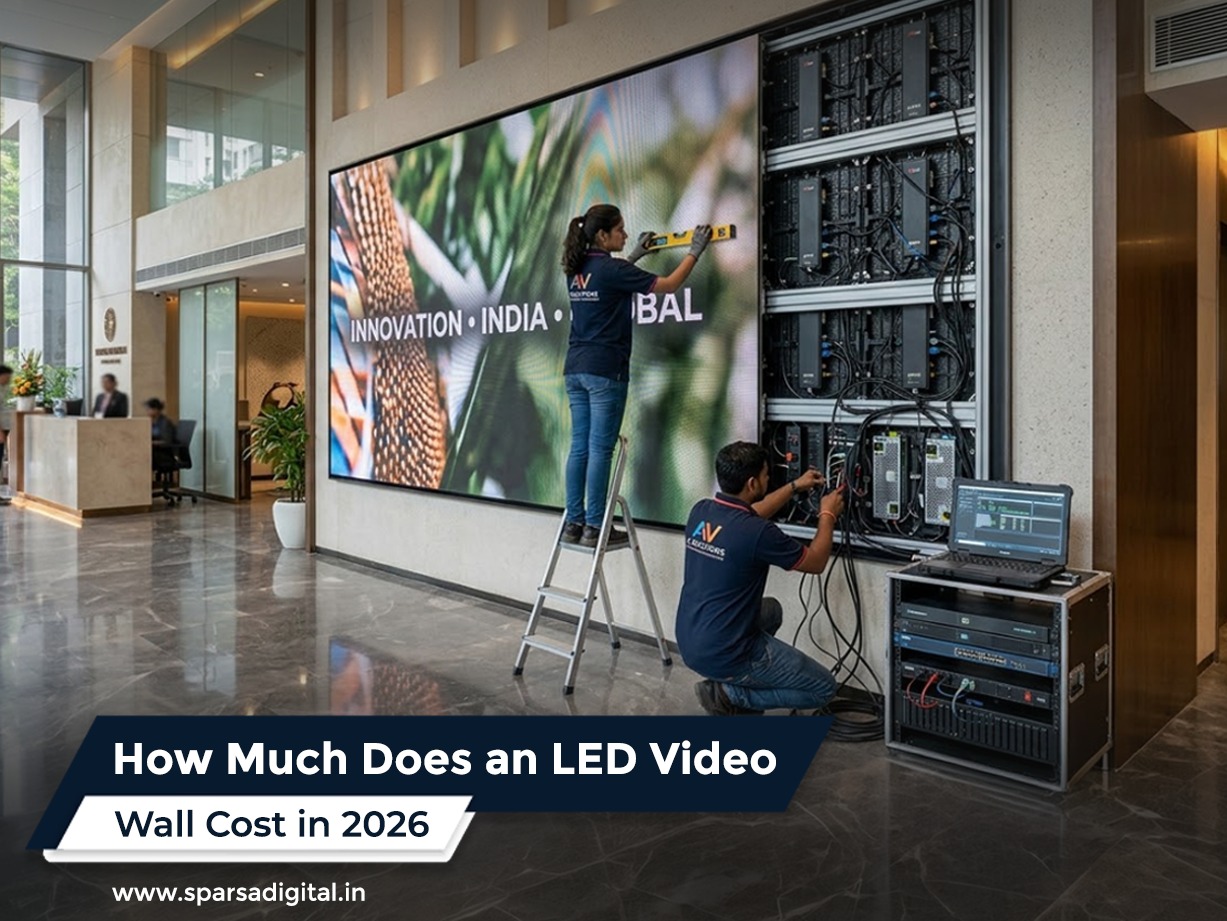
The price of an LED video wall in 2026. If you ask three vendors to quote for the same size LED wall, you’ll likely receive three very different quotes. For what appears to be the same screen on paper, one might return for ₹2 lakh, another for ₹5 lakh, and a third for ₹9 lakh.
Vendors aren’t attempting to pull a fast one. The term “LED video wall” encompasses a wide range of components, build quality, and specifications, and a single figure rarely captures the whole picture.
Why Do Quotes Differ So Much?
The majority of that spread is typically caused by a few factors.
- Origin and build quality of the panel. By far, this is the most important factor. For true quality control, long-lasting LED chips, and reliable color calibration, low-cost imported panels are far less expensive than those made by reputable manufacturers. On the first day, both panels will display a picture, but after three years, only one of them still looks good.
- Pitch of pixels. Compared to a coarser pitch, a finer pitch packs several times as many LEDs into the same space, which directly raises the cost of materials.
- Indoors versus. outside. To withstand sun, rain, and temperature fluctuations, outdoor panels require stronger cabinets, weatherproof sealing, and increased brightness, things that indoor panels do not have to deal with.
- Warranty and Brand. A well-known LED chip brand with an on-site warranty of two to three years will nearly always be more expensive than unbranded parts with an ambiguous or shortened warranty. That is typically a fair trade.
- What is contained in the quote? Certain quotes are limited to panels. Others include mounting, cabling, installation, control systems, and even content design. If you place an all-inclusive quote next to a panels-only quote, the former will appear incredibly inexpensive.
- Order scale and volume. Because fixed costs like the control system are spread across more panels, larger walls typically receive a better rate per square foot.
As you work through the numbers below, bear these six in mind. Depending on where a particular vendor falls on each range, each one changes.
Cost according to Pixel Pitch
| Pixel Pitch | Typical Price (per sq. ft, indoor) | Best Viewing Distance |
| P1.5 – P1.8 | ₹9,000 – ₹18,000+ | 1.5 – 3 m |
| P2.5 | ₹6,000 – ₹10,000 | 2.5 – 4 m |
| P3 | ₹5,000 – ₹8,000 | 3 – 5 m |
| P4 | ₹3,500 – ₹6,000 | 4 – 8 m |
| P5 – P6 | ₹2,500 – ₹5,000 | 6 – 10 m |
A quick sanity check: if the cost of a P2. 5 indoor wall is significantly less than ₹5,000 per square meter. Feet, inquire about the brand of panel, rate of refresh, and duration of warranty. A trade-off, typically in component quality or after-sales support, is almost always concealed by exceptionally low pricing at a fine pitch.
Additionally, it’s important to fight the impulse to overbuy on pitch. When viewed from six meters away, a P4 wall appears nearly identical to a P2. 5 wall, but it may be thirty to forty percent less expensive. Instead of choosing the number that sounds most impressive on the spec sheet, match the pitch to your actual room and typical viewing distance.
Screen size-based pricing
The rate per square foot is determined by pixel pitch. The total bill is determined by size. A mid-range P2. 5 or P3 indoor build, panels only, typically comes in the following sizes.
| Wall Size | Area | Estimated Cost (Panels Only) |
| 6 ft x 4 ft | 24 sq. ft. | ₹1.2 – ₹2 Lakh |
| 10 ft x 6 ft | 60 sq. ft. | ₹3 – ₹4.8 Lakh |
| 12 ft x 8 ft | 96 sq. ft. | ₹5 – ₹7.7 Lakh |
| 16 ft x 9 ft | 144 sq. ft. | ₹7.2 – ₹11.5 Lakh |
| 20 ft x 10 ft | 200 sq. ft. | ₹10 – ₹16 Lakh |
These figures do not include installation, structural mounting, or CMS software; they only cover panels and a basic control system.
Since fixed costs like the sending card and processor don’t scale in a straight line with size, larger walls are frequently slightly less expensive per square foot. However, larger installations also result in higher logistical and structural costs, which can reduce that savings, particularly on non-standard surfaces or above ground.
Costs associated with installation and structure
Because installation is frequently quoted separately or not at all until much later in the process, this is where many buyers fall victim.
- The surface is the only factor that affects structural mounting. It is simple to build a solid, flat interior wall. Real material and labor costs are increased by curved surfaces, false ceiling mounts, and outdoor billboards requiring steel framing.
- Dedicated wiring, breakers, and occasionally a separate power distribution unit for larger or outdoor walls drawing substantial power are all included in electrical work.
- Every panel is linked to the control system via data infrastructure. This may also require running cables through walls or ceilings for large or multi-room projects, which would require additional labor time.
- Anything mounted at a height is subject to rigging and safety regulations, especially large indoor walls in public areas or outdoor billboards, which may require certified rigging and safety sign-off.
- Wall size and site complexity are correlated with labor and crew size. It could require two technicians per day to complete a small indoor wall. With a larger crew and specialized lifting equipment, a large outdoor wall can become a multi-day task. Installation and structural work typically increase the cost of panels by 15–30%, with additional costs for outdoor or structurally challenging locations.
In order to see exactly what you’re paying for, always request installation as a separate, itemized line rather than combined into a single, ambiguous total.
Frequently, the quote is omitted
The panels themselves are not the source of some of the biggest budget surprises. They originate from what was not stated in the first quote. software that manages content.
Many quotes only include hardware and a simple controller. Verify whether a CMS license is included or charged separately, usually as a recurring subscription, if you want remote updates, scheduling, or multi-screen management. content production.
Content is displayed in panels, but it still needs to be designed. Budget for an ongoing content service or a one-time design fee if you don’t have an internal team.
Annual Maintenance Contract, or AMC. For a predetermined amount of time, component failure is covered under basic warranty.
Preventive inspections, routine cleaning, and recalibration are typically covered by a separate yearly contract rather than being provided automatically. extra panels.
It’s typical to have one or two extra panels for large outdoor walls on hand for prompt replacement. Sometimes this is mentioned at all, and other times it is quoted separately.
Transportation and site entry. Costs that are never included in a standard quote may be added for remote locations or installations requiring cranes or special access equipment.
GST and other levies. Verify whether tax is included in the quoted amount; if it isn’t, this could cause the final figure to change by nearly a fifth.
Ask directly, “What’s not included in this number?” before signing off. Vendors who can provide a clear, written response to this question are typically more reliable than those who only discuss round, all-inclusive figures.
Obtaining a Precise Estimate
Giving vendors enough information to provide accurate quotes and then comparing those quotes on equal terms is the only dependable way to arrive at a figure you can genuinely plan around.
Give precise measurements and location information. The suggested pitch and brightness, and consequently the price, depend on a number of factors, including indoor or outdoor, wall type, height off the ground, and ambient light.
Decide on your main viewing distance. This is the quickest way to avoid overspending on a more polished pitch than you truly require.
Request an itemized quote. panels, control system, mounting, labor for installation, software, and AMC instead of a single combined figure.
Obtain the panel’s brand and warranty details in writing rather than just orally. This is frequently where two quotes that appear similar actually differ from one another.
Before making a decision, especially for outdoor or structurally challenging projects, request site photos or a visit.
One of the most frequent causes of a final bill exceeding the estimate is unexpected site conditions. Obtain a minimum of two or three quotes for the same specification.
Finding the lowest number is only one aspect of the process; another is identifying what one vendor included that another did not, which typically provides more information than just the price. The best way to make LED video wall quotes truly comparable rather than a guessing game is still to have a well-prepared brief that you share with each vendor you approach.
FAQs
- How much should an LED video wall cost on average for a small business in India?
A small indoor wall at P2. 5 or P3 that is between 24 and 60 square feet in size will typically cost between ₹1. 2 lakh and ₹4. 8 lakh for the panels alone, plus additional costs for installation and software.
- For a retail store, is P2. 5 or P3 a better value?
P3 looks nearly as good as P2. 5 in most retail settings where patrons aren’t standing directly in front of the screen, and it does so at a significantly lower cost. For the majority of stores, it is therefore a better option.
- Does the cost of installation add to the cost of the panel?
Yes, it does. Installation, structural mounting, and electrical work typically increase the base panel cost by an additional 15-30%, depending on how complex the site is.
- Why do some quotes appear so much less expensive than others?
Lower-grade panels, a shorter warranty, or missing line items like software and installation that would be included in a more comprehensive quote are frequently indicated by a lower number on paper. The content of each quote, not just the sum at the bottom, is what truly compares.
- How much is an outdoor wall more expensive than an indoor wall?
At the same pixel pitch, anticipate about 20-40% more. This premium is used for stronger construction to withstand outdoor conditions, increased brightness, and weatherproofing.
- Is a CMS required, or does the wall come with one?
Vendors differ in this regard. Some quotes only include a basic controller, leaving scheduling and remote management as separate expenses that are sometimes set up as subscriptions. Before you sign anything, make sure you understand.
- How can one obtain a large wall at a lower cost without compromising quality?
Instead of choosing the best option on the price list, choose a pixel pitch based on how far away people will actually be. Without making the situation worse, that one choice contributes more to cost control than nearly anything else.
- How long do LED video walls last before requiring significant upkeep?
Excellent panels are designed to last for tens of thousands of hours, or about 8 to 10 years when used every day. Outdoor units are an exception, as their exposure to the weather necessitates more frequent inspections.
