
Table of contents
If you have ever stood at a traffic signal in Mumbai, walked through a mall in Bengaluru, or attended an IPL match in Hyderabad, chances are you have locked eyes with a blazing, full-colour LED advertising screen. Bright, dynamic, impossible to ignore; these screens have quietly taken over India’s advertising landscape, replacing static flex banners and painted hoardings with something far more powerful: live, updateable, attention-commanding visual communication.
By 2026, the LED display market in India is one of the fastest-growing in Asia. Falling hardware costs, the spread of 4G and 5G networks, aggressive smart city investments, and the explosion of retail, events, and out-of-home advertising have combined to make the LED advertising screen accessible to businesses far beyond the metro cities and big-budget brands that first adopted them.
What Is an LED Advertising Screen?
An LED advertising screen is an electronic display panel that uses an array of light-emitting diodes (LEDs) to produce bright, vibrant, full-colour visual content for commercial communication. The content shown including images, videos, animations, live data, can be changed remotely at any time, making these displays infinitely more flexible than any printed signage.
Unlike a consumer television, an LED advertising screen is designed for continuous commercial operation: 16 to 24 hours a day, 365 days a year, often in challenging environments. Outdoor variants resist rain, dust, heat, and humidity. Indoor variants deliver razor-sharp resolution for close-up retail viewing. Both categories share the core advantage that sets LED apart from all alternatives- the ability to show dynamic, scheduled, remotely managed content on a surface of virtually any size.
Types of LED Advertising Screens
Understanding the different types available in the Indian market is essential to choosing the right solution. Here is a comprehensive overview of every major category.
1. Outdoor Advertising LED Display Screen
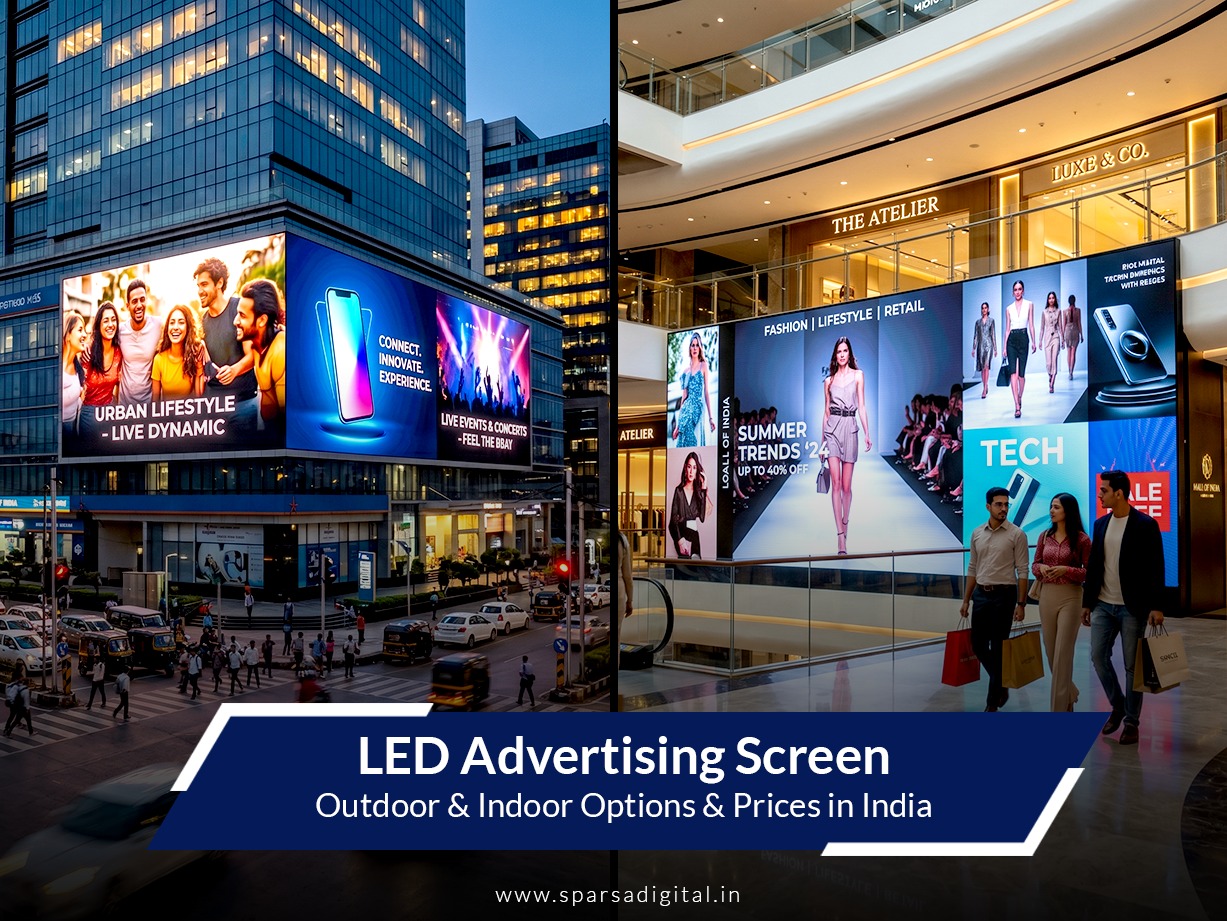
The outdoor advertising LED display screen is the most visible and iconic format in the Indian market. These are the large, luminous panels you see towering over highways, mounted on commercial building rooftops, and standing at prominent traffic junctions across every major Indian city.
Built for India’s demanding outdoor conditions – monsoon rain, coastal humidity, dust storms, and extreme summer heat, outdoor LED panels carry IP65 or higher ingress protection ratings, meaning they are fully sealed against dust and resistant to water jets from any direction.
Key technical specifications for outdoor LED displays:
- Brightness: 5,000-10,000 nits
- IP Rating: IP65 minimum; IP66 or IP67 for coastal or flood-prone zones
- Pixel Pitch: P4 through P16 (selected based on viewing distance)
- Operating Temperature: -20°C to +60°C
- Cabinet Material: Die-cast aluminium or galvanised steel
- Viewing Angle: 140°-160° horizontal and vertical
- Power Consumption: 300W-800W per sq. m. at maximum load
Outdoor LED screens in India are modular. Standard cabinet sizes such as 960mm × 960mm or 500mm × 1,000mm are assembled in grids to create the final screen. This modular approach also simplifies maintenance, since a faulty cabinet can be swapped out without shutting down the rest of the display.
Primary applications in India: Highway hoardings, building rooftop displays, traffic junction boards, petrol station forecourt signs, stadium perimeter screens, airport exteriors, railway station facades.
2. Outdoor LED Advertising Screen for Building Facades
A specialised and increasingly popular format, the outdoor LED advertising screen for building facades integrates directly into the exterior architecture of commercial buildings. These installations transform the building itself into an advertising medium, creating landmark visual identities that draw attention from hundreds of metres away.
Cities like Mumbai’s BKC, Delhi’s Connaught Place and Aerocity, Bengaluru’s MG Road, and Hyderabad’s Hitech City have seen a wave of such installations as premium commercial real estate developers compete for tenant brands and public attention.
Facade LED screens are often built using transparent LED or mesh LED technology. Panels with a significant proportion of open space between LED nodes, allowing natural light and air to pass through. This reduces the structural load on the building, maintains ventilation, and allows the glass facade behind the screen to remain partially visible during the day. At night, the open mesh becomes invisible and the screen appears solid and vibrant.
Typical pixel pitches for facade applications range from P10 to P25, since these screens are designed to be viewed from 30 to 200 metres away. Extremely fine resolution at those distances would be an expensive irrelevance.
Primary applications in India: Luxury commercial towers, hotel facades, entertainment complexes, shopping mall exteriors, brand headquarters.
3. Indoor LED Advertising Screen
The indoor LED advertising screen brings the same dynamic, high-impact visual communication to enclosed environments including retail stores, corporate offices, hotel lobbies, airports, hospitals, educational institutions, and event venues.
Because indoor environments are controlled for lighting, indoor LED panels do not need the extreme brightness of outdoor displays. Instead, they prioritise resolution, using much finer pixel pitches to deliver crisp, detailed imagery suitable for viewers standing 1 to 8 metres from the screen.
Key technical specifications for indoor LED screens:
- Brightness: 800-2,000 nits
- Pixel Pitch: P1.2 through P4 (the finer the pitch, the higher the resolution)
- Refresh Rate: 3,840 Hz or above (essential for broadcast quality video and photography)
- Cabinet Construction: Lightweight aluminium, front or rear serviceable
- Viewing Angle: 160°+ for wide coverage in large spaces
Indoor LED screens are commonly used in video wall configurations. Multiple cabinets tiled together to create seamless, large-format visual surfaces. Unlike LCD video walls, which have physical bezels (frames) between panels, LED video walls are completely seamless. This makes them the preferred choice wherever absolute visual continuity is required.
Primary applications in India: Retail flagship stores, shopping mall atriums, hotel ballrooms and lobbies, corporate experience centres, conference centres, bank branches, entertainment venues, broadcast studios, command and control rooms.
4. LED Screens for Events
LED screens for events represent one of the most dynamic and commercially vibrant segments of the Indian LED display market. India’s events industry which encompasses IPL and ISL matches, national and international concerts, corporate conferences, political rallies, trade expositions, and one of the world’s largest wedding markets, runs on rented LED display infrastructure.
Event LED panels are purpose-engineered for rapid deployment and dismantling. They differ from permanent installation panels in several important ways:
- Ultra-light cabinets: Most weigh under 7 kg per panel for manual handling without cranes
- Tool-free assembly: Magnetic or quick-lock connectors allow panels to be assembled into large screens in under an hour
- Die-cast magnesium alloy frames: Balance structural rigidity with minimal weight
- Front and rear serviceability: Fast module replacement during live events without disassembling the whole screen
- High refresh rates: 3,840 Hz or above for flicker-free broadcast camera coverage
Common configurations for Indian events include main stage screens of 12m × 6m to 20m × 10m, supplementary side-fill screens at 45-degree angles, and IMAG (Image Magnification) screens positioned to give rear audiences a close-up view of performers or speakers.
Pixel pitches range from P2.6 to P3.9 for close-viewing stage screens, and P4.8 to P6 for large venue fill screens viewed from 15 metres or more.
Primary applications in India: Concert stage backdrops, IPL match screens, corporate conferences and product launches, political rallies and public events, wedding functions, trade show exhibition stands, religious gatherings and yatras.
5. Digital Signage Display (Commercial LED Format)
The term digital signage display covers a broad category of commercial display solutions, but LED-based digital signage has become increasingly dominant in applications that previously relied on LCD technology, particularly where brightness, seamless tiling, or large format are priorities.
Within LED-based digital signage, several specialised formats have emerged in the Indian market:
LED poster displays are slim, freestanding panels that function as digital alternatives to traditional printed standees. Typically 75 to 98 inches in height and available in portrait or landscape orientation, they are widely used in malls, airports, and retail stores.
Transparent LED displays are built using special LED modules where the PCB (printed circuit board) is extremely thin, creating a 30% to 70% transparent panel. When mounted on glass windows or facades, they can show vivid content without fully blocking the view through the glass, transforming shop windows and glass walls into advertising surfaces.
COB (Chip-on-Board) LED displays use a newer packaging technology where the LED chips are bonded directly to the PCB and encapsulated in a protective layer, rather than being individually housed in an SMD package. COB displays offer superior contrast, reduced reflection, better impact resistance, and higher quality at ultra-fine pixel pitches, making them popular for premium indoor retail and corporate applications.
Primary applications in India: Retail chain stores, QSR menu boards, pharmacy chains, airport concourses, corporate reception areas, hospital lobbies, showrooms, and hospitality venues.
6. Advertising Boards (Digital Replacements for Static Hoardings)
Traditional advertising boards like static flex banners, painted walls, backlit displays, and tin hoardings are being systematically replaced by LED displays across India’s urban landscape. This is driven by both commercial logic and regulatory trends.
From a commercial standpoint, a single LED advertising board can host 6 to 12 advertisers in rotation, with each slot priced individually. This means the site owner earns several times the revenue of a static hoarding occupying the same physical space. Advertisers benefit from the ability to run time-sensitive campaigns, update creative instantly, and target specific dayparts.
From a regulatory standpoint, several Indian municipal corporations have introduced digital advertising policies that cap the number of static hoardings while permitting or even incentivising digital LED displays as part of urban beautification and smart city programmes. Cities like Mumbai, Pune, Ahmedabad, and Hyderabad have been active in this space.
Primary applications: Commercial hoardings in shopping districts, highway advertising, transit route advertising, mall perimeter boards, sports venue perimeter advertising.
LED Advertising Screen Prices in India (2026)
Pricing varies significantly by type, pixel pitch, brand, and installation complexity. The figures below are realistic indicative ranges for the Indian market in 2026.
Indoor LED Screen Prices
| Pixel Pitch | Typical Application | Price per Sq. Metre (Approx.) |
| P1.2 – P1.5 | Boardrooms, broadcast studios, premium retail | ₹80,000 – ₹1,60,000 |
| P1.8 – P2.5 | Corporate lobbies, flagship stores, malls | ₹35,000 – ₹80,000 |
| P3 – P4 | Stage backdrops, hotel ballrooms | ₹18,000 – ₹40,000 |
| P5 – P6 | Large indoor auditoriums, exhibition halls | ₹10,000 – ₹20,000 |
Outdoor LED Screen Prices
| Pixel Pitch | Typical Application | Price per Sq. Metre (Approx.) |
| P3 – P4 | Petrol station signs, retail frontage | ₹40,000 – ₹75,000 |
| P5 – P6 | Commercial hoardings, stadium perimeters | ₹22,000 – ₹45,000 |
| P8 – P10 | Highway hoardings, large outdoor sites | ₹12,000 – ₹25,000 |
| P12 – P16 | Very large building facades, long-range viewing | ₹7,000 – ₹14,000 |
Event LED Screen Rental Prices
| Screen Size | Rental (Per Day, Approx.) |
| Up to 12 sq. m (e.g., 4m × 3m) | ₹12,000 – ₹35,000 |
| 12-30 sq. m (e.g., 6m × 4m) | ₹30,000 – ₹75,000 |
| 30-60 sq. m (e.g., 8m × 6m) | ₹65,000 – ₹1,30,000 |
| 60-120 sq. m | ₹1,20,000 – ₹2,80,000 |
| 120+ sq. m (large concerts, rallies) | ₹2,50,000 – ₹10,00,000+ |
Rental prices are for the screen only. Installation, rigging, operator, content management, and transport may be charged separately. Prices vary by city and season- October through March is the peak event season in India.
Top LED Advertising Screen Brands Available in India
The Indian market is served by brands across several tiers:
Premium Tier: Absen, Leyard, Unilumin, Barco, Daktronics used for flagship installations at international airports, five-star hotels, and major stadiums. Backed by comprehensive warranties and professional service networks.
Mid-Range Tier: Liantronics, Ledman, Retop, Radiant- quality products at competitive price points, widely used by system integrators for commercial hoarding networks and corporate deployments.
India-Based Suppliers: Xtreme Media, Syberry, Magnus, Mirackle- these companies either assemble locally using imported modules or represent international brands. They typically offer strong local technical support, which is invaluable for large networks spread across multiple cities.
Direct-Import / Budget Tier: Numerous Shenzhen-based manufacturers supply directly to Indian buyers via platforms like Alibaba and IndiaMART. Pricing is competitive but buyers need technical competence to evaluate quality, manage shipping and customs, and handle maintenance without a local service network.
How to Choose the Right LED Advertising Screen
Follow this structured process to avoid costly mistakes:
Step 1 : Define the environment. Outdoor or indoor? This determines brightness, IP rating, and cabinet construction. An indoor panel used outdoors will fail within months.
Step 2 : Establish the viewing distance. The minimum comfortable viewing distance for an LED screen is approximately equal to the pixel pitch in millimetres multiplied by 1,000. A P8 panel is ideally viewed from 8 metres or more; a P2 panel delivers sharp imagery from just 2 metres.
Step 3 : Size the screen correctly. Calculate based on the viewing area, content layout, and structural constraints. Oversizing wastes capital; undersizing reduces visual impact.
Step 4 : Decide on content and playback requirements. Static brand messaging needs only a basic media player. Full-motion video with live data overlays needs a higher-spec control system. Multi-screen networks need a robust CMS.
Step 5 : Calculate total cost of ownership. Hardware + installation + civil and structural work + power supply and electrical work + CMS licence + connectivity + annual maintenance. The panel itself is often only 40-60% of the total project cost.
Step 6 : Check regulatory requirements. Outdoor displays in Indian cities require municipal permissions. Some locations need additional clearances from traffic police, NHAI (for highway sites), or the Airports Authority of India (AAI) for installations near flight paths.
Step 7 : Evaluate suppliers rigorously. Request references, arrange site visits to existing installations, clarify warranty coverage (typically 2-3 years for cabinets, 1 year for modules and power supplies), and confirm local spare parts availability and service response times.
Frequently Asked Questions (FAQs)
Q1. What is an LED advertising screen and how is it different from a regular display?
An LED advertising screen is a commercial-grade display built for continuous operation, typically 16 to 24 hours a day, using LED technology to produce bright, vivid, dynamic content for advertising and communication. Unlike a consumer TV or monitor, it is designed for demanding environments, supports remote content management, and can be tiled into any size. It is available in outdoor-rated variants that withstand India’s weather conditions.
Q2. What is the best pixel pitch for an outdoor LED advertising screen in India?
It depends on the viewing distance. For highway hoardings viewed from 15 metres or more, P8 to P10 is a practical and cost-effective choice. For commercial hoardings in shopping districts viewed from 6-12 metres, P5 to P6 delivers sharper imagery. For retail frontage or petrol stations where viewers pass within 3-5 metres, P3 to P4 is appropriate.
Q3. How much does an outdoor LED advertising screen cost in India in 2026?
Outdoor LED panels in India cost approximately ₹12,000 to ₹75,000 per square metre depending on pixel pitch, brand, and specification. A complete turnkey installation, including the panel, structure, electrical work, and CMS for a standard P8 highway hoarding of 12 sq. m. would typically cost ₹4,00,000 to ₹9,00,000 in 2026.
Q4. What are LED screens for events, and can I rent them?
Event LED screens are lightweight, modular panels designed for rapid setup and dismantling at concerts, conferences, sports events, weddings, and political rallies. Yes, rental is widely available across India through event production companies and LED display rental specialists. Rental prices range from approximately ₹12,000 to ₹10,00,000+ per day depending on screen size and location.
Q5. How long does an LED advertising screen last?
Quality LED modules are rated for 50,000 to 100,000 hours of operational life. Running a screen for 12 hours per day, that translates to approximately 11 to 22 years before LEDs reach half their original brightness (the industry standard for measuring LED lifespan). Peripheral components like power supplies and control cards typically need replacement every 5-8 years. With proper maintenance, a well-installed LED advertising screen should give reliable service for 8-12 years.
Q6. What content formats can I show on an LED advertising screen?
LED advertising screens can display full-motion video (MP4, MOV, AVI), static images (JPEG, PNG), animated graphics (GIF), live HDMI inputs (for real-time event feeds or broadcast content), HTML5 dynamic templates (for live data like weather, scores, prices), and multi-zone layouts combining different content types on a single screen. Content is typically managed via a cloud-based CMS that enables scheduling, remote updates, and performance monitoring.
Q7. What is programmatic DOOH and is it relevant in India?
Programmatic DOOH (Digital Out-of-Home) is the automated, real-time buying and selling of advertising slots on digital outdoor screens, using audience data, location context, and competitive bidding, similar to how online display advertising works. Yes, it is active and growing in India’s major metro cities, with several platform providers connecting outdoor screen networks to programmatic demand-side platforms (DSPs). It is most developed in Mumbai, Delhi NCR, and Bengaluru.
Q8. Can an LED advertising screen operate without an internet connection?
Yes. Many LED displays operate using a local media player with pre-loaded content, requiring no active internet connection for playback. However, internet connectivity is required for remote content updates via a cloud CMS, live data feeds, real-time monitoring, and programmatic ad serving. For installations in remote locations, 4G-based connectivity via a SIM card in the control unit is a practical solution.
Q9. What is the difference between SMD and COB LED technology?
SMD (Surface Mounted Device) is the conventional LED packaging technology where individual LED chips are housed in tiny plastic packages mounted on the PCB. COB (Chip-on-Board) bonds the LED chips directly to the PCB and encapsulates them in a single protective layer. COB offers better contrast (no reflection from individual LED housings), improved uniformity, higher resistance to physical damage, and superior performance at very fine pixel pitches. COB displays cost more but are increasingly preferred for premium fine-pitch indoor applications.
Q10. Which sectors use LED advertising screens the most in India?
The highest-volume users of LED advertising screens in India are outdoor advertising operators (DOOH networks), retail chains and shopping malls, the events and entertainment industry (concerts, sports, weddings), corporate campuses and hospitality groups, transportation infrastructure (airports, metro systems, railways), and government and smart city projects. The events sector and outdoor advertising are currently experiencing the strongest growth in 2026.
Conclusion
The LED advertising screen has evolved from a premium novelty into a mainstream commercial infrastructure across India. Whether you need an outdoor advertising LED display screen to command attention on a busy highway, an indoor digital signage display for a flagship retail store, or a large-format LED screen for events that will light up a concert stage, the technology is mature, the supply chain is well-established, and the pricing in India in 2026 is more accessible than ever.
Success with LED advertising comes down to matching the right technology to the right environment, understanding total cost of ownership beyond the panel price, choosing a supplier with genuine local support capability, and keeping up with regulatory requirements. Do those things well, and an LED advertising screen is not just an expense- it is a durable, high-impact asset that delivers measurable commercial returns for years.
India’s digital advertising screen revolution has only just begun. The screens are getting smarter, the content more targeted, and the business case stronger with every passing year. The question is not whether to invest; it is where to start.
