

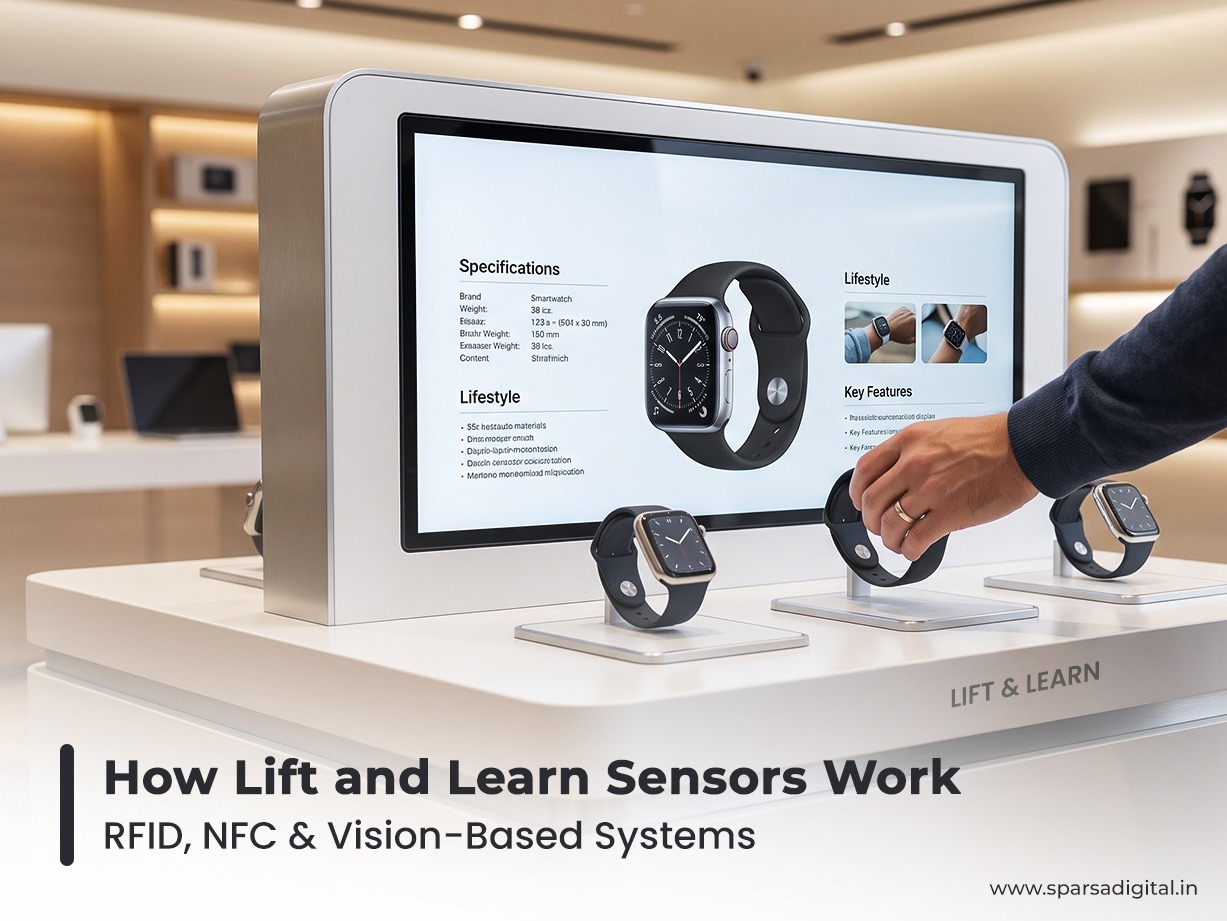
When a shopper picks up a product and a nearby screen instantly comes to life with videos, pricing, or specs, it feels almost magical. But there’s no magic involved, only carefully engineered hardware working behind the scenes. At the heart of every interactive shelf experience are lift and learn sensors, the components responsible for detecting the moment a product leaves the shelf and triggering the right content in response.
Understanding how these sensors work helps retailers, brands, and technology teams choose the right system for their stores. Not all sensor technologies are created equal. Some rely on radio waves, others on light, and some on cameras and computer vision. Each comes with its own strengths, limitations, and ideal use cases.
What Are Lift and Learn Sensors?
Lift and learn sensors are the detection components embedded in or around retail shelving that identify when a product has been picked up, moved, or returned. They form the foundation of any interactive shelf display system, translating a simple physical action, a hand reaching for a product, into a digital signal that triggers content on a nearby screen.
Without accurate, fast sensors, the entire lift and learn experience falls apart. If detection is slow, unreliable, or misidentifies products, the interactive experience feels broken rather than impressive. That’s why sensor technology is often the most critical design decision retailers make when implementing these systems.
There are three primary categories of sensors used in modern lift and learn retail deployments:
- RFID-based sensors
- NFC-based sensors
- Vision-based (camera and computer vision) systems
Let’s explore each in detail.
RFID-Based Lift and Learn Sensors
What Is RFID?
RFID stands for Radio Frequency Identification. It’s a wireless technology that uses radio waves to identify and track tags attached to objects. In retail settings, small RFID tags are attached to individual products or product packaging, while RFID readers are installed on or near the shelf.
How RFID Lift and Learn Sensors Work
Each product carries a unique RFID tag containing an identifying code. When a shelf-mounted RFID reader detects that a tagged product has moved out of range, or when the tag’s signal strength changes as the item is lifted, the system recognizes the action instantly.
Here’s a simplified breakdown of the process:
- Tagging: Every product on the shelf has an RFID tag, either embedded in packaging or attached as a label.
- Continuous scanning: The RFID reader continuously scans for tags within its range.
- Signal change detection: When a product is lifted, the tag moves away from the reader, causing a measurable change in signal strength or complete signal loss.
- Product identification: The system matches the tag’s unique ID to a specific product in its database.
- Content trigger: Once identified, the connected display shows relevant content for that exact product.
Advantages of RFID Sensors
- High accuracy for individual SKUs: Because each tag is unique, RFID systems can distinguish between very similar products, such as different colors or sizes of the same item.
- Reliable detection range: RFID doesn’t require direct line of sight, so tags can be detected even if partially obscured.
- Scalable across large inventories: Retailers with many SKUs can tag each product individually without needing separate physical sensors for every position.
Limitations of RFID Sensors
- Tagging cost and labor: Every individual product needs a tag applied, which adds cost and time, especially for high-volume, low-cost items.
- Signal interference: Metal shelving, liquids, or dense packaging materials can sometimes interfere with radio signals.
- Tag durability: Tags can be damaged, removed, or degraded over time, especially in high-traffic retail environments.
RFID tends to work best in categories where individual product tracking matters most, such as electronics, cosmetics, or premium goods, where retailers already use RFID for inventory management and can extend that same tagging infrastructure to power lift and learn experiences.
NFC-Based Lift and Learn Sensors
What Is NFC?
NFC, or Near Field Communication, is a short-range wireless technology closely related to RFID but designed for very close proximity interactions, typically within a few centimeters. NFC is the same technology used in contactless payments and smartphone tap-to-pay systems.
How NFC Lift and Learn Sensors Work
Unlike RFID, which can detect signals from a distance, NFC requires very close contact between the tag and reader. In lift and learn applications, NFC is often used slightly differently than RFID:
- NFC tags embedded in shelf positions or products: Tags are placed either on the product itself or at specific shelf slots.
- Proximity-based triggering: When a shopper’s device or a product-embedded tag comes close to a reader, the system registers an interaction.
- Data exchange: The NFC reader retrieves the tag’s stored information, identifying the exact product or shelf position.
- Display activation: Relevant content appears on the connected screen based on the identified tag.
Where NFC Fits in Retail
NFC is less commonly used than RFID for pure lift-detection because of its short range, but it plays a valuable role in specific scenarios:
- Shopper-initiated interactions: Some retailers use NFC to let shoppers tap their smartphones near a product to pull up additional information, effectively combining lift and learn concepts with personal device engagement.
- Shelf-edge tagging: NFC tags placed at fixed shelf positions can detect when a product is removed from that specific slot, useful in smaller, tightly controlled displays.
Advantages of NFC Sensors
- Low interference: Because of its short range, NFC experiences less signal crosstalk compared to RFID in dense shelf environments.
- Smartphone compatibility: Most modern smartphones have built-in NFC readers, enabling direct shopper interaction without additional hardware.
- Cost-effective for small deployments: NFC tags are generally inexpensive and simple to deploy for smaller product sets.
Limitations of NFC Sensors
- Very short range: NFC’s proximity requirement makes it less practical for detecting lifts across a wide shelf area compared to RFID.
- Slower scanning for large inventories: NFC isn’t ideal for simultaneously tracking many products across a large shelf space.
- Limited use for passive detection: Since NFC often requires an active tap or very close proximity, it’s less suited for fully automatic, hands-free lift detection compared to RFID or vision-based systems.
Vision-Based Lift and Learn Sensors
What Are Vision-Based Systems?
Vision-based lift and learn sensors use cameras and computer vision algorithms instead of radio-based tags to detect product movement. Rather than relying on a physical tag attached to each item, these systems visually monitor the shelf and use image recognition to identify when and which product has been picked up.
How Vision-Based Sensors Work
- Camera installation: Small cameras are mounted above, below, or within the shelving unit, providing a clear view of product positions.
- Continuous image analysis: Computer vision software continuously analyzes the shelf, tracking product positions in real time.
- Movement detection: When a product is removed, the software detects the visual change, an empty space appearing where the item once sat.
- Product recognition: Using image recognition models, the system identifies which specific product was removed based on its appearance, shape, or shelf position.
- Content trigger: The identified product’s information is sent to the nearest display.
Advantages of Vision-Based Systems
- No tagging required: Since detection relies on visual recognition rather than physical tags, there’s no need to individually tag every product, reducing labor and material costs.
- Rich behavioral data: Cameras can capture additional shopper behavior data, such as how long someone hovers near a shelf before picking up an item, or whether multiple products are compared side by side.
- Flexible for changing inventory: Since there’s no physical tagging step, vision systems can adapt more easily to frequently rotating product lines or seasonal displays.
Limitations of Vision-Based Systems
- Lighting sensitivity: Poor lighting conditions or reflective packaging can sometimes affect detection accuracy.
- Higher computational requirements: Real-time image processing requires more processing power compared to simple signal-based detection.
- Privacy considerations: Because cameras are involved, retailers must carefully manage data privacy and ensure compliance with relevant regulations regarding in-store surveillance and shopper data collection.
- Initial setup complexity: Calibrating cameras and training recognition models for accurate detection can require more upfront technical work compared to RFID or NFC systems.
Vision-based systems are increasingly popular in flagship or innovation-focused retail environments where the added behavioral insight and flexibility outweigh the higher setup complexity.
Comparing RFID, NFC, and Vision-Based Sensors
| Feature | RFID | NFC | Vision-Based |
| Detection Range | Medium to long | Very short | Wide (camera-dependent) |
| Tagging Required | Yes | Yes | No |
| Setup Complexity | Moderate | Low | High |
| Best For | Large SKU inventories | Small, controlled displays | Flexible, tag-free environments |
| Data Richness | Moderate | Low | High |
| Interference Risk | Moderate | Low | Lighting-dependent |
Choosing the Right Lift and Learn Sensor Technology
There’s no single “best” sensor technology for every retail environment. The right choice depends on several factors:
Store Size and Product Volume
Large stores with thousands of SKUs often benefit from RFID’s scalability, while smaller, curated displays might do well with NFC or vision-based systems.
Budget Considerations
RFID and NFC require tagging costs per product, which can add up quickly for high-volume, low-cost items. Vision-based systems avoid tagging costs but require more investment in cameras and processing infrastructure upfront.
Desired Data Depth
If a retailer wants deep behavioral insights, such as dwell time, comparison behavior, or hesitation patterns, vision-based systems typically provide richer data compared to signal-based detection alone.
Product Type
Products with metal packaging or liquid content may interfere with RFID signals, making vision-based detection a more reliable alternative in those categories.
Existing Infrastructure
Retailers that already use RFID for inventory management may find it more cost-effective to extend that same tagging system to power lift and learn experiences rather than investing in an entirely separate technology.
The Role of Hybrid Sensor Systems
Increasingly, retailers are combining multiple sensor types to overcome individual limitations. For example, a store might use RFID for accurate product identification while layering in vision-based cameras to capture additional shopper behavior data like dwell time and hesitation patterns.
These hybrid approaches allow retailers to get the best of both worlds: precise identification from radio-based tagging alongside rich behavioral insight from computer vision, creating a more complete picture of shopper interaction at the shelf.
Final Thoughts
The experience of picking up a product and instantly seeing relevant information appear on a screen feels seamless to shoppers, but it relies on carefully chosen sensor technology working precisely behind the scenes. Whether a retailer chooses RFID, NFC, vision-based systems, or a hybrid combination, the goal remains the same: accurately detecting product interaction and delivering the right content at exactly the right moment.
As lift and learn sensors continue to evolve, expect increasing integration between these technologies, along with advances in artificial intelligence that make product recognition faster, cheaper, and more reliable across every category of retail.
Frequently Asked Questions (FAQs)
1. What are lift and learn sensors?
Lift and learn sensors are detection devices, such as RFID readers, NFC tags, or cameras, used to identify when a shopper picks up a product from a shelf, triggering relevant content on a nearby display.
2. How does RFID work in lift and learn systems?
RFID tags attached to products communicate with nearby readers using radio waves. When a tagged product is lifted, the reader detects a change in signal strength, identifies the specific product, and triggers the appropriate display content.
3. What is the difference between RFID and NFC sensors?
RFID can detect signals from a greater distance, making it suitable for scanning entire shelves, while NFC requires very close proximity, typically just a few centimeters, making it better suited for direct taps or smaller, controlled interactions.
4. Do vision-based lift and learn systems require tags on products?
No. Vision-based systems use cameras and computer vision algorithms to visually detect when a product is removed, eliminating the need for physical tags on each item.
5. Which sensor type is most accurate for large retail inventories?
RFID is generally considered the most scalable and accurate option for large inventories, since each product carries a unique tag that allows precise identification even among similar items.
6. Can lighting affect vision-based lift and learn sensors?
Yes. Poor lighting conditions or highly reflective packaging can sometimes reduce the accuracy of camera-based detection systems, making proper lighting design an important consideration during installation.
7. Are there privacy concerns with vision-based lift and learn sensors?
Since vision-based systems use cameras, retailers must ensure compliance with relevant data privacy regulations and clearly communicate how any collected data is used, particularly if shopper images are processed or stored.
8. Can retailers combine multiple sensor technologies?
Yes. Many retailers use hybrid systems, combining RFID for accurate product identification with vision-based cameras for deeper behavioral insights like dwell time and comparison patterns.
9. Which lift and learn sensor type is most cost-effective?
NFC tends to be the most affordable option for small, controlled displays, while RFID and vision-based systems each carry different cost considerations depending on inventory size and desired data depth.
10. How do retailers choose between RFID, NFC, and vision-based systems?
The right choice depends on factors like store size, product volume, budget, desired data richness, and whether existing infrastructure like RFID inventory systems can be extended to support lift and learn experiences.