

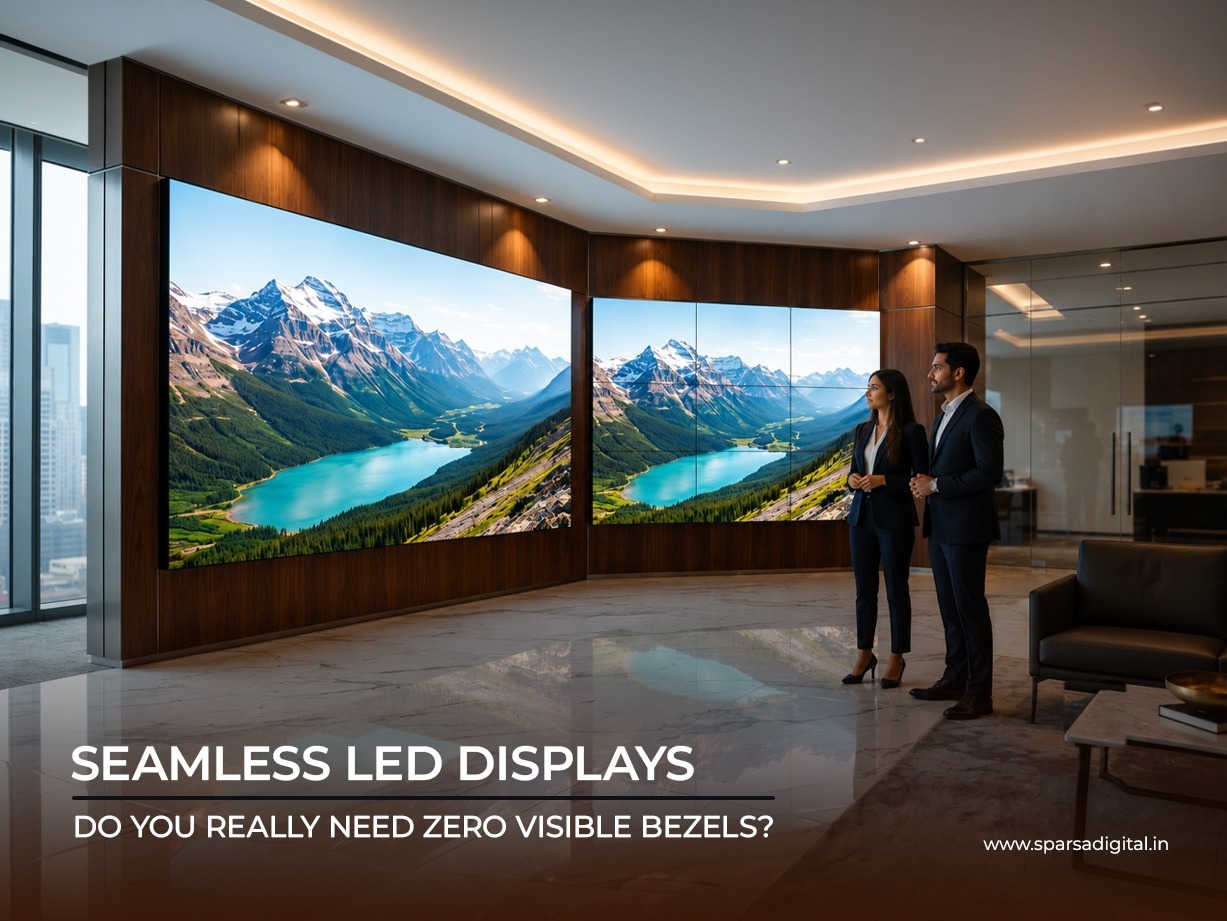
Walk into any AV showroom and you’ll hear the word “seamless” thrown around a lot. It sounds like the obvious upgrade, who wouldn’t want a display with zero visible lines? But seamless panels come at a real cost premium, and for a lot of installations, that cost buys you very little practical benefit. Before you spec a seamless LED display into your next project, it’s worth understanding exactly what the term means, where it actually matters, and where a standard panel will do the job just as well.
What “Seamless” Actually Means
In LED display terminology, a “seam” is the visible line where two cabinets or modules meet. Every large-format LED video panel is built from smaller tiles, typically 500mm or 600mm square cabinets, joined edge to edge to form one continuous image. On a standard panel, the mechanical frame around each cabinet creates a thin gap, usually somewhere between 0.5mm and 1mm, where the border between tiles is visible, especially on light-colored or white content.
A seamless LED display uses cabinet designs engineered to eliminate that gap almost entirely, often down to a fraction of a millimeter, achieved through precision-machined edges, magnetic alignment systems, and tighter mechanical tolerances during manufacturing. Some ultra thin LED display products go a step further, combining seamless tiling with slim cabinet depths (sometimes under 30mm) to create a display that looks less like a video wall and more like a single flat panel, similar to a giant television.
It’s worth being clear about what seamless does not mean. It doesn’t mean there are no lines at all under any viewing condition at close range, under bright light, or on certain content, you may still notice faint divisions if you look for them. What it means is that the seams are minimized to the point where, at normal viewing distances, the image reads as one continuous surface rather than a grid of tiles. This is different from pixel pitch, which refers to the distance between individual LEDs and determines image resolution and optimal viewing distance. A display can have a fine pixel pitch and still have visible cabinet seams, or a coarser pitch with a genuinely seamless build. They’re solving two different problems, and it’s easy to conflate them when comparing spec sheets.
Where Seams Matter Most (and Where They Don’t)
The value of a seamless build depends almost entirely on viewing distance and content type- not on the venue itself.
Where seams matter most:
- Close-viewing indoor LED display installations: Lobby walls, retail storefronts, reception desks, and boardrooms where people stand within a few feet of the screen. At close range, even a hairline gap between cabinets is noticeable, and on solid-color or white backgrounds it can look distracting.
- Content with large flat color fields: Corporate branding walls, artistic installations, or displays showing simple graphics and typography. Seams show up most on uniform backgrounds; busy video content tends to camouflage them naturally.
- Architectural or design-forward installations: A wall mounted LED display meant to look like a piece of furniture or architecture, rather than an obvious “screen,” benefits from the illusion that seamless construction provides.
Where seams matter far less:
- Control rooms and command centers, where operators care about data clarity and uptime, not aesthetic continuity, and where budgets are usually already stretched across redundancy and processing hardware.
- Large venue screens viewed from a distance: Stadiums, concert stages, and outdoor plazas, where viewers are 20+ feet away and seams are visually imperceptible regardless of panel type.
- Fast-moving video content, like sports broadcasts or motion graphics, where the eye is tracking movement rather than scanning for construction lines.
- Rental and staging applications, where panels are assembled and struck repeatedly, and where a small amount of visible framing rarely bothers an audience focused on the event itself.
A useful rule of thumb: if people will stand closer to the display than its recommended minimum viewing distance, seams will be visible and worth addressing. If they won’t, you’re likely paying for an upgrade nobody in the room will ever notice.
Cost Difference vs Standard Panels
Seamless construction isn’t a firmware setting or a finishing touch. It’s a manufacturing discipline that touches the cabinet design, the mold tooling, and the assembly process. That shows up directly in price.
As a general range, seamless LED display panels run 20% to 40% more than standard cabinets at the same pixel pitch and specification, though the gap varies by manufacturer and by how thin the cabinet is. Ultra thin LED display products that combine seamless tiling with slim depth and lightweight materials sit at the higher end of that range, since they require additional engineering to maintain structural rigidity without the bulk of a standard frame.
That premium isn’t just about the visible seam, it typically comes bundled with tighter overall manufacturing tolerances, which can mean better color and brightness uniformity across the wall, and sometimes tool-free or magnetic front-service designs that make maintenance faster. So you’re not paying purely for a cosmetic feature; you’re often getting a better-built product across several dimensions at once.
The practical question isn’t “is seamless better”, it almost always is, on paper. The question is whether that improvement is worth the added line-item cost for your specific installation. For a video wall in a busy lobby that thousands of people will walk past and glance at from ten feet away, the seamless upgrade is often hard to justify. For a curated brand experience where someone will be standing arm’s length from the screen, it usually pays for itself in the impression it leaves.
Best Use Cases for Seamless Displays
Seamless panels earn their premium in specific, predictable scenarios:
- Retail and hospitality brand walls. Flagship stores, hotel lobbies, and restaurant feature walls are built to be looked at up close, often photographed, and judged on polish. A visible grid pattern undercuts the premium feel these spaces are designed to create.
- Broadcast and virtual production backgrounds. Camera lenses are far less forgiving than the human eye. Seams that are invisible in person can become obvious once a display is captured on camera, particularly in close-up or moving shots, making seamless construction close to a requirement in these settings.
- Executive boardrooms and briefing centers. These rooms are small, well-lit, and viewed at close range by a small, attentive audience; exactly the conditions where cabinet seams are most visible and most likely to be noticed.
- Museum, gallery, and experiential installations. Where the display itself is part of the visual composition, not just a screen showing content, seamlessness contributes directly to the design intent.
- Curved or shaped video walls. Non-flat installations already draw the eye to the display’s construction; keeping seams minimal helps the shape read as intentional rather than assembled from parts.
Outside of these categories- control rooms, large-venue screens, rental staging, distant-viewing digital signage- a standard LED video panel at the right pixel pitch will deliver the same visual impact for less money, and that budget is often better spent on brightness, processing, or redundancy instead.
FAQs
- Is a seamless LED display the same as a “borderless” or “gapless” display?
Yes, these terms are generally used interchangeably by manufacturers to describe the same feature: minimized visible gaps between adjacent LED cabinets or modules.
- Does seamless construction affect image quality or resolution?
Not directly. Seamlessness is a mechanical and cosmetic property of the cabinet design, while resolution is determined by pixel pitch. A seamless display isn’t automatically sharper, it’s just built so the tiling is less visible.
- Can seamless panels be serviced as easily as standard panels?
It depends on the manufacturer. Many seamless designs use magnetic or tool-free front-access panels specifically to offset the tighter fit tolerances, which can make servicing just as fast, or faster, than standard cabinets. It’s worth confirming service access during the spec process rather than assuming.
- Is an ultra thin LED display always seamless, or vice versa?
No. Thinness (cabinet depth) and seamlessness (gap between tiles) are separate design characteristics. Many ultra thin panels are also seamless, since both target a cleaner aesthetic, but you can find products with just one feature or the other.
- How do I know if seamless is worth it for my project?
Start with viewing distance and content type. If viewers will regularly stand within a few feet of the display and it will show static or brand-focused content, seamless is usually worth the premium. If the display will be viewed from a distance or dominated by fast-moving video, a standard panel will typically look just as good for meaningfully less cost.