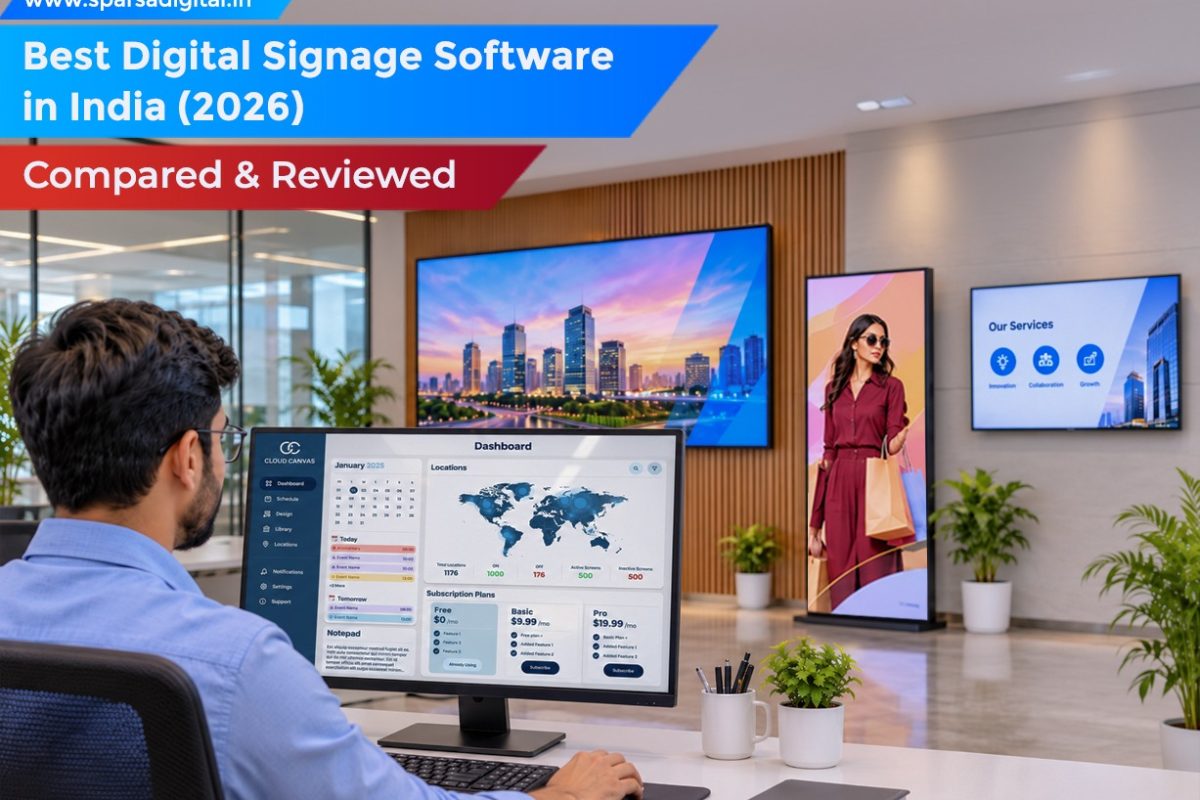
Best Digital Signage Software in India (2026): Compared & Reviewed

Here’s a scene maximum shoppers will recognise. You ask 3 carriers for a quote. All 3 say “clean to use,” “cloud-based,” “complete guide.” The brochures appear nearly identical. Then the monitors pass up, one is going clean on a Monday morning, and also you discover which dealer certainly selects the phone.

That’s the actual take a look at the pleasant digital signage software program. The characteristic listing subjects much less than what it is want to stay with six months in.

India’s signage marketplace is developing fast, so there is no scarcity of choices. Some dealers lead with monitors and deal with software programs as an add-on. Some are huge international names with a skinny presence here. Others have first rate software programs however now no longer a whole lot of hand-holding.

So we positioned 4 names aspect through aspect: Sparsa Digital, Nevon Express, Planar and Pixelled Display. Below, you may see how we judged them, what every one does well, wherein every is weaker, and who should purchase what. Whatever you pick, take a look at your pinnacle earlier than signing anything. Run a pilot. Seriously.

How We Compared These Platforms

A contrast most effectively facilitates if the yardstick remains the equal, so each platform was given the equal seven questions.

First, how deep is the software program? Plenty of equipment can help you add a video and press play. Far fewer deal with scheduling, person roles, far off control, reviews and hyperlinks to different commercial enterprise equipment. Second, is it clean? If a person on the front table can not extradite a display without ringing IT, the machine quietly stops getting used.

Then there is support in India: a nearby crew, brief replies, a person who can communicate in your workforce in a language they may be snug with. A notable product with a sluggish helpdesk will nonetheless harm you. Compliance comes next, mainly in case you are a central authority or PSU client who desires a dealer proven at the Government e-Marketplace (GeM). Private shoppers normally care about extra information protection and smooth invoicing.

We additionally checked out documentation and training. Good courses and movies accelerate a rollout. Thin ones push each no doubt onto the guide table. After that got scalability (can it pass from 5 monitors to 5 hundred without a rebuild?) and value, which means what you get for the money, now no longer simply the sticky label price.

Where do our statistics come from? Public product pages, documentation and fashionable marketplace knowledge. [Publisher: add details of demos, customer calls or hands-on testing, and state clearly if this guide is published by one of the vendors reviewed.]

One warning before we go on. Features, expenses and guide fashions extradited all of the time. Treat this as a map, then verify the information with every dealer earlier than you spend a rupee.

Sparsa Digital: AI Scheduling, Cloud, GeM Verified

Sparsa Digital is a software program first. Everything runs from an internet dashboard, so that you can extradite a display in Pune whilst sitting in Delhi. No web page is needed.

The characteristic shoppers ask approximately maximum is AI scheduling. Instead of hand-constructing each playlist, your crew shall we the device assist determine what performs and when. Picture a café pushing warm liquids withinside the morning and bloodless ones after lunch, or a medical institution displaying journeying hours simply because the ready room fills up. [Publisher: confirm exactly what the AI scheduling does today.]

Cloud control is the second piece. Updates attain monitors fast, you may institution presentations via way of means of city, department or department, and far flung tracking flags a display that is long gone offline earlier than a purchaser mentions it.

Then there may be GeM, which subjects lots in case you purchase for the government. A GeM-validated supplier may be discovered and checked at the legitimate portal. That makes procurement less complicated and the audit path cleaner.

Who’s it for? Government departments, PSUs, hotels, hospitals, universities, retail chains and company offices. Basically all people who need valuable manipulation and compliance without more paperwork.

A phrase of care, though. No platform fits everyone. Confirm pricing, hardware compatibility and function limits for the duration of a pilot. [Publisher: add pricing model, supported players and any known limitations.]

Our view: in case you need software program depth, neighborhood aid and procurement-prepared credentials in a single place, Sparsa Digital is the maximum whole choice of this institution. We have not compared prices, so test that component yourself.

Nevon Express: Hardware-First, Limited Software

Nevon Express is highly acknowledged for hardware: presentations, kiosks, standees. That is not a criticism. Lots of tasks begin with the bodily stuff, and shopping for monitors, stands and kiosks from a single provider can prevent some headaches. [Publisher: verify current product range and manufacturing claims.]

The software program is in which we would press harder. From what is publicly visible, it appears lighter than structures constructed around software programs. For a handful of monitors, fundamental upload-and-loop equipment can be all you need. Once you are going for walks many sites, though, you may need finer scheduling, right reviews and permissions, and you will need to recognize they exist earlier than you purchase.

So ask the seller directly out:

• Can I control each display from everywhere over the cloud?

• Can I set personal roles or approvals?

• What reviews display uptime and what truly played?

• Is there an API for connecting different systems?

• Is the software program included, or billed separately?

The vendor’s solutions will let you know greater than any brochure. Vague replies are a solution too.

It’s great in shape for small or mid-sized tasks in which hardware is the principle spend and the content material remains simple: some menus, some promos, now no longer an awful lot else.

If getting strong bodily presentations fast is your priority, Nevon Express merits a look. If software program flexibility will make or spoil the project, position it subsequent to a software program-first platform earlier than you commit.

Planar: Premium International, No Local Support

Planar is a famous international show brand. People understand it for amazing monitors and huge video walls, and for flagship lobbies, manipulate rooms and showpiece areas it consists of actual weight.

Its popularity rests on construct quality, photo overall performance and professional-grade hardware. Large corporates and design-led areas regularly select it after they need a top rate look. A lengthy international tune document allows whilst the price range is huge and the stakes are high.

The query for Indian shoppers is support. Global manufacturers do not usually have deep neighborhood teams, and primarily based totally on our evaluation you ought to test precisely what Planar gives at the floor in India today. Where are the carrier engineers? How quick does maintenance happen? Who handles a guarantee claim? A lovely display screen that waits 3 weeks for a technician continues to be a darkish display screen. [Publisher: verify Planar’s current India presence, partner network and service commitments before publishing.]

A few different matters to test:

• Pricing. Imported top rate merchandise is commonly price greater. Ask for the total price, along with set up and long-time period aid.

• Procurement. Government shoppers ought to affirm how the product may be offered thru accepted channels.

• Software. Excellent hardware would not robotically suggest a wealthy content material platform. Ask what content material gear includes it.

It fits huge corporations with beneficent budgets and a depended on set up associates who can cowl neighborhood carriers. Planar is a sturdy call for hardware. For many shoppers right here the identifying component might not be nice at all. It’ll be aid, so get the solution in writing.

Pixelled Display: Basic CMS, Thin Documentation

Pixelled Display is an entry-degree manner into virtual signage. If you have some monitors and easy desires, a simple content material control system (CMS) may be sufficient to get going.

The upside of simple is a mild getting to know curve. When all you do is add pix or films and loop them, an easy device can do the activity without costing much. Small shops, clinics and neighborhood branches frequently fall into this group. [Publisher: verify current pricing, plans and features.]

The disadvantage indicates later. Based on our evaluation, the CMS is simple and the general public documentation appears thin. That subjects greater than humans expect. Without clean publications or schooling films, each new person finally ends up leaning at the aid desk. If your crew grows, provides places or modifications personnel frequently, you will sense it.

What “simple” can suggest day to day:

• Fewer scheduling options

• Limited reporting

• Less manage over who can edit what

• Harder troubleshooting whilst some thing breaks

Here’s a clean manner to check it. Ask for a tribulation account, then hand a non-technical colleague an easy activity, like scheduling an advertising for subsequent Friday. If they battle without help, you’ve found out something useful.

It works exceptionally for terribly small setups in which price subjects maximum and content material hardly ever modify.

So, a first rate starter option. If you intend to scale, meet audit desires or run greater complicated campaigns, examine it with greater successful structures first.

Feature Comparison Table

The desk under sums up how the 4 structures examine our criteria. It displays our studying publicly to have information, so affirm each element with the seller earlier than you decide.

CriteriaSparsa DigitalNevon ExpressPlanarPixelled Display
Core focusSoftware platformHardwarePremium displaysEntry-level CMS
Software depthAdvancedLimitedVaries by productBasic
AI schedulingYesNot highlightedNot highlightedNot highlighted
Cloud managementYesLimitedVariesBasic
GeM verifiedYesCheck portalCheck portalCheck portal
Local support in IndiaYesVerifyVerifyVerify
DocumentationDetailedVerifyStrong, globalThin
Scales to many sitesYesLimitedYes, with partnersLimited
Best forGovt, PSU, chainsHardware-led projectsPremium installationsSmall setups

A brief notice on studying it. “Verify” the way we could not verify the factor from public sources, so ask the seller directly. “Not highlighted” way the characteristic is not in reality advertised. It does not imply it is impossible.

Don’t select out a winner with the aid of using counting ticks, either. Weigh the rows that depend on you. A authorities client has to deliver GeM repute more weight. A store with branches in six towns will care maximum approximately cloud manipulation and scale. And in case you’re jogging one save with screens, rate and ease in all likelihood win.

Which One Should You Choose?

The first-class virtual signage software program relies upon who you’re and what you are seeking to do. Here’s a difficult guide.

Go with Sparsa Digital in case you’re a central authority department, PSU, resort group, medical institution or multi-department commercial enterprise that desires robust software programs, relevant manipulate and procurement-equipped credentials. Of the four, it is the maximum desire for consumers who assume to grow.

Pick Nevon Express if hardware, like kiosks or standees, is your essential buy and your content material wishes are basic. Just discover precisely what the software program consists of earlier than you sign.

Consider Planar for a top class showpiece, which includes a flagship foyer or video wall, so long as you’ve got a relied on neighborhood companion for set up and service. Choose Pixelled Display in case you run a completely small setup, need a low-value begin and infrequently extract what is on screen.

Before you decide, do this:

1. Write down your must-have capabilities and your budget.

2. Shortlist vendors.

3. Ask for a stay demo of the usage of your very own content material.

4. Run a small pilot on 3 screens.

5. Test guide. Raise a query and time the reply.

6. Compare the 3-12 months value, now no longer handiest the primary invoice.

A brief pilot tells you extra than any brochure. You’ll see how the software program feels, how the crew responds, and whether or not the guarantees maintain up whilst something is going wrong.

FAQs

  1. What is the first-class irtual signage software program in India?

There is not one winner for each client. For software program depth, neighborhood guide and GeM credentials, Sparsa Digital comes out beforehand on this comparison. Small or hardware-led initiatives can be happier with some other option.

  1. How much does virtual signage software program value?

Most carriers fee month-to-month or yearly, according to screen. Hardware, set up and guide frequently value more, so ask for the 3-12 months total.

  1. Do I want a GeM-validated software program for authorities initiatives?

Government consumers are normally predicted to shop for via GeM whilst an object is indexed there. A GeM-validated supplier makes that easier. Check your department’s modern rules.

  1. Is cloud-primarily based totally signage higher than on-premise?

For maximum businesses, yes. Cloud equipment allows you to update, display and scale from anywhere. On-premises can still be healthy organizations with strict community policies.

  1. Can virtual signage run without the internet?

Usually. Good systems hold content material for the media participant and keep on gambling till the relationship comes back.

  1. How lengthy does setup take?

A small setup may stay in days. Bigger, multi-web website online tasks regularly take numerous weeks after you rely on hardware, content material and training.

  1. What ought to I ask a seller earlier than buying?

Ask approximately nearby support, reaction times, documentation, person roles, reporting, hardware compatibility and general cost. Then ask for a stay demo and a pilot.

The right platform should make your screens easy to run and leave your team feeling confident. Compare carefully, test before you buy, and go with the vendor who still answers the phone after the sale.

GeM Approved Digital Signage: What It Means & Why It Matters for Govt Buyers

Buying virtual signage for a central authority office, hospital, railway station, or college isn’t always like shopping for it for a personal shop. Rules apply. Budgets are audited. Every rupee ought to be justified. That is why GeM authorised virtual signage has turned out to be such an essential word for public quarter shoppers in India.

But what does “GeM authorised” truly imply? Is it a first-rate stamp, a licence, or truly a listing? And how can a purchaser make sure a seller is actually earlier than putting an order?

This guide answers the ones questions in undeniable language. You will examine what the Government e-Marketplace is, why it matters, how to test a supplier’s status, and the way the shopping system works from begin to finish. Whether you’re a procurement officer, an IT head, or a PSU manager, you may use those steps properly.

What is GeM (Government e-Marketplace)?

The Government e-Marketplace, or GeM, is India’s reputable on-line platform for public procurement. The authorities released it in 2016 to make shopping simpler, faster, and more open. It is administered below the Ministry of Commerce and Industry.

Before GeM, many departments offered items through paper tenders, lengthy approval chains, and restricted seller lists. This regularly causes delays, better costs, and little visibility. GeM moves the complete system on-line. Buyers seek a catalogue, examine merchandise, and location orders on one portal. Sellers listing their services and products as soon as possible attain shoppers throughout the country.

The platform covers a large variety of items. These consist of computers, furniture, vehicles, software, and offerings consisting of manpower and facility management. Displays and virtual signage answers additionally seem below applicable categories.

GeM gives numerous approaches to buy:

• Direct buy for low-price items

• Bidding for large orders, in which more than one dealers compete

• Reverse auction, in which dealers decrease their costs in actual time

• Custom bids for unique or complicated necessities

The specific price limits for every technique come from authorities’ economic regulations and may change, so continually take a look at today’s steering in your department.

Why GeM Approval Matters for Public Sector Buyers

The term “GeM authorised virtual signage” commonly means a product or supplier that is registered, verified, and indexed at the portal. For public quarter shoppers, this brings actual benefits.

1. Compliance with procurement regulations.

Government shoppers are typically predicted to buy items and offerings to be had on GeM thru the platform. Buying from an indexed supplier allows you comply with the General Financial Rules and keep away from audit objections later.

2. Transparency and audit trail.

Every bid, comparison, order, and fee is recorded online. Auditors can hint choices easily. This protects officials from questions on favouritism or hidden deals.

3. Competitive pricing.

Because many dealers compete withinside the equal space, expenses have a tendency to be fair. Reverse auctions can push expenses down further. You can evaluate specs and quotes aspect with the aid of using aspect earlier than you decide.

4. Faster buying.

Paper tenders can take weeks or months. On GeM, a easy buy may be executed in days. That is a large assist while a brand new building, campaign, or occasion has a decent deadline.

5. Seller verification.

GeM exams dealers’ fundamental documents, including commercial enterprise registration, PAN, and financial institution details. This lowers the threat of managing faux or untraceable vendors.

6. Support for nearby industry.

The platform shall we customers clear out for Make in India merchandise and for MSME and startup dealers. This helps countrywide coverage goals.

7. Clear fee and dispute process.

Orders, transport confirmation, and bills comply with a described path. If something is going wrong, there may be a file and a criticism channel.

One critical point: GeM list isn’t always an assurance of product quality. It confirms that a dealer is registered and the product is indexed. Smart customers nonetheless test specs, warranties, certifications, and after-income guide earlier than ordering.

How to Verify a Vendor’s GeM Status

Never depend on a brochure or an income name alone. A supplier can declare to be GeM permitted without being lively at the portal. Verification takes just a few minutes in case you comply with a clean process.

Step 1: Ask for the GeM Seller ID.

Every registered dealer has a completely unique ID. An authentic supplier will proportion it without hesitation. Also ask for his or her criminal organisation call and registration details.

Step 2: Check the portal directly.

Log in to the GeM internet site together with your client account. Search for the vendor with the aid of using call or ID, or look for the product class. Confirm that the vendor profile exists and is lively.

Step 3: Match the product list.

Make certain the precise virtual signage product you need is indexed withinside the dealer’s catalogue. A supplier can be registered for one class however now no longer for another. Compare the model, display size, resolution, and assurance with what they provided you.

Step 4: Review dealer details.

Look at the vendor’s profile, ratings, beyond performance, and any notes on transport. Check whether or not they may be an OEM (authentic manufacturer), a reseller, or a carrier provider. For resellers, ask for authorization letters from the brand.

Step 5: Verify helping documents.

Request GST registration, PAN, MSME or startup certificate if relevant, and product certifications including BIS in which applicable. Cross-test names and numbers.

Step 6: Check nearby content material claims.

If you want a Make in India product, affirm the declared nearby content material at the list and ask for helping documents.

Red flags to observe for:

• A dealer who avoids sharing their GeM ID

• Prices a long way underneath the marketplace range

• Pressure to pay out of doors the portal

• Product info that don’t suit the catalogue list

If whatever appears wrong, pause the acquisition and lift it together along with your procurement group or via GeM’s assist channels. A little while of checking can keep months of trouble.

Procurement Process for Govt/PSU Buyers

Buying virtual signage via GeM follows a clean sequence. Exact steps vary via way of means of organization, however the go with the drift beneath applies to maximum authorities and PSU shoppers.

1. Define your want.
List in which displays will go, what number of you want, and what they should do. Note display size, brightness, resolution, working hours, content material software program, and whether or not you need cloud or on-premise control. Also plan for set up, training, and assisting.

2. Check the finances and approvals.

Get administrative and monetary sanction as your branch requires. Keep the approval document equipped for audit.

3. Search the catalogue.

Log in as a customer and search for matching products. Use filters for emblem, specification, price, and Make in India fame. Shortlist appropriate options.

4. Choose the shopping method.

Depending on the order cost and your rules, you can purchase directly, run a bid, or preserve an opposite auction. For complicated needs, along with a complete hotel-fashion or campus-huge signage network, a custom bid with targeted specs frequently works best.

5. Write clean specs.

Avoid emblem names until allowed. Describe technical needs, shipping timelines, set up scope, assurance, and carrier levels. Clear phrases lessen disputes later.

6. Evaluate offers.

Compare technical compliance first, then price. Check vendor credentials and the use of the verification steps above.

7. Place the order.

Issue the agreement or buy order via the portal. Both aspects then have a virtual record.

8. Delivery and inspection.

Inspect the gadget in opposition to the order. Confirm quantity, condition, and specs earlier than accepting.

9. Installation and acceptance.

Test the displays and software program. Sign off is most effective while the whole thing works as agreed.

10. Payment and closure.

Release charge as in line with agreement phrases, and document all files for audit. Good making plans in the beginning makes each later step less complicated.

Sparsa’s GeM Verification

Choosing a dealer is less complicated while you may verify their credentials quickly. This segment explains how Sparsa helps shoppers who need evidence of GeM fame earlier than they commit.

What shoppers can verify?

Sparsa stocks its GeM vendor info brazenly with potential authorities and PSU clients. Buyers can use these records to discover the organisation profile and the applicable product listings at the portal. [Sparsa team: add GeM Seller ID, listed categories, and seller type here.]

Documents to be had on request.

Public region shoppers generally want a whole document. Sparsa can offer assisting files along with organisation registration, GST info, product specs, and assurance phrases. [Sparsa team: confirm the exact list, including any BIS, MSME, or OEM certificates.]

Clear specs.

Every indexed virtual signage product comes with an in depth specification sheet. This facilitates shoppers to write correct bids and evaluate gives fairly.

Support beyond the sale.

Government initiatives hardly ever cease at shipping. Buyers additionally want set up, content material software program setup, body of workers training, and dependable after-income carrier. Sparsa works with customer teams to devise every of those stages, so monitors move stay easily and maintain running. [Sparsa team: add service coverage areas and support response times.]

An easy manner to test us. We inspire each purchaser to comply with the identical tick list you will use for any supplier:

• Ask for our GeM Seller ID

• Confirm it at the portal yourself

• Match the product list to our quote

• Review our files and beyond paintings

Transparency isn’t a favour. It is the inspiration of public procurement, and it’s miles how considered is built. If you would really like to assist with verification, specifications, or a pattern bid document, attain out to the Sparsa group and we can manual you via it.

FAQs

  1. What does GeM authorised virtual signage mean?

It approaches when the vendor and product are registered and indexed at the Government e-Marketplace, so public zone customers can buy them via the reliable portal.

  1. Is a GeM list similar to an exceptional certificate?

No. Listing confirms registration, now no longer product exceptional. Always test specifications, warranties, and any required certifications.

  1. Are authorities departments required to shop for GeM?

Government customers are commonly predicted to shop for gadgets to be had on GeM via the platform. Rules can vary, so verify the cutting-edge pointers to your organization.

  1. How do I verify a supplier is genuine?

Ask for his or her GeM Seller ID, look for it at the portal, and suit the product list and files to their quote.

  1. Can PSUs and kingdom our bodies use GeM?

Yes. Central and kingdom departments, PSUs, and plenty of self-sustaining and neighborhood bodies can sign in as customers.

  1. Can I purchase set up and aid via GeM?

Often yes, both as a part of the product bid or via carrier categories. Define this simply to your bid document.

  1. What if a dealer does now no longer supply as promised?

Use the portal’s criticism and dispute process. The virtual file of your order facilitates remedy troubles.

For public zone teams, GeM authorised virtual signage gives speed, fairness, and a smooth audit trail. Verify first, specify simply, and purchase with confidence.

Digital Signage Software for Hospitals: Features, Uses & Buying Guide

Hospitals are among the confusing places people ever walk into. They have wings, floors, departments and entrances. Visitors are often anxious in pain or unfamiliar with the layout. Digital signage software for hospitals solves this problem. It uses wayfinding screens, queue displays, patient information boards and emergency alerts all managed through a platform that is built for healthcare’s unique operations and rules.

Hospital deployments are different from corporate signage. A confusing wayfinding screen can keep a patient from getting care. A set data display can create a compliance problem. This guide discusses the use cases of how to handle compliance and data, how to integrate emergency alerts, how to manage content for many departments and gives a realistic timeline for a hospital-wide rollout.

Use Cases: Wayfinding, Queue Management & Patient Info

Digital signage software for hospitals covers distinct functions. Each function solves an operational problem inside the same facility.

Wayfinding displays guide patients and visitors from the entrance to their destination. The destination may be a department, a doctor’s office, radiology or a ward. Interactive kiosks let visitors search for a department or doctor by name. They then receive step‑by‑step directions with a QR code. The visitor can scan the QR code to continue navigation on their phone while walking. Static directional screens at junctions, such as elevator lobbies and hallway intersections reinforce this with simple arrow‑and‑label signs. This reduces the number of times staff must leave patient care to give directions.

Queue management displays are essential in places such as outpatient departments, pharmacy counters, diagnostic labs and billing desks. These screens show the queue number that is being served. They also show estimated wait times and the counter or room to go to. When the system is integrated with a token‑generation system it reduces crowding near service counters. It also gives waiting patients a sense of progress which eases the stress of an uncomfortable wait.

Patient information boards serve purposes depending on where they are placed. In waiting areas they can show health information, hospital announcements or visiting hour rules. On inpatient wards, bed‑status boards, which are shown to authorized staff and not to the public, help nursing teams see occupancy, patient status and care team assignments quickly. Outside operating theatres update boards can show procedure status, such as in surgery in recovery or ready for family without compromising patient privacy. They often use a number instead of a patient name.

Department‑specific displays complete the list of use cases. A pharmacy counter can show prescription‑ready notifications. A diagnostic lab can show a report‑collection status. A cafeteria menu board can show information for staff and visitors. Each of these runs on the underlying CMS but serves a specific operational purpose.

Together these use cases lessen the load on reception and nursing staff. Those staff would otherwise answer questions such as “Where do I go?” and “How much longer?” They also give hospital administration a platform to manage wayfinding, queueing and informational content across a large campus.

Compliance & Data Considerations

Healthcare environments have compliance rules. Generic digital signage platforms are not always built to meet those rules. Therefore compliance is one of the important criteria when choosing a system.

Patient privacy on displays is the most immediate concern. Any display that can be seen by the public, waiting areas, hallways, lobby screens, should never show identifiable patient information unless it is absolutely necessary and properly authorized. Surgery status boards, queue displays and bed‑status screens are usually designed to avoid this problem. They use numbers, initials or anonymized identifiers instead of full patient names. This is done to keep health information from being visible to other visitors.

Role‑based access control is more important in hospitals than in other signage deployments. Different displays legitimately need levels of information. A nursing station display that shows bed and patient status must be restricted to authorized clinical staff. A public wayfinding kiosk in the lobby does not need any patient data access. A hospital‑grade CMS should support permissions. That way content and data access are set correctly for each screen.

Data residency and storage should be clarified with every vendor. This is especially true for hospitals in India that follow the Digital Personal Data Protection Act. That Act controls how personal data is gathered, kept and used. When a signage platform connects to hospital information systems (HIS) to fetch appointment details for display, data residency and storage must be checked. Data residency and storage must be verified to see where the data is processed and stored. Also Data residency and storage must meet the hospital’s data governance rules. These checks should occur before deployment not after.

Audit trails and content approval workflows let hospitals show responsibility for what’s shown and when. Audit trails and content approval workflows matter for both rules and for answering compliance questions. Many hospital CMS systems send sensitive content changes through an approval step before they appear live. By letting any staff member change clinical displays without checks Audit trails and content approval workflows provide safety.

Vendor security practices must also be examined. Vendor security practices include encryption while data moves and while it stays. Vendor security practices also require security updates for media players. Vendor security practices demand data processing agreements. Signage systems can be an entry point into networks. None of these Vendor security practices replace the hospital’s compliance team checking laws. Vendor security practices should be a basic standard that a serious vendor offers.

Emergency Alert Integration

Beyond wayfinding and informational use, hospital digital signage can serve an important role during emergencies if the system is built for it.

Mass notification override is the feature. In emergencies like fire, security incidents, weather or code situations the signage system must instantly replace all current routine content on all or some screens with emergency instructions. Mass notification override must work at once and reliably. If a wayfinding board keeps showing a department directory while an evacuation is happening Mass notification override fails. The display is useless.

Integration with hospital emergency systems lets the signage platform trigger automatically. Integration with hospital emergency systems avoids a staff member having to send alerts to each screen during a crisis. Integration with hospital emergency systems connects the CMS to the fire alarm, mass notification or emergency management software. When the source triggers an alert, Integration with hospital emergency systems sends it to every screen in seconds.

Zone-specific messaging is often better than a blanket alert. During an incident like a fire in one wing Zone-specific messaging shows evacuation instructions on screens in the affected zone. Zone-specific messaging shows a message on screens in other areas, such as shelter in place or “please remain calm if the situation is contained elsewhere.” Zone-specific messaging reduces panic across the facility.

Multi-language emergency content is especially important in Indian hospitals. In these hospitals patients and visitors may prefer a language over English or Hindi. Multi-language emergency content uses -set emergency templates in many languages. These templates can be deployed instantly, not translated during a crisis. Multi-language emergency content makes sure everyone in the building understands the instructions.

Testing and drills must be part of any hospital’s routine after emergency alert integration is installed. An untested override system is a liability, not a safety feature. Testing and drills confirm that the alert reaches every screen as expected. Testing and drills are essential, not optional.

A hospital evaluating signage vendors must treat emergency alert reliability as a requirement. A hospital evaluating signage vendors should test it directly during evaluation. A hospital evaluating signage vendors should not accept a vendor’s feature list at face value.

Multi-Department Content Control

A hospital campus usually covers departments, each with its own content needs. Managing this complexity without over‑centralizing or losing consistency is a design challenge.

Centralized administration with permissions is the common method. Centralized administration with permissions lets a hospital‑wide communications or IT team keep control over branding, general announcements and emergency protocols. Centralized administration with permissions gives individual departments like radiology, pharmacy, outpatient services, permission to manage their own queue displays, department‑specific announcements or informational content inside pre‑approved templates.

Screen grouping by department and location lets administrators push content to the screens needed. Screen grouping by department and location can target all pharmacy counters across the campus. Screen grouping by department and location can target the cardiology waiting area. Screen grouping by department and location can target every screen on a floor. Screen grouping, by department and location does this without choosing each display one by one.

Approval workflows for departments add an extra layer of control where it is appropriate. A department such as oncology or mental health services may require that any patient‑facing content changes go through a supervisor approval step because of the sensitivity of the information and setting. A general waiting‑area announcement may not need the level of oversight.

Scheduling across departments with operating hours matters for hospitals where some departments such as emergency or ICU run 24 hours a day while other departments such as outpatient clinics or diagnostic labs operate on standard business hours. A good CMS allows each department’s displays to follow their relevant schedule instead of forcing a single hospital‑wide schedule onto every screen.

Getting this governance structure early in implementation such as deciding who can edit what and which content requires approval prevents both the chaos of ungoverned departmental sprawl and the bottleneck of a central team being the only ones who can touch any screen.

Implementation Timeline for Hospitals

Rolling out signage across a hospital campus typically takes longer than a comparable retail or corporate deployment. This is because of the complexity compliance review and the simple fact that hospitals cannot easily pause operations for installation work.

Planning and vendor evaluation (4-8 weeks) covers defining use cases across departments evaluating CMS platforms against compliance and emergency alert requirements and securing budget approval. This is often the phase because of the number of stakeholders such as IT, facilities, clinical leadership and compliance who must sign off before a hospital‑wide system is selected.

Infrastructure and network assessment (2-4 weeks) confirms that the hospital’s existing network can support the planned number of screens, checks Wi‑Fi or wired connectivity in areas where displays will be installed and identifies any infrastructure gaps. This is especially relevant in hospital buildings where network cabling was not originally designed for digital signage.

Pilot deployment (4-6 weeks) usually starts in one or two departments or a single building wing. It tests wayfinding accuracy, queue system integration and emergency alert propagation at a scale before committing to campus‑wide rollout. This phase is where integration issues with the hospital information system or token‑generation software typically surface and get resolved.

Compliance and security review (runs to pilot) involves the hospital’s IT security and compliance teams reviewing data handling, access controls and vendor security practices. This review ideally occurs alongside the pilot rather than as a late‑stage gate that delays the broader rollout.

Phased campus‑wide rollout (2-4 months) extends the proven pilot configuration department by department or building by building. It avoids a simultaneous hospital‑wide switch, which would be operationally risky and difficult to support if issues arise across every department at once.

Post‑launch stabilization (4-8 weeks after rollout) addresses inevitable adjustments. These may include screens needing repositioning content templates needing refinement and additional staff training. Only after these adjustments is the system considered operational and handed over to routine maintenance.

All told, a realistic timeline for a mid‑to‑large hospital campus runs six to nine months from planning to full stabilization. This is meaningfully longer than a retail chain deployment because of the compliance review, emergency system integration and the operational constraint of not disrupting active patient care during installation.

FAQs

  1. Does hospital digital signage need to be HIPAA or DPDP Act compliant?

Hospitals in India must evaluate signage systems against the Digital Personal Data Protection Act’s requirements for handling data especially if the system integrates with hospital information systems to display patient data. Hospitals with patients or partnerships may also need to consider other regional regulations such as HIPAA. This evaluation should involve the hospital’s compliance team rather than relying solely on vendor claims.

  1. Can patient names be shown on hospital signage?

Generally public‑facing displays should avoid showing patient names. Instead they should use numbers, initials or anonymized identifiers especially for queue displays, surgery status boards and any information visible to other patients and visitors. Full patient information should be restricted to authorized clinical staff displays

  1. How does emergency alert override work on hospital signage?

An integrated system connects the CMS to the hospital’s emergency management or fire alarm system. When an alert is triggered at the source it automatically overrides content across some or all screens, with emergency instructions. This eliminates the need for a staff member to manually push the alert to every display during a crisis.

  1. How long does a hospital digital signage rollout typically take?

For a mid-to- hospital campus a realistic hospital digital signage rollout timeline runs six to nine months from initial planning through full stabilization. This hospital digital signage rollout includes vendor evaluation, pilot deployment, compliance review and a phased department-by-department rollout of a single campus‑wide switch.

  1. Can different hospital departments manage their screen content?

Yes most hospital-grade CMS platforms support department-level permissions. Individual departments can manage their routine content. Queue displays, department announcements. Inside templates and boundaries set centrally. Hospital‑wide branding and emergency protocols stay under control.

  1. What happens to hospital signage screens during a network or internet outage?

A built hospital CMS caches current content locally on each screen’s media player. Displays then keep showing their synced content during a network outage instead of going blank. This is very important, for wayfinding and queue displays that patients rely on all day.

Conclusion

It helps visitors reduces crowding in waiting areas and fixes inconsistent department communication. It also becomes infrastructure during emergencies provided it is built with hospital-specific compliance, access control and alert reliability from the beginning. When choosing a vendor look specifically at emergency override reliability, role-based data access and realistic implementation support. Do not assume a generic signage platform adapted later will satisfy a hospital’s operational and regulatory needs.

How AI-Powered Content Scheduling Operates in AI Digital Signage CMS (2026)

How AI-Powered Content Scheduling Operates in AI Digital Signage CMS (2026)

When you ask any marketing team or facilities manager who oversees more than a few screens what consumes their time, scheduling almost always comes up. Someone needs to make decisions about what plays where, replace seasonal content, make adjustments for slow versus busy hours, and fix the slide that still has the promotion from last month because no one remembered to remove it. The majority of that manual labor is supposed to be relieved by an AI digital signage CMS.

However, the term is used loosely, and not all platforms that claim to have AI features do much more than give a scheduling calendar a makeover. This article examines what makes a CMS truly AI-powered, how scheduling functions internally, where it saves money and time, and how to discern a true capability from a marketing slide.

What Constitutes “AI-Powered” CMS?

The truth is that different vendors have very different standards for what qualifies as AI-powered, and a lot of it depends on whether the system makes decisions or simply carries out manually entered rules. Fixed logic is used by a traditional CMS.

When you designate a time slot for a playlist, the screen plays that exact playlist in that order until someone modifies it. That is static, but it is still useful. Nothing changes until a human intervenes. A layer that reacts to changing circumstances without requiring continuous human input is added by an AI digital signage CMS. This could entail changing content according to the weather, time of day, or even local events gleaned from external data feeds, or modifying what plays based on foot traffic data from a linked sensor.

Some platforms even go so far as to use camera-based audience analytics or engagement metrics to analyze which content truly receives attention and subtly reweight what plays more frequently based on what works. Whether the system learns and adapts over time or if it’s just executing a slightly more complicated set of if-this-then-that rules disguised as artificial intelligence is the true distinction worth searching for.

In order to refine scheduling decisions based on actual events rather than assumptions made when the rules were first established, genuine machine learning components examine past performance data, foot traffic patterns, or even sales figures associated with particular screens.

Additionally, it’s important to remember that AI in this context typically does not imply that the system is producing original creative content on its own. While some are starting to add basic content generation tools as a separate feature layered on top of scheduling, the majority of AI digital signage CMS platforms concentrate on optimizing when and where existing content plays rather than writing or designing the content itself.

The Process of AI Content Scheduling

AI-driven scheduling begins fundamentally in the same manner as traditional scheduling: content is uploaded, tagged, and given rules regarding its permitted usage. After that setup is complete, the difference becomes apparent. The system continuously pulls in signals that influence what should be displayed at any given moment rather than adhering to a set calendar.

A screen near an entrance may automatically change to a welcome message during a busy morning rush and to slower-paced brand content during a quiet mid-afternoon lull thanks to footfall sensors or camera-based counters that feed in real-time traffic data. A retail screen can react to what’s truly selling thanks to point-of-sale integration, highlighting a promotion for a product that’s selling well or pulling back on one that isn’t.

Triggers based on time and weather are also frequently used building blocks. Without having to manually change playlists across dozens of locations, a chain of quick-service restaurants might have its system automatically promote cold drinks on a hot afternoon and switch to hot beverages once the temperature drops. Without requiring a marketing team to keep track of every screen that needs to be updated, certain platforms integrate calendar or event data to modify content around regional events, holidays, or planned promotions.

Rather than creating something from scratch, the scheduling engine usually selects the best match from an authorized pool by scoring available content against current conditions. In compliance-heavy sectors like healthcare or finance, where each piece of content typically requires approval before it can be published anywhere, this distinction is crucial. Since the same rules and learning apply to every screen in the network at the same time, multi-location businesses gain an additional layer of value.

Without someone having to manually duplicate that insight store by store, scheduling decisions at other locations can be automatically informed by a pattern that appears at one store location, such as a specific display doing well during lunch.

The Explanation for Predictive Content Optimization

What plays and when are managed by scheduling. Predictive optimization takes it a step further by attempting to predict what will likely work well in that particular slot or location before it has even been tested.

Typically, this is accomplished by examining past performance data, engagement metrics, dwell time, click-through rates if the display is interactive, sales lift when that information is accessible, and creating a model of which kinds of content work best in what circumstances. Instead of waiting for each new asset to run its entire course before making adjustments, the system gradually begins to make educated guesses about new content based on patterns it has already learned.

For instance, even before that particular piece has been tested, the system can begin prioritizing similarly structured new content during those same windows if data indicates that shorter, high-motion video content consistently outperforms static slides during high-traffic periods across a retail chain. It is a type of pattern matching that is continuously modified as new data is received and applied to what has historically generated attention or conversions.

Using anonymized demographic estimates from camera-based sensors to infer the likely age range or gender skew of nearby viewers, some platforms extend this into audience-level predictions where privacy regulations and hardware permit. They then favor content that has historically been shown to resonate better with that audience segment.

This raises serious privacy concerns, so before implementing it, any company thinking about it should find out precisely what data is being collected, how it is anonymized, and whether local laws call for particular disclosures or consent procedures. Predictive optimization is useful primarily for compounding small gains. A system that continuously pushes content toward what is statistically more likely to land across hundreds of screens and thousands of daily plays adds up to a significantly better-performing network over months without a content team manually re-strategizing every slot by hand. However, no single prediction can change results overnight.

It is important to keep in mind that volume is where predictive optimization performs best. The true benefit is primarily seen in larger networks with steady content flow, as a single screen with a limited variety of content won’t produce enough data for the system to learn much from.

AI vs. Manual Scheduling: Cost and Time Savings

Businesses with more than a few screens typically see the biggest time savings from AI-assisted scheduling, as manual scheduling begins to take actual hours each week. A manually managed network typically requires someone to monitor performance, modify playlists, and coordinate updates across locations on a regular basis, typically weekly at the very least, and occasionally daily for companies that run regular promotions.

A marketing or operations person’s time can be easily consumed by a network of even 15 to 20 screens spread across a few locations. This time is primarily used for repetitive adjustments rather than making strategic decisions. A large portion of that tedious work is transferred to the AI digital signage CMS itself. Rather than manually switching a lunch promotion in and out every day, the schedule makes its own adjustments based on pre-existing rules and learned patterns.

Instead of manually carrying out every routine change, the human role shifts to evaluating performance summaries, approving new content, and filling in for exceptions. Although they are more cumulative and less immediate, cost savings follow a similar pattern. Staff time can be used for other tasks when fewer hours are spent on manual scheduling, which is more important for lean teams than for companies with dedicated signage employees.

Additionally, there is a performance-driven cost benefit that should be taken into account: content that is more closely aligned with real-world circumstances tends to convert better, whether it’s increasing foot traffic, promoting the right product at the right time, or just keeping messaging current rather than stale.

The initial outlay and setup time are the trade-offs. AI-enabled platforms are usually more expensive than basic CMS software, and it takes a lot of work to set up the system correctly, connect sensors, integrate POS data, and define rules before the time savings become apparent. If a company only has two or three screens in one place, the setup expense might not be worth it. The payback period for a larger network is typically expressed in months rather than years.

Real-World Use Cases

Using AI-driven scheduling to modify promotions based on inventory levels, time of day, and foot traffic patterns across multiple store locations without a central team manually managing every screen individually, retail chains are likely the most prominent adopters of this technology.

Similar reasoning is used by quick-service restaurants to modify their menu boards according to the time of day, the weather, and what’s actually selling well that day. This logic is sometimes directly linked to point-of-sale systems, so a sold-out item automatically disappears from the board instead of upsetting patrons who order something that isn’t available.

AI scheduling is used differently in corporate offices and on campuses, frequently for wayfinding and internal communications. Without having to manually update dozens of screens throughout a campus every morning, screens can display pertinent information based on the time of day, upcoming meetings taken from calendar integrations, or even building occupancy data.

For wayfinding and advertising, transit hubs and airports heavily rely on AI-assisted scheduling. At that scale, manual scheduling simply cannot keep up with content that needs to change almost instantly due to flight delays, gate changes, or shifting passenger flow.

Since every piece of content typically requires clinical or compliance sign-off before it can be scheduled at all, healthcare facilities use more limited versions of this due to compliance requirements. They frequently use AI primarily to optimize the timing and placement of pre-approved educational or wayfinding content rather than promotional material.

Why Most Competitors Don’t Have This Yet

Retrofitting AI-driven scheduling into an existing system is more difficult than it first appears because many digital signage vendors developed their platforms years before it became technically feasible and reasonably priced.

Real AI-driven scheduling requires a consistent flow of data to learn from, including foot traffic, sales, and engagement. It also requires a significant engineering investment to build the infrastructure necessary to reliably gather, clean, and act upon that data. Many vendors have mastered the CMS aspect, but they haven’t developed or integrated the data pipeline required to make scheduling truly adaptive, as opposed to merely automated based on predetermined rules.

Additionally, there is a trade-off between cost and complexity that prevents some vendors from pursuing this course. Ongoing model training and monitoring are necessary for predictive features, adding operational overhead that smaller CMS providers might not have the staff or funds to adequately support. Adding surface-level automation and marketing it as AI is frequently more profitable, at least initially, than developing true learning capability underneath.

Another factor is integration complexity. Connecting to external systems, POS platforms, sensors, calendar tools, and weather APIs, all of which require their own technical work and continuous maintenance, is typically necessary for meaningful AI scheduling. Because it’s easier to create and maintain, vendors with weak integration capabilities typically stick to content scheduling based on manually entered rules.

Although more platforms are investing in the underlying data infrastructure, this gap is closing, which explains why there is still a wide range of maturity among vendors in the AI digital signage CMS space, even though several claim to have similar-sounding features on their marketing pages.

Here’s How to Assess CMS Marketing AI Claims

It’s important to ask pointed questions before accepting a vendor’s marketing claims at face value because “AI-powered” is used so loosely throughout the industry. Inquire specifically about the data that the system uses and the sources of that data.

In simple terms, a vendor with true AI capabilities should be able to describe the signals that feed the system, such as foot traffic counts, sales data, weather, and how those signals actually alter what gets scheduled. Answers that are vague and lack specifics regarding “smart algorithms” are a legitimate red flag.

Find out if the system simply follows predetermined rules or if it improves over time. The longer the system operates on a particular network, the better the scheduling decisions should become, according to real learning capability. What’s being sold is probably rules-based automation with an AI label attached for marketing purposes if a vendor is unable to identify any mechanism for that improvement.

Ask for a demo with actual data, not a carefully chosen example designed to highlight the system’s best features. Since real-world data rarely looks as clean as a sales demo, ask to see how the platform handles an actual dataset, preferably with some messiness in it. Examine what occurs when the AI layer is not activated. With or without its AI features enabled, a platform that barely modifies scheduling doesn’t provide much more than what a simple content management system already does.

Before signing a contract, it is reasonable to request the performance difference between AI-assisted scheduling and manual scheduling, as demonstrated by actual numbers rather than a slide that makes vague claims about improvement.

Lastly, inquire about data privacy and compliance, particularly when it comes to camera-based audience analytics. Reasonable vendors should not treat anonymization, data retention, and regulatory compliance as afterthoughts; instead, they should have clear answers.

FAQs

  1. Is specific hardware needed for an AI digital signage CMS?

Not always, but some characteristics do. Simple AI-driven scheduling that uses time, weather, or sales data usually works with a standard media player and screens that are already in place. Features like audience analytics and foot traffic counting typically require additional sensors or cameras to be connected to the system.

  1. In comparison to a standard CMS, how much does an AI digital signage CMS normally cost?

Although prices vary greatly between vendors, AI-enabled platforms are typically more expensive than entry-level CMS software and are frequently marketed as premium tiers or add-on modules. Until the number of screens increases to the point where the time savings outweigh the additional expense for smaller networks, it might not be worth it.

  1. Can content that hasn’t been used before be scheduled using AI?

Yes, to some extent. Since predictive features rely on past data, truly new content won’t have any performance history to start with. In order to deal with this, the majority of platforms begin new content in a default rotation and modify its scheduling weight after sufficient performance data is gathered.

  1. Is scheduling powered by AI limited to large multi-location networks?

It delivers the most measurable value at scale, but even smaller networks with a handful of screens can benefit from basic automated adjustments like time-of-day or weather-based triggers, even if the more advanced predictive features make more sense for larger deployments.

  1. Does AI content scheduling eliminate the requirement for a content strategy?

No. The system optimizes when and where existing approved content plays, not what that content should say or look like. Since AI scheduling can only use the content that is provided, a solid content strategy is still important.

Features, Advantages, and Top Selections of AI Content Scheduling Software (2026)

Features, Advantages, and Top Selections of AI Content Scheduling Software (2026)

When using digital screens, most teams eventually run into the same issue. Someone is still manually switching playlists across twelve locations every Monday morning, content that made sense in January appears stale by March, and a promotion continues to run after the stock runs out. The purpose of AI content scheduling software is to relieve people of tedious tasks by enabling the system to make quicker, more intelligent decisions about what plays where and when.

This article explains what AI content scheduling actually entails, what features are important to look for before selecting a platform, how much time it actually saves compared to manual scheduling, and how it manages events, weather, and multi-location networks. The way Sparsa’s scheduling engine tackles the issue is examined in the conclusion.

What is AI Content Scheduling?

In its most basic form, content scheduling is the process of selecting what will play on a screen and when. Conventional scheduling accomplishes this through predetermined guidelines established by an individual: this playlist operates from 9 to 5, this promotion changes every Friday, this holiday message launches on a particular day.

Although it is static, it functions. Until someone intervenes and makes the necessary changes, nothing changes. Instead of just using a set calendar, AI content scheduling software adds a layer that reacts to actual circumstances. Instead of having a human decide on every swap beforehand, the system takes in real-time signals, foot traffic information, time of day, weather, sales numbers, and even calendar events.

It then modifies what plays based on actual events rather than assumptions made weeks ago when the schedule was created. Whether the software learns from results or simply performs slightly more complex automation is the most important distinction. Simple automation might say, “If it rains, show the umbrella ad,” which is helpful but still merely a written rule.

Genuine AI scheduling goes one step further, monitoring which content works best in what circumstances over time and progressively modifying scheduling choices based on data rather than initial guesses. It is important to be clear about the limitations of this software. The majority of AI content scheduling tools don’t create original content on their own. Based on trends and real-time data, they are choosing when and where to display already-approved content.

A human team still handles content strategy and creative work; the software’s role is to ensure that the appropriate piece appears in front of the appropriate audience at the appropriate time without requiring a human to manually schedule each slot. When companies with more than a few screens switch from manually scheduled to condition-responsive, the true value usually becomes apparent.

Important Features to Consider

Knowing which features truly make a difference and which are merely marketing gimmicks is helpful because not all platforms that claim to be AI-powered offer the same depth. The starting point is rule-based triggers. Seek software that can modify content according to day of the week, time of day, weather, and calendar events without requiring a human to create a new schedule for each variation.

Even before any learning capacity is activated, this alone saves significant time. Just as important as the scheduling logic itself is data integration. Instead of relying solely on conjecture, a platform that links to point-of-sale systems, foot traffic sensors, or CRM data can make scheduling decisions based on actual activity at a location.

Specifically, find out what integrations are available and how simple it is to connect them to systems that are already in use. Platforms that are truly AI-driven are distinguished from rules-based automation that is labeled as AI by performance-based learning. Instead of remaining stagnant after setup, the software should monitor content performance, dwell time, engagement, and conversions where measurable, and modify future scheduling based on those findings.

Workflows for content approval are important for any company that has brand guidelines or compliance requirements. Someone typically needs to be able to define an authorized content pool and override automated decisions when needed, even with AI selecting what to schedule. Any company that operates multiple locations must have multi-location management. Seek out centralized dashboards that allow a small team to oversee dozens or hundreds of screens without having to configure each one separately, and that allow scheduling at different locations to be informed by insights gained at one location.

The list is completed by analytics and reporting. In order for a marketing or operations team to truly see what’s working and make future decisions about content strategy, good software should display clear, comprehensible performance data rather than just a dashboard full of numbers.

Time Savings Vs Manual Scheduling

It’s simple to underestimate the time cost of manual scheduling until you add it up over the course of a whole year. A team overseeing even 15 to 20 screens in a few different locations frequently dedicates several hours each week to modifying playlists, identifying underperforming content, and organizing updates for promotions or seasonal shifts.

When you multiply that by 52 weeks, you can see that a significant portion of an employee’s work is devoted to repetitive tasks rather than real strategy. The majority of that repetitive task is transferred to AI content scheduling software. The schedule automatically updates based on pre-established rules and learned patterns rather than a person manually changing a lunch promotion in and out every day or making adjustments for a weather forecast.

Instead of carrying out each routine change by hand, the human role shifts to reviewing results, approving new content, and handling exceptions. This does not imply that the software is completely autonomous. In addition to reviewing performance summaries and making strategic decisions about new campaigns or content direction, the majority of teams still conduct periodic check-ins. The amount of manual, repetitive adjustment work needed to maintain the network’s daily operation varies.

The time savings usually increase with the size of the network. Since manual scheduling wasn’t taking much time in the first place, a single-location business with two or three screens might not notice a significant difference. Since the overhead of manual coordination increases far more quickly than the number of screens, a company with screens spread across ten or more locations frequently benefits the most.

Although it appears gradually, there is also a cost dimension. Staff time that is freed up can be used for higher-value tasks, and content that is tailored to actual circumstances typically converts better than content that follows a set, less flexible schedule. The payback isn’t immediate because setup requires significant effort up front, but for networks of significant size, it’s typically measured in months rather than years.

Weather-Triggered & Event-Triggered Content

Some of the most useful and understandable uses of AI content scheduling software are weather and event-based scheduling, which are typically where companies see quick, noticeable returns. The scheduling system is linked to a live weather feed for each screen’s location in order for weather-triggered content to function.

Without having to manually update the schedule at each location, a chain of quick-service restaurants might automatically promote iced drinks when the temperature rises above a certain point and switch to hot beverages when it falls. When rain is predicted in the area, a retail chain that sells seasonal goods can rotate promotions for umbrellas or rain gear, then stop them once the weather clears.

The idea behind event-triggered content is similar, but it uses internal scheduling systems, local event listings, or calendar data rather than weather feeds. Before an event, a screen next to a stadium or other location may automatically display pertinent promotions; after the event, it will switch back to regular content.

A version of this is used by corporate offices for internal signage that shows the availability of meeting rooms, forthcoming town halls, or building announcements that are taken straight from calendar integrations instead of requiring daily manual updates. These triggers are valuable because they are relevant, not just convenient. When content is tailored to the current conditions, it outperforms a generic loop, and the effect spreads throughout a network with hundreds of plays per day.

It does require some attention to detail. In order to prevent a screen from becoming stuck displaying an out-of-date weather-based promotion in the event that a data feed has a problem, weather and event triggers should have explicit thresholds and backup content for edge cases. Well-designed platforms automatically incorporate that fallback logic. Large-scale multi-location scheduling.

AI content scheduling software typically demonstrates its greatest advantage over manual processes when it comes to handling content across dozens or hundreds of screens, which introduces issues that just don’t exist at a single location. The first difficulty is consistency. Without a central team manually pushing updates to each location individually, a brand running the same campaign across fifty stores needs every screen to display the appropriate content at the appropriate time.

This is resolved by centralized scheduling platforms, which allow a small team to create rules once and apply them throughout the network. Local variations are only added where they are truly necessary, such as in the case of regional promotions or local weather conditions. The second benefit, which is unique to AI-driven platforms rather than simple centralized CMS tools, is learning across locations.

Scheduling decisions at other locations can be automatically informed by a pattern that appears at one store, such as a specific content type performing particularly well during a given time window, without the need for someone to manually identify the trend and replicate it store by store. The value of this type of cross-location learning increases with network size because more data is used to inform the system’s decisions.

Additionally important is operational efficiency. Different time zones, different local laws, and screens with different hardware or connectivity limitations are all common challenges for multi-location networks. Effective scheduling software reduces the operational load on the team in charge of centrally managing the network by handling these variations without requiring separate manual configuration for each site.

Beyond a certain size, reporting at scale becomes crucial. Teams require aggregated dashboards that highlight underperforming locations, content types, or time slots so that attention is directed where it is most needed, as opposed to going over each screen individually.

AI Scheduling Engine by Sparsa

The foundation of Sparsa’s AI content scheduling strategy is the notion that scheduling should become more intelligent over the course of a network’s operation rather than remaining fixed at the initial configuration. The engine integrates time, weather, calendar events, and rule-based triggers with a learning layer that monitors content performance across all screens and modifies future scheduling based on actual outcomes rather than conjecture.

The system gradually shifts scheduling weight toward content types and timing patterns that have actually increased engagement as it develops a picture of what typically works best under particular conditions at each location. The platform is made so that scheduling decisions at multiple locations can be informed by insights from one site, eliminating the need for a central team to manually identify and duplicate every pattern.

This is combined with content approval controls so that brand and compliance teams have the last say over what can run, and a centralized dashboard that keeps oversight manageable even as the number of connected screens increases. With connections for point-of-sale data, foot traffic sensors, and calendar tools, integration is viewed as a fundamental component of the system rather than an add-on.

This allows scheduling decisions to be based on actual operational data rather than relying solely on conjecture. Weather and event triggers come with fallback content and clear thresholds by default, so a temporary data feed problem won’t leave a screen stuck displaying out-of-date information. The engine’s overarching objective is simple: minimize the repetitive, manual labor involved in managing a content network while maintaining sufficient human control so that teams can rely on what’s currently playing on their screens.

FAQs

  1. What distinguishes AI content scheduling software from standard content management systems?

A standard CMS operates content according to predetermined rules that are manually set by an individual. Without requiring continuous human input, AI content scheduling software adds a layer that reacts to real-time conditions, weather, foot traffic, sales data, and learns from performance over time.

  1. For a small business with a few screens, is AI content scheduling software worthwhile?

The more sophisticated learning features typically provide the greatest benefit for networks with a greater number of screens producing sufficient data for the system to learn from, though it can still be useful for simple automation tasks like weather or time-based triggers.

  1. Is a content team no longer necessary with AI scheduling software?

No. It determines the timing and location of already-approved content, but not its content’s content or appearance. Human input is still needed for content strategy and creative work; the software takes care of the scheduling logic.

  1. How long does it take for AI content scheduling to produce results?

The amount of data that the network produces determines this. While smaller networks may take longer because there is less activity for the system to learn from, larger, more active networks frequently see noticeable improvements in a matter of weeks.

  1. Is it possible for AI content scheduling software to function without each screen having internet connectivity?

The majority of weather and event-triggered features depend on a live data connection, so sporadic connectivity may limit the scheduling’s responsiveness. In order to ensure that screens continue to function properly even in the event of a brief connection loss, good platforms usually incorporate offline fallback content.

  1. Which companies stand to gain the most from multi-location AI scheduling?

Retail chains, restaurant groups, and any company that manages screens across multiple locations typically benefit the most from centralized AI scheduling because the overhead of manual coordination increases rapidly with each new location.

Digital-Signage-CMS-for-Education-Powering-Cloud-CMS-Signage-and-Centralized-Campus-Signage

Digital Signage CMS for Education: Powering Cloud CMS Signage and Centralized Campus Signage

Educational institutions today are more complex and connected than ever before. Schools, colleges, universities, and training centers are no longer just places for academic instruction, they are dynamic ecosystems where communication, safety, engagement, and learning intersect. In this evolving environment, traditional notice boards, printed circulars, and manual announcements are proving inadequate.

This is where digital signage CMS for education emerges as a transformative solution. When powered by cloud CMS signage, educational institutions gain the ability to manage content centrally, deliver real-time information, and create a truly centralized campus signage network that enhances communication and learning experiences across campuses.

In this blog, we explore how digital signage CMS works in education, the role of cloud-based content management systems, the importance of centralized campus signage, key benefits, real-world applications, implementation strategies, challenges, and future trends along with detailed FAQs.

What Is Digital Signage CMS for Education?

A digital signage CMS for education is a content management system specifically designed to create, manage, schedule, and distribute digital content across multiple screens within educational environments. These screens may be located in classrooms, hallways, libraries, cafeterias, hostels, auditoriums, and outdoor campus areas.

Unlike generic CMS platforms, education-focused digital signage CMS solutions are built to support:

  • Academic schedules and timetables
  • Campus announcements and alerts
  • Learning content and educational media
  • Event promotions and student engagement content
  • Emergency and safety communication

The CMS acts as the control center for all digital displays, ensuring consistent, timely, and relevant information delivery.

Understanding Cloud CMS Signage in Education

Cloud CMS signage refers to a digital signage content management system hosted on the cloud rather than on local servers. This allows administrators and educators to manage content remotely from any device with internet access.

How Cloud CMS Signage Works

  1. Content is created or uploaded via a web-based dashboard
  2. Content is stored securely in the cloud
  3. Administrators assign content to specific screens or screen groups
  4. Updates are pushed instantly across the network
  5. Screens display content in real time or as scheduled

For educational institutions with multiple buildings or campuses, cloud CMS signage is a game-changer.

Why Education Needs Centralized Campus Signage

Centralized campus signage means managing all digital screens across an institution from a single platform. Whether it’s one school or a university with multiple campuses, centralized control ensures uniform communication and operational efficiency.

The Communication Challenge in Education

Educational institutions deal with:

  • Frequent schedule changes
  • Last-minute announcements
  • Emergency alerts
  • Event promotions
  • Academic updates

Without centralized systems, communication becomes fragmented, slow, and inconsistent.

Centralized campus signage solves this by ensuring that the right message reaches the right audience at the right time.

Key Benefits of Digital Signage CMS for Education

1. Centralized Content Management

With a digital signage CMS for education, administrators can control hundreds of screens from a single dashboard. Content updates no longer require physical access to each display.

This is especially valuable for institutions with large or multi-location campuses.

2. Real-Time Communication

Cloud CMS signage enables instant updates. Whether it’s a class cancellation, weather alert, or exam notice, information can be displayed immediately across relevant screens.

Real-time communication improves responsiveness and trust.

3. Improved Student Engagement

Digital displays with dynamic visuals, videos, and interactive elements attract attention far more effectively than printed notices. Students are more likely to read and respond to digital messages.

4. Cost Savings Over Time

While the initial investment in digital signage infrastructure may seem high, institutions save significantly by reducing:

  • Printing costs
  • Paper waste
  • Manual labor for notice distribution

Centralized campus signage offers long-term operational efficiency.

5. Sustainability and Eco-Friendliness

Cloud-based digital signage reduces paper usage and waste, supporting green campus initiatives and sustainability goals.

Applications of Cloud CMS Signage in Educational Institutions

1. Classroom Communication

Digital signage CMS for education can be integrated into classrooms to display:

  • Daily lesson agendas
  • Visual learning aids
  • Assignment deadlines
  • Live announcements

This supports blended and smart classroom environments.

2. School and College Corridors

In hallways and common areas, centralized campus signage can show:

  • Timetables and room allocations
  • Faculty availability
  • Student achievements
  • Motivational content

These displays keep students informed without overcrowding notice boards.

3. Libraries and Learning Centers

Cloud CMS signage in libraries can be used for:

  • Digital catalogs and directions
  • Library rules and updates
  • Research tips and tutorials
  • Event notifications

This transforms libraries into interactive information hubs.

4. Auditoriums and Event Spaces

Digital signage CMS allows institutions to manage:

  • Event schedules
  • Guest speaker introductions
  • Seating information
  • Live announcements

All content can be updated instantly from a centralized system.

5. Campus Safety and Emergency Alerts

One of the most critical uses of centralized campus signage is emergency communication. Cloud CMS signage enables:

  • Instant campus-wide alerts
  • Evacuation instructions
  • Safety notifications

This ensures fast, consistent communication during critical situations.

6. Cafeterias and Hostels

In cafeterias, digital signage CMS for education can display:

  • Daily menus
  • Nutritional information
  • Timings and announcements

In hostels, screens can show notices, rules, and emergency contacts.

Role of Digital Signage CMS in Multi-Campus Institutions

Universities and large education groups often operate across multiple locations. Managing communication across these campuses is a major challenge.

With cloud CMS signage:

  • Content can be customized for each campus
  • Global announcements can be pushed to all locations
  • Local updates can be managed independently

This balance of centralized control and local flexibility is essential for large institutions.

Features to Look for in a Digital Signage CMS for Education

When choosing a solution, educational institutions should consider the following features:

1. Cloud-Based Access

A true cloud CMS signage platform allows remote access without complex infrastructure.

2. User Roles and Permissions

Different users- administrators, faculty, IT staff should have controlled access levels.

3. Scheduling and Automation

Content should be scheduled by date, time, or event, reducing manual intervention.

4. Multi-Screen and Multi-Zone Support

Centralized campus signage requires grouping and zoning screens for targeted communication.

5. Integration Capabilities

The CMS should integrate with learning management systems (LMS), calendars, and databases.

6. Analytics and Reporting

Challenges in Implementing Centralized Campus Signage

1. Resistance to Change

Staff and faculty may be hesitant to adopt new technology.

Solution: Training sessions and clear demonstrations of benefits.

2. Content Overload

Too much information on screens can reduce effectiveness.

Solution: Clear content guidelines and structured templates.

3. Network and Connectivity Issues

Cloud CMS signage depends on stable internet connectivity.

Solution: Reliable infrastructure and offline fallback options.

Best Practices for Using Cloud CMS Signage in Education

  • Keep content concise and visually clear
  • Rotate messages to avoid screen fatigue
  • Use consistent branding and color schemes
  • Schedule academic and non-academic content strategically
  • Review and update content regularly

The Future of Digital Signage CMS for Education

The future of digital signage CMS for education is driven by innovation and intelligence.

  • AI-powered content recommendations
  • Personalized signage for students and staff
  • Integration with mobile apps and QR codes
  • Data-driven decision-making through analytics
  • Smart campuses with IoT-enabled signage

Cloud CMS signage will become an integral part of digital-first education ecosystems.

Why Centralized Campus Signage Is a Strategic Investment

Centralized campus signage is not just a communication tool- it is a strategic asset that enhances:

  • Institutional efficiency
  • Student experience
  • Campus safety
  • Brand image

Educational institutions that invest in modern signage infrastructure position themselves as forward-thinking and student-centric.

Conclusion

A robust digital signage CMS for education, powered by cloud CMS signage, is essential for building efficient, connected, and responsive educational environments. By adopting centralized campus signage, institutions can streamline communication, enhance learning experiences, and future-proof their campuses.

As education continues to evolve, cloud-based digital signage will play a critical role in shaping smart, informed, and engaged academic communities.

FAQs: Digital Signage CMS for Education

1. What is a digital signage CMS for education?

It is a content management system designed to manage and distribute digital content across educational institution displays.

2. How does cloud CMS signage benefit schools and colleges?

It allows remote content management, real-time updates, scalability, and reduced IT infrastructure costs.

3. What is centralized campus signage?

Centralized campus signage refers to managing all digital displays across a campus or multiple campuses from one platform.

4. Is cloud CMS signage secure for educational data?

Yes, most platforms offer encryption, secure access, and user permission controls.

5. Can digital signage CMS integrate with LMS systems?

Many education-focused CMS platforms support integration with learning management systems.

6. Is digital signage suitable for small schools?

Yes, cloud CMS signage is scalable and works for institutions of all sizes.

7. How often can content be updated?

Content can be updated instantly or scheduled as needed.

8. Does centralized campus signage require constant internet?

The Internet is required for updates, but some systems support offline playback.

9. What types of screens can be managed?

The CMS can manage indoor displays, outdoor LED screens, interactive panels, and video walls.

10. Why should educational institutions invest in digital signage CMS?

It improves communication, reduces operational costs, enhances learning environments, and supports smart campus initiatives.

How Customizable Digital Signage CMS with Remote Updates is Revolutionising Business Displays

How Customizable Digital Signage CMS with Remote Updates is Revolutionising Business Displays

In a fast-moving, visually-driven business landscape, communication must be instant, targeted, and impactful. From retail stores and corporate offices to restaurants and transportation hubs, digital displays have become essential tools for delivering real-time information and captivating visual content. However, managing these displays across multiple locations or rapidly updating messages in response to changing conditions used to be a logistical nightmare.

That’s where the combination of a customized digital signage CMS and digital signage remote content update capability has transformed the game. Businesses can now control their screens from anywhere, schedule campaigns, and tailor displays to specific audiences without ever being on-site.

In this blog, we’ll explore how this powerful combination is revolutionising business displays, the benefits for various industries, the technology that makes it possible, and the future of remote-enabled signage.

1. The Evolution of Business Displays

Business displays have come a long way from static posters and printed boards. Early digital screens required manual content loading, often via USB drives, and offered little flexibility. The process was time-consuming, error-prone, and limited to what could be physically delivered to the screen.

The arrival of digital signage remote content update technology changed this forever. Suddenly, a marketing team in one city could control and refresh dozens, even hundreds, of screens around the country in real-time. Combined with the ability to customize digital signage CMS features for each industry’s unique needs, this advancement turned static displays into dynamic, strategic communication tools.

2. What is a Digital Signage CMS?

A Content Management System (CMS) for digital signage is a software platform that allows businesses to create, organize, schedule, and distribute content to their display screens. A customized digital signage CMS offers flexibility to adapt the interface, content formats, and scheduling capabilities to specific business goals.

Key functions of a modern CMS include:

  • Centralized content control for multiple locations.

  • Scheduling content by time, date, or location.

  • Integration with live data sources (weather, social feeds, inventory).

  • User permissions for different team members.

  • Templates for fast content creation.

When paired with digital signage remote content update capabilities, a CMS becomes a powerful central hub for all visual communications.

3. How Remote Content Updates Work

A digital signage remote content update system uses an internet connection to push new media files, schedules, or settings to displays in real-time. This typically involves:

  1. Uploading content to the CMS platform.

  2. Selecting target screens or groups for the update.

  3. Scheduling immediate or timed deployment.

  4. Syncing updates via secure cloud or network connections.

This means a retail chain can change its promotions across all stores in minutes, or a transport operator can update arrival boards instantly when schedules shift.

4. Why Businesses are Choosing Customizable CMS with Remote Updates

The synergy between customized digital signage CMS and digital signage remote content update delivers several game-changing advantages:

4.1 Instant Messaging

Emergencies, flash sales, or breaking news can be displayed in seconds, ensuring your audience always sees timely, relevant information.

4.2 Location-Specific Content

You can customize digital signage CMS rules to deliver unique content to different stores, offices, or regions, all from the same dashboard.

4.3 Reduced Operational Costs

Remote updates eliminate the need for on-site staff to manage screens, cutting travel time and expenses.

4.4 Brand Consistency

Ensures all displays use the same brand templates, colors, and tone, regardless of location.

5. Key Features to Look for in a Customizable CMS

If you’re considering investing in a customized digital signage CMS with digital signage remote content update, look for these must-have features:

  • Drag-and-drop content creation tools for ease of use.

  • Multi-user support with role-based permissions.

  • Automated scheduling for seasonal or time-sensitive campaigns.

  • Cloud-based storage for media assets.

  • Real-time monitoring of display health and playback status.

  • Integration APIs for POS systems, CRMs, and live feeds.

6. Industry Applications

6.1 Retail

Retailers use digital signage remote content update to change pricing, promote limited-time offers, and tailor product displays to local demographics.

6.2 Hospitality

Hotels and restaurants customize digital signage CMS to update menus, event schedules, and welcome messages for guests, often across multiple properties.

6.3 Transportation

Airports, train stations, and bus terminals depend on instant digital signage remote content update to relay real-time schedules, gate changes, and emergency alerts.

6.4 Corporate

Large offices use customized digital signage CMS tools to share internal communications, KPIs, and meeting room bookings across campuses.

7. Benefits of Remote-Enabled, Customizable Signage

  1. Scalability – Easily expand to new locations without complex setup.

  2. Speed – Launch nationwide campaigns in seconds.

  3. Accuracy – Reduce human errors in manual updates.

  4. Engagement – Use targeted, dynamic visuals to capture attention.

  5. Analytics – Track content performance and audience engagement.

8. The Technology Behind It

A digital signage remote content update system typically relies on:

  • Cloud-based servers for global accessibility.

  • Encrypted data transfer for security.

  • Smart media players connected to each display.

  • Responsive CMS interfaces accessible from desktop or mobile.

With a customized digital signage CMS, these technologies can be adapted for your specific workflows, branding, and integration needs.

9. Common Mistakes to Avoid

  • Overloading screens with too much information.

  • Neglecting to customize digital signage CMS templates for readability.

  • Failing to schedule digital signage remote content update checks to ensure delivery.

  • Using low-resolution assets on high-definition displays.

The next generation of customized digital signage CMS platforms will incorporate:

  • AI-driven personalization of content.

  • Voice-controlled updates for hands-free operation.

  • Integration with IoT devices for contextual messaging.

  • 5G connectivity for faster remote updates.

Conclusion

The combination of a customized digital signage CMS and digital signage remote content update capabilities is transforming how businesses communicate. No longer constrained by location or slow manual processes, organizations can deliver targeted, dynamic, and consistent messages to audiences anywhere, anytime.

From boosting sales in retail to improving passenger experiences in transport hubs, this technology is proving to be one of the most valuable tools in modern business communication. As customization and remote capabilities evolve, their impact will only deepen, making them essential for any forward-thinking organization.

FAQs

Q1: Can I control multiple locations with one CMS?
 A: Yes, a customised digital signage CMS allows centralized control of all screens from a single platform.

Q2: How fast can I update my displays remotely?
 A: With a digital signage remote content update, changes can be live in seconds, depending on internet speed.

Q3: Is cloud storage necessary for remote updates?
 A: While not mandatory, cloud storage offers better scalability and accessibility for content management.

Q4: Can I schedule updates in advance?
 A: Absolutely,  most CMS platforms allow you to set schedules for days, weeks, or months ahead.

Q5: What industries benefit most from this technology?
 A: Retail, hospitality, transportation, education, and corporate sectors all see major benefits.

Digital Standees and CMS for Signage Transforming the Way We Communicate

Leveraging Digital Standees and CMS for Signage: Transforming the Way We Communicate

In today’s fast-paced world, the way businesses communicate with their customers has undergone a dramatic transformation. Traditional forms of signage are gradually being replaced by modern digital solutions, allowing businesses to communicate more effectively and efficiently. Among these solutions, digital standees and Content Management Systems (CMS) for signage have become increasingly popular. These technological innovations have not only enhanced the visual appeal of advertisements but also provided businesses with greater flexibility, real-time updates, and improved audience engagement.

In this blog post, we will explore how digital standees and CMS for signage are revolutionizing the signage industry. We will also look at case studies of companies that have successfully integrated these technologies into their operations.

What Are Digital Standees?

Digital standees are large digital displays used for advertising, information dissemination, and engagement. Unlike traditional static signage, digital standees can display dynamic content such as videos, animations, and live feeds. These displays are often used in high-traffic areas such as malls, airports, corporate offices, and retail outlets.

The key advantages of digital standees include:

  1. Dynamic Content: Digital standees can easily update content in real-time, displaying video, promotions, and interactive media that capture the audience’s attention.
  2. Versatility: These digital displays can be used for various purposes, including advertising, public service announcements, directions, and customer engagement.
  3. Cost-Effectiveness: While the initial setup costs may be higher than traditional signage, digital standees eliminate the need for frequent printing and manual updates, reducing long-term maintenance costs.
  4. Enhanced Customer Experience: With the ability to display tailored and interactive content, digital standees can significantly enhance the overall customer experience by providing engaging and personalized communication.

The Role of CMS for Signage

A Content Management System (CMS) for signage is a software solution that allows businesses to manage and schedule content on digital displays remotely. This system provides a central dashboard where users can upload, schedule, and monitor content across multiple digital standees or other digital signage devices.

Key benefits of using CMS for signage include:

  1. Centralized Control: A CMS gives businesses the ability to control and update content across all their digital signage displays from one central location, ensuring consistency and saving time.
  2. Real-Time Content Updates: With a CMS, businesses can make real-time changes to content, ensuring that the information displayed is always up-to-date and relevant.
  3. Remote Management: Content can be updated remotely, allowing for quick modifications or emergency messaging without needing to send a technician to the physical location.
  4. Analytics and Reporting: Advanced CMS platforms offer analytics features that track the performance of the content displayed. Businesses can gather insights into customer engagement, optimize content, and improve future campaigns.
  5. Custom Scheduling: The CMS enables businesses to schedule content to be displayed at specific times, ensuring that promotions or messages are shown at optimal moments.

Case Studies: Real-World Examples of Digital Standees and CMS for Signage

Let’s take a look at some successful case studies where companies have effectively implemented digital standees and CMS for signage.

1. Retail Store Digital Advertising – Zara

Zara, a leading global fashion retailer, implemented digital signage in their stores worldwide. Their stores now feature digital standees that display dynamic content such as seasonal promotions, new collections, and fashion trends. With the help of a CMS, Zara manages content across hundreds of stores, ensuring that every location is displaying the right content at the right time.

Using the CMS platform, Zara can schedule promotions based on local market trends and customer behavior. The ability to update content in real-time allows them to launch flash sales, new arrivals, or any emergency messaging across all stores without delay. Additionally, the CMS provides valuable data analytics, allowing Zara to monitor the effectiveness of their campaigns and make data-driven decisions to improve customer engagement.

2. Airport Wayfinding – London Heathrow Airport

London Heathrow Airport implemented a network of digital standees and signage to help passengers navigate the busy terminals. The digital standees display real-time flight information, gate changes, security updates, and other important announcements. The airport uses a CMS to manage this content remotely, ensuring that passengers are always informed.

During high-traffic periods, such as holiday seasons, the airport can quickly update digital standees with relevant information like security wait times, baggage claim updates, and emergency instructions. The system also allows the airport to adjust messaging in real-time in response to unexpected events, such as flight delays or cancellations, providing a more efficient and smoother experience for travelers.

3. Corporate Office Communication – Microsoft

Microsoft’s corporate headquarters in Redmond, Washington, uses digital standees to enhance internal communication. In their open office spaces, digital signage displays information such as announcements, upcoming events, team highlights, and live social media feeds. The content is managed through a CMS, ensuring that relevant messages reach employees promptly.

For example, the HR department can use the CMS to schedule wellness tips, employee recognition posts, or updates about office events. The ability to update content remotely and on the fly ensures that employees are always kept in the loop, improving engagement and morale within the company.

4. Museum Experience – The British Museum

The British Museum in London has adopted digital standees to enrich the visitor experience. These standees are placed throughout the museum, offering interactive content about exhibits, historical facts, and multimedia presentations. The museum uses CMS to manage the content displayed on these screens, ensuring that visitors receive a rich, engaging experience that complements their visit.

The CMS platform allows the museum to tailor content based on the current exhibition or special events. They can also update the digital standees with real-time information, such as exhibit changes, guided tour availability, or even visitor feedback. This dynamic approach helps keep the museum experience fresh and engaging for visitors of all ages.

Conclusion

Digital standees and CMS for signage are transforming the way businesses interact with their audiences. These technologies not only provide businesses with the ability to display dynamic content but also offer an efficient and scalable solution for content management and real-time updates. From retail stores to airports, corporate offices, and museums, the applications for digital signage are vast and varied.

By adopting digital standees and CMS, companies can improve customer engagement, optimize communication strategies, and enhance their brand presence. As more businesses embrace these innovations, we can expect digital signage to become an even more integral part of our daily lives, shaping the way we receive and interact with information.

Digital-Notice-Boards-and-Content-Management-Systems

Here’s How You Can Revolutionize Communication with Digital Notice Boards and Content Management Systems

In today’s fast-paced world, where information needs to be communicated efficiently and effectively, traditional methods of displaying notices and announcements are increasingly becoming outdated. Paper-based notice boards, flyers, and printed posters are not only environmentally unsustainable but also prone to becoming outdated quickly and are hard to update. Enter the world of digital notice boards and content management systems (CMS)—innovative technologies that have transformed how organizations communicate with their audiences, both internally and externally.

Whether for schools, offices, hospitals, retail outlets, or public spaces, digital notice boards have become a crucial part of modern communication. Paired with a robust content management system, these tools allow organizations to streamline the display of information, offering flexibility, real-time updates, and a much more engaging way to interact with an audience.

What is a Digital Notice Board?

A digital notice board is an electronic display system that allows organizations to post announcements, important messages, schedules, and other content in a digital format. These boards are typically large LED or LCD screens that display dynamic content such as text, images, videos, and animations, replacing the traditional bulletin boards used for notices in offices, schools, and public areas.

Digital notice boards are designed to capture attention more effectively than static paper-based notices. They can display content in various forms, including real-time news, weather updates, event schedules, emergency alerts, and promotional materials, providing a much more engaging user experience. The key advantage is the ability to update and modify the displayed content remotely, instantly, and as needed, ensuring that the information remains accurate and timely.

Product Banner (1)

The Role of a Content Management System (CMS) in Digital Notice Boards

A content management system (CMS) is a software platform that controls and organises the content displayed on digital notice boards. This system allows users to create, manage, and schedule content across one or more screens from a centralised location. The CMS provides an intuitive interface for users to upload, edit, and organize content, ensuring that the correct information is displayed at the right time and in the right format.

Benefits of Digital Notice Boards and CMS Integration

The combination of digital notice boards and a powerful content management system offers several key advantages for organizations looking to modernize their communication efforts. Here are some of the primary benefits:

1. Improved Communication and Engagement

Digital notice boards are far more engaging than traditional printed boards. With the ability to include rich media content such as images, videos, and animations, digital notice boards can capture attention more effectively and communicate messages in a way that resonates with the audience. Furthermore, with real-time updates, important announcements or emergency alerts can be disseminated instantly, ensuring that no one misses crucial information.

2. Cost and Time Efficiency

Maintaining traditional paper-based notice boards is not only costly but also time-consuming. Printing and distributing paper notices, especially when changes need to be made, can require a lot of effort and resources. In contrast, digital notice boards, powered by CMS platforms, significantly reduce the need for physical materials and the time spent managing them. Content can be updated remotely in just a few clicks, and the need for staff to manually replace or adjust notices is eliminated.

3. Environmental Sustainability

Digital notice boards help reduce paper waste, which is an important step toward creating a more sustainable workplace or community. By moving from paper-based notices to digital screens, organizations contribute to lowering their carbon footprint and promoting environmentally friendly practices.

4. Increased Flexibility and Control

One of the most significant advantages of using a CMS for managing digital notice boards is the increased flexibility it offers. Content can changed on the fly, allowing organizations to react to changing circumstances or urgent announcements with ease. For example, in a school setting, the CMS can used to switch between class schedules, emergency alerts, and event information, depending on the time of day.

5. Improved Brand Image and Aesthetics

With digital notice boards, organizations can present a more modern, polished, and professional image. High-quality displays can customized to reflect the brand’s color scheme and design, and the flexibility of content types ensures that messages are visually engaging. This makes digital notice boards an ideal tool for businesses, educational institutions, and public spaces that want to leave a lasting impression.

6. Enhanced Security and Access Control

The integration of a CMS allows organizations to assign different levels of access to their digital notice boards, ensuring that only authorized personnel can update or modify content. This helps safeguard sensitive information and prevent unauthorized access or tampering.

7. Scalability for Multiple Locations

For businesses or organizations that operate in multiple locations, digital notice boards managed through a CMS provide scalability. A centralized CMS allows administrators to control the content on screens across multiple branches or offices from a single interface, ensuring consistent messaging across all locations.

Use Cases of Digital Notice Boards and CMS

The applications of digital notice boards and content management systems are vast and can adapted to various industries:

  • Educational Institutions: In schools and universities, digital notice boards can used to display class schedules, announcements, event updates, and emergency alerts. The CMS allows for easy scheduling and updating of content across different campus locations.
  • Corporate Offices: Businesses use digital notice boards for internal communications, such as employee announcements, meeting schedules, or company-wide updates. The ability to update content in real-time and the flexibility to display multimedia content enhances employee engagement and communication.
  • Healthcare Facilities: Hospitals and clinics use digital notice boards to share important information with patients, visitors, and staff. These might include wait times, health tips, facility guidelines, and emergency information.
  • Retail Stores: Digital notice boards in retail spaces can used to display promotional offers, store events, product information, or wayfinding directions. The CMS ensures that promotions can quickly updated to match the current marketing campaign.

Conclusion

Digital notice boards, when paired with an efficient content management system, offer a modern solution to communication challenges faced by organizations. Whether for schools, offices, hospitals, or public spaces, digital notice boards bring efficiency, flexibility, and engagement to the forefront of communication strategies.

By replacing traditional paper-based methods with digital signage, organizations not only streamline communication but also contribute to a more sustainable, dynamic, and visually appealing environment. A well-integrated CMS ensures that content is always up-to-date, accurately targeted, and easily accessible, making it an invaluable tool in today’s digital-first world.

As organizations continue to embrace digital transformation, the role of digital notice boards and content management systems will only grow, offering endless possibilities for better engagement, communication, and efficiency.

Unlocking the Power of CMS and Digital Signage Software for Effective Communication

Unlocking the Power of CMS and Digital Signage Software for Effective Communication

In today’s fast-paced digital world, staying ahead in the game means embracing technology that enables seamless and dynamic communication. Two critical tools in this realm are Content Management Systems (CMS) and digital signage software. Both play pivotal roles in delivering engaging content and managing digital displays effectively. This blog explores how leveraging CMS and digital signage software can transform your communication strategy, streamline operations, and enhance audience engagement.

The Synergy Between CMS and Digital Signage Software

Integrating CMS with digital signage software can significantly enhance your communication strategy. Here’s how:

  1. Streamlined Content Management
    A CMS provides a centralized platform for managing all your digital content, including text, images, and videos. When integrated with digital signage software, this centralization extends to your digital displays. Instead of managing content separately for your website and digital signage, you can use your CMS to push updates directly to your screens. This integration ensures consistency across all channels and saves time by eliminating the need for duplicate content management efforts.
  2. Efficient Content Scheduling and Automation
    Digital signage software offers robust scheduling capabilities, allowing you to automate content updates on your screens. When paired with a CMS, you can schedule content in advance and manage it from a single interface. For example, if you’re running a promotional campaign, you can prepare all the content in your CMS, set the schedule in your digital signage software, and let the system automatically update your displays at the designated times. This efficiency is especially valuable for businesses with multiple locations or those that require frequent content changes.
  3. Enhanced Audience Engagement
    Combining CMS and digital signage software enables more interactive and engaging experiences for your audience. You can create compelling content in your CMS and push it to your digital displays, including interactive elements like polls, quizzes, and real-time social media feeds. This integration helps create a cohesive experience across your digital platforms, fostering higher engagement and interaction with your audience.
  4. Real-Time Updates and Flexibility
    The ability to make real-time updates is a significant advantage of digital signage software. When integrated with a CMS, you can quickly update content across all digital displays from a single platform. This capability is particularly useful for time-sensitive information such as news updates, emergency notifications, or live event coverage. With real-time updates, you ensure that your audience always receives the most current and relevant information.
  5. Data-Driven Insights and Analytics
    Both CMS and digital signage software can provide valuable insights into content performance and audience engagement. By analyzing data from your digital signage software, you can track metrics such as viewer interaction, dwell time, and content effectiveness. When combined with analytics from your CMS, you gain a comprehensive understanding of how your content performs across different channels. This data-driven approach allows you to refine your content strategy and make informed decisions based on real-world performance.

Best Practices for Integrating CMS with Digital Signage Software

  1. Choose Compatible Platforms
    When integrating CMS with digital signage software, ensure that the platforms you select are compatible and can seamlessly work together. Many modern CMS and digital signage solutions offer built-in integration capabilities or API support. Choosing compatible platforms will facilitate smoother data exchange and synchronization between your content management and digital display systems.
  2. Maintain Content Consistency
    Consistency is key to effective communication. Ensure that the content you create in your CMS is consistent with what’s displayed on your digital signage. This consistency helps reinforce your messaging and brand identity. Use templates and standardized formats in your CMS to maintain uniformity across different channels and digital displays.
  3. Leverage Automated Workflows
    Take advantage of automated workflows offered by digital signage software to streamline content updates. Set up automated processes for content publishing, scheduling, and rotation. This automation reduces manual effort and ensures that your content is always up-to-date without requiring constant intervention.
  4. Regularly Monitor and Update Content
    Even with automated updates, it’s important to regularly monitor and refresh your content. Outdated or irrelevant content can detract from the effectiveness of your digital signage. Regularly review your content in both your CMS and digital signage software to ensure it remains engaging and aligned with your current messaging and objectives.
  5. Train Your Team
    Proper training is essential for maximizing the benefits of CMS and digital signage software. Ensure that your team is well-versed in using both platforms and understands how to manage and update content efficiently. Training will help avoid common pitfalls and ensure that your digital communication strategy runs smoothly.

Conclusion

The integration of Content Management Systems (CMS) and digital signage software represents a powerful combination for modern communication strategies. By leveraging the strengths of both tools, businesses can streamline content management, enhance audience engagement, and make real-time updates with ease. Whether you’re looking to manage digital displays in retail environments, corporate lobbies, or public spaces, the synergy between CMS and digital signage software offers a versatile and effective solution.

Embrace these technologies to transform your communication approach, deliver compelling content, and stay ahead in a digitally driven world. With the right integration and best practices, you can unlock the full potential of CMS and digital signage software, driving more meaningful interactions and achieving your business objectives with greater efficiency.

Sparsa Digital
Privacy Overview

This website uses cookies so that we can provide you with the best user experience possible. Cookie information is stored in your browser and performs functions such as recognising you when you return to our website and helping our team to understand which sections of the website you find most interesting and useful.