
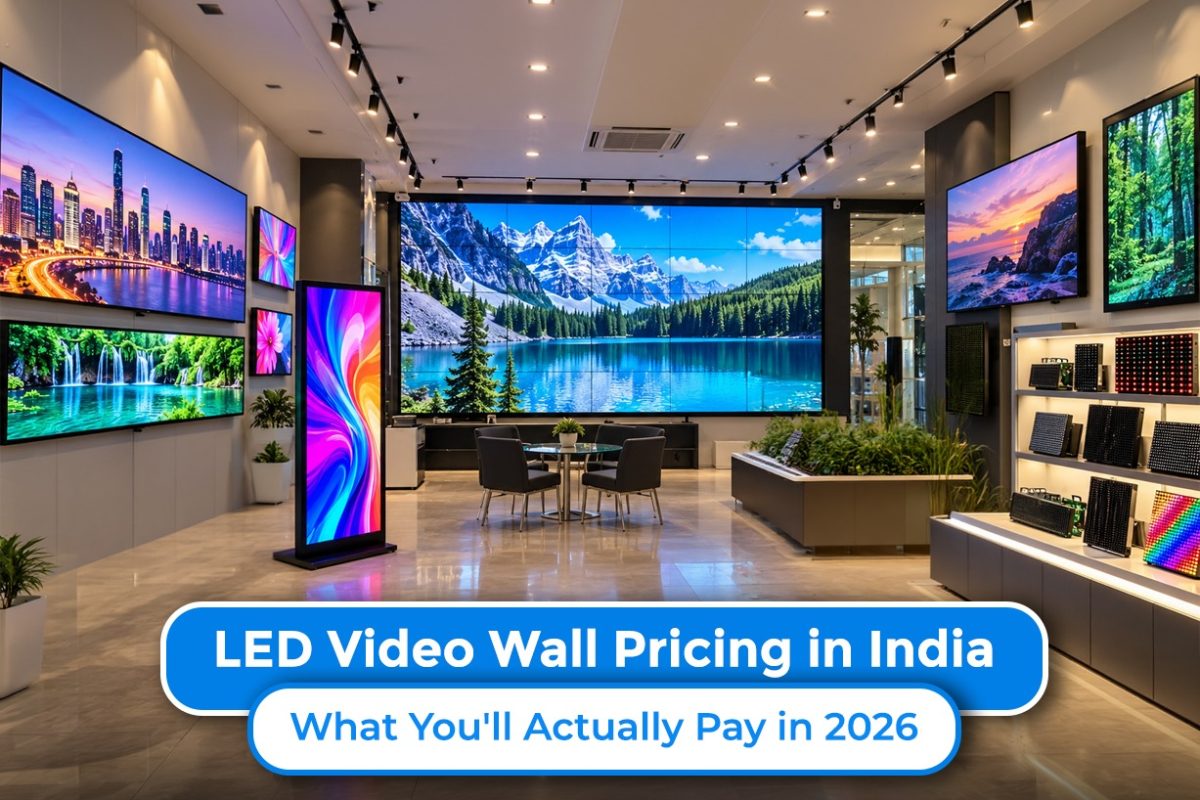
LED Video Wall Pricing in India: What You’ll Actually Pay in 2026

If you ask five vendors the question “how does an LED video wall India installation cost?” you will probably receive five separate answers. The prices can vary from a few lakh rupees to more than a crore. Vendors are not playing games; LED video wall pricing really changes by five to ten times. The change depends on pixel pitch, the size of the wall, whether the LED video wall is used indoors or outdoors and what extras are added beyond the panels.

This guide shows the 2026 prices by pixel pitch and by screen size. It explains why indoor and outdoor prices differ. It lists the items that are usually added to the price. It also talks about financing options if you cannot pay the amount at once.

Price Table by Pixel Pitch

Pixel pitch is the distance in millimeters between LED clusters. It is the factor that drives cost. A smaller pitch places LEDs in the same area producing a sharper picture. Because more LEDs are used, the number of components and the price go up.

Indoor LED video wall pricing by pixel pitch (per sq. Ft., 2026):

Pixel PitchPrice per Sq. Ft.Typical Use
P3₹4,500 – ₹5,500Retail displays, lobbies, general signage
P2.5₹5,500 – ₹8,000Showrooms, corporate reception, retail
P2₹6,500 – ₹10,000Boardrooms, premium retail, studios
P1.86₹7,500 – ₹9,000Close-viewing corporate displays
P1.5₹9,000 – ₹18,000Control rooms, command centers, premium boardrooms
P1.2 and finer₹18,000 – ₹25,000+Broadcast studios, ultra-premium installations

Outdoor LED video wall pricing by pixel pitch (per sq. ft., 2026):

Pixel PitchPrice per Sq. Ft.Typical Use
P10₹1,500 – ₹4,000Large billboards, highway advertising
P6-P8₹3,900 – ₹5,900Stadium perimeter boards, outdoor retail
P4-P5₹5,000 – ₹7,000High-traffic advertising, stadium screens
P3₹8,000 – ₹14,000Premium outdoor, close-viewing advertising

The trend is clear. Each time you choose a pixel pitch the price per square foot climbs by about twenty to forty percent. A finer pitch uses denser LED modules. It also requires manufacturing tolerances and more careful calibration. A P1.2 fine‑pitch wall can cost four or five times more per foot than a basic P10 outdoor display even though both are called LED video walls.

Most buyers find the pixel pitch by looking at the minimum viewing distance. If you pay a P1.5 fine‑pitch wall that is seen from fifteen meters away you waste money on detail that no one at that distance can see. Ask the vendor to confirm the pitch that matches your viewing distance instead of choosing the finest one. That is a simple way to keep costs down.

Price Table by Screen Size

The total screen size also increases cost. It is useful to see numbers because many buyers are surprised how fast a modest display price grows when you add installation and electronics.

Typical indoor P2.5 installation costs (2026):

Screen SizeArea (sq. ft.)Approx. Total Cost (before extras)
10ft × 6ft60 sq. ft.₹3.3 lakh – ₹4.8 lakh
12ft × 8ft96 sq. ft.₹5.3 lakh – ₹7.7 lakh
20ft × 10ft200 sq. ft.₹11 lakh – ₹16 lakh

Larger installations (mixed pixel pitch, sq. meter basis):

Screen SizeAreaApprox. Total Cost
3m × 2m6 sq. m₹15 lakh – ₹30 lakh
4m × 2.5m10 sq. m₹25 lakh – ₹50 lakh
8m × 4m32 sq. m₹80 lakh – ₹1.5 crore

The numbers shown here include the panels and the simplest installation work. They usually do not cover the items mentioned in the next section and that is where most project budgets go out of line. A vendor who says ₹3.3 lakh for a 10×6‑ft wall is not lying. That price rarely equals the final bill once you add structural mounting, processors and electrical work.

Rental pricing follows a model. It is useful to know if you need a display for an event instead of a permanent installation. In India renting an LED wall usually costs ₹35-₹120 per foot for a day. Fine‑pitch P2.5 screens cost ₹80-₹120 per square foot per day. Outdoor P4.8 screens cost ₹35-₹55 per foot per day. Renting is a cheaper option for a one‑time exhibition, a wedding or a product launch than buying the hardware.

Indoor vs Outdoor Price Gap

It is easy to think that outdoor displays, which are larger and tougher, should cost more than displays. However per foot the opposite is usually true. Knowing why matters when you plan a budget.

Pixel pitch is the reason. Outdoor displays are usually seen from away like a highway billboard while indoor displays are seen from close up like a boardroom screen. Outdoor installations therefore use a pixel pitch from P4 to P10. This makes them cheaper per foot than the P1.5-P3 range that indoor displays use. A simple outdoor P10 display can cost ₹1,500-₹4,000 per square foot, which is cheaper than even the cheapest indoor fine‑pitch options.

Where outdoor costs catch up or exceed pricing is when the pixel pitch is the same. A high‑end outdoor P3 display made for close‑viewing advertising needs brightness and weatherproofing in addition to the fine pitch. It can cost ₹8,000-₹14,000 per foot. That price is the same as or higher than mid‑range indoor pricing because it mixes the fine‑pitch cost with outdoor engineering.

Brightness requirements add cost outdoors. Indoor displays usually need 800-1,500 nits. Outdoor displays need 5,000 nits or more to stay visible in sunlight. The LED parts that give brightness and the drivers that power them cost more. This extra cost partly cancels the savings from using a pixel pitch outdoors.

Weatherproofing and structural engineering add costs for outdoor installations. IP65‑rated enclosures, housings (especially useful in coastal Indian cities) and mounting structures that can handle wind load all increase outdoor project costs. Indoor installations do not need these features.

Net effect: For the screen size a standard outdoor display, which has a coarser pitch and is less sensitive to close viewing is usually 20-40% cheaper than an indoor fine‑pitch wall. However a premium close‑viewing outdoor display can cost much as or more than the indoor version once brightness and weatherproofing are added to the pixel pitch cost.

What’s Usually Extra

The tables above show prices that depend on pixel pitch and size. They cover the LED panels and the basic mounting. In projects budgets almost always include several other cost categories that vendors do not always tell you about at first.

Video processors and controllers are hardware that are not included in the per‑square‑foot price. A simple processor for a display can add ₹30,000-₹80,000. Professional processors for large multi‑input installations can cost lakh rupees.

Structural mounting and rigging can vary a lot. The variation depends on the wall type, ceiling height. Whether the display is suspended, wall‑mounted or built into a custom frame. For center‑hung installations a structural engineering assessment and custom fabrication can add 15-30% to the hardware cost.

Electrical work. Such as power circuits, surge protection and occasionally backup power. Is often billed separately from the display. This is especially true for installations that need a lot of continuous power.

Content management software licensing is usually a recurring cost, not a one‑time fee. The price usually ranges from a thousand rupees per year for basic scheduling software to much more for enterprise‑grade platforms that manage many screens and allow remote monitoring.

Transportation and installation labor for locations outside major metro areas can add a significant percentage to the total project cost. Specialized LED installation technicians and equipment are not available everywhere, in India.

Annual maintenance contracts (AMC) normally cost between five percent and ten percent of the hardware price each year. They cover servicing, replacement of LED cluster modules when they fail and technical help. Many new buyers do not plan for this expense until the first service call comes.

GST and import duties when they apply add cost. This is especially important because many LED display parts used in India are brought in from abroad. That makes the landed cost change when currency rates and duty rules change.

Ask every vendor for a quote that lists panels, processor, mounting, electrical software licensing and Annual maintenance contracts (AMC) separately. This is the way to stop a quoted price from being thirty to fifty percent lower than the real installed cost.

Financing Options

Because even a small LED video wall can cost lakh rupees and bigger ones can reach crores, many Indian businesses use financing instead of paying everything up front.

Equipment loans banks and NBFCs (non‑banking companies) are the simplest choice. The LED display can often act as collateral. The loan term usually lasts between twenty‑four and sixty months. Interest rates depend on the business credit score. Whether the loan is secured. This method fits businesses that want to keep the LED video wall for years.

Vendor financing and EMI plans are now often provided by LED display makers and system integrators. They may have qualification rules than a bank loan but the effective rate can be higher. This can be a choice for smaller businesses that do not have a long credit history.

Leasing is an option for businesses that plan to upgrade their LED video wall in a few years. LED technology keeps getting brighter and more detailed. Lease payments are usually less than loan EMIs for the gear but the display is not owned unless the lease has a buy‑out clause.

Rental mentioned earlier in the pricing part is not financing. It still helps the budget for events. Rental lets you avoid buying a capital item when the LED video wall is needed only for a short time.

Whatever path you pick first get the cost list that shows panels, processor, mounting, software and Annual maintenance contracts (AMC). This makes sure the loan or lease money covers the project, not only the headline price per square foot of panels.

FAQs

  1. What is the average cost of a LED video wall in India?

A small indoor LED video wall that is ten feet by six feet (sixty square feet) and uses a common P2.5 pixel pitch usually costs between three point three lakh rupees and four point eight lakh rupees. That price is before you add mounting, processors and electrical work.

  1. Why do two LED video walls of this size have such different prices?

Pixel pitch is the reason. A finer pitch costs a lot more per foot than a coarser pitch. Brightness, panel brand, indoor or outdoor rating and what is added in the quote- processor, installation, software, also add to the price difference.

  1. Is LED video wall pricing always cheaper than indoor?

No it is not always cheaper. Outdoor displays that people see from afar usually use a coarser cheaper pixel pitch so they cost less per square foot than fine‑pitch indoor walls.. High‑end outdoor walls that are meant for close viewing and need fine pitch and bright light can cost the same or more as indoor walls.

  1. How much should I budget beyond the per-foot panel price?

A good rule of thumb is to add twenty to forty percent to the panel price for mounting, processors, electrical work and labor. Add a maintenance cost that is about five to ten percent of the initial hardware price.

  1. Is renting an LED video wall cheaper than buying for a one-time event?

Yes, for one event the rental is usually cheaper. In India renting an LED video wall costs between thirty‑five and one hundred twenty rupees per foot each day depending on the pixel pitch. That is much less than buying the hardware for a display that will not be used again.

  1. What financing option is best, for a business buying an LED video wall?

It depends on whether you plan to keep the display long‑term or expect to upgrade within a year. An equipment loan makes sense for long‑term ownership of the display. Leasing suits businesses that are anticipating a technology refresh for the display. Vendor EMI plans can help businesses that lack a credit history to get approved for the display more easily.

Conclusion

LED video wall pricing in India genuinely varies by an order of magnitude depending on pixel pitch, size and whether the LED video wall is used indoors or outdoors. That is why comparing quotes on a per square foot” number without checking what is included can be misleading. I would advise you to get an itemized breakdown from at least two or three vendors. Confirm that the pixel pitch matches your viewing distance. Factor in installation, software and maintenance, from the start of treating these as afterthoughts once the panels have already arrived.

Digital Video Walls vs Single LED Screens: What’s Actually Different

At glance a large indoor display and a video wall might seem like the same thing. Both show high-quality images. Both can be big enough to cover a lobby, a store front or a stage at an event.. A digital video wall and a single LED screen work in very different ways.. That difference affects how they are installed, how they are used and how they are maintained over time.

Many people think the only real choice is size. “I need something so I need a video wall.”. The right choice depends on more than just size. It also depends on resolution needs, how far people will be from the screen, the budget and how the content will be made and managed. This guide explains the differences: how a video wall is built from multiple panels, how those panels work together when a video wall is actually the better choice and the special challenges that come with multi-panel setups that don’t affect a single screen.

The Core Difference: Panels vs One Screen

The difference is in the name. A digital video wall is made up of individual display panels. LED tiles, LCD panels or modular cubes. Put them together in a grid. These panels are connected so they act as one screen. A single LED screen on the hand is one solid display surface. It can be a direct-view LED panel built as one piece or a big LCD or OLED screen made as a single unit.

This is a simple difference. Panels vs one screen. Changes almost everything else.

Because a video wall is made of parts it’s modular. You can add panels, take some out or rearrange them to change the size or shape of the display. Want a 3×3 grid for one event and a 4×2 layout this year? A video wall can be changed. A single screen can’t be changed. It stays exactly as it was built.

Bezels and seams are the obvious result of this modularity. LCD and older video wall panels have a frame around each tile. That creates lines in the picture. Modern ultra-narrow-bezel panels have lines but the lines are still there. Pitch LED video walls almost eliminate visible bezels because LED modules can be joined tightly together. That’s why LED is the choice for high-end video walls. A single LED screen has no seams because it is one surface.

Scalability and maximum size are also very different. The size of a screen is limited by what manufacturers can make and ship. Most single screens are much smaller than what a video wall can reach. A video wall, built from repeating units can grow to cover a building wall or a big stadium screen. The only limits are support and money not manufacturing.

Repair and redundancy work differently. If a single LED screen breaks the whole display goes out until it’s fixed or replaced. If one panel in a video wall fails the rest keep working. Only the broken panel stops showing content. This is an advantage for places that can’t afford downtime. Like control rooms, security centers or busy retail stores.

How Multiple Panels Sync as One Image

Getting panels to act like one screen is a hard job. That’s why video walls cost more than you might expect based on the number of panels

Video processors and controllers are the heart of the system. They don’t send the video signal to each panel. Instead they split the image. Send exactly the right data to each panel. This uses special signal distribution systems, over Cat6 cables or fiber for larger setups. Without this panels would show the image or not line up.

Genlock and timing sync keep every panel showing the thing at the same time. Even a tiny delay between panels shows up as tearing or flickering with fast motion. Professional systems use genlock signals to make sure every panel refreshes in sync.

Color and brightness calibration is another challenge. Even LED modules from the batch can have small differences in brightness and color. Video wall installations usually include a calibration process. Special cameras measure each panel’s output. Adjust it electronically to make the whole image look the same.

Content mapping and edge blending are important for nonrectangular or curved setups. Software maps content to the panel layout. It corrects for any misalignments. Edge blending. Common with projectors. Helps smooth the overlap between images.

Redundant signal paths are common in systems. If the main controller fails a backup system takes over. This keeps displays running during moments. Like in broadcast or control rooms.

All this equipment. Controllers, calibration tools, sync gear. Is invisible when it works well. The goal is for a video wall to look like one screen even though dozens of parts are working behind it.

Where Video Walls Make Sense

Even with extra complexity there are times when a video wall is clearly better than a single screen. Knowing when is key.

Large displays are the most obvious case. When you need a screen than what’s made as one unit. Like a whole building wall, a stadium screen or a concert stage backdrop. A video wall is not just better. It’s the choice. No single screen can be that big.

Unusual or custom shapes are another fit. Panels can be arranged into L-shapes, curved walls, screens that wrap around corners or even screens with cutouts for doors and windows. A single screen can only be rectangular. This flexibility is impossible with a unit.

Mission-always-on environments like security centers, network operations or air traffic control benefit from video walls. If one panel goes out the rest keep working. Operators still see most of the screen. That matters when a failure could cause danger or big losses.

Budget-phased installations also help. A video wall can grow over time. Start with a setup and add panels later as money allows. You can’t do that with a screen. It must be bought in full from the start.

Venues that need to change setups. Like rental companies, event planners and touring production teams. Use video walls because they can take them apart, move them and build them again in different shapes. A fixed screen can’t be reconfigured.

For spaces. Like conference rooms, retail stores or reception areas. A single screen is usually simpler and cheaper. It’s easier to install, calibrate and repair. Video walls bring complexity only when the size, shape or reliability needs justify it.

Content Considerations You Won’t Face with a Single Screen

The hardware differences are part of the story. Making content for a video wall brings challenges that don’t exist with a screen. Many people buying a video wall for the time don’t realize how big this gap is.

Resolution and aspect ratio planning get harder. The total resolution of a video wall is often not standard. It may not be 16:9 like screens. Content must be. Adjusted for this unique shape and size. A video or image made for a screen may need to be cropped, resized or redesigned to look good on the wall.

Bezel compensation in content design matters with LCD setups. Because each panel has a frame, content creators must avoid placing things. Like a person’s face or key text. Right on the seam. If they do the image gets. Cut off.

File size and processing power go up. A video wall with 4K panels can have a resolution many times larger than a single 4K screen. That means files, more powerful playback systems and higher bandwidth for sending content. The tech behind the screen must handle more.

Content management software gets more complicated. A CMS for a video wall must manage how content is split across the grid. It must schedule content for the display as one unit. It may also need to show things in different areas. Like a logo in one corner while the main screen changes.

The bottom line: creating content for a video wall takes planning, more skill and better tools. A single screen avoids all of this.. When the display needs to be large, shaped or always on, the extra work is worth it.

Testing and preview workflows get more complicated. Content that looks fine on a designer’s monitor can appear completely off when displayed across a video wall with a different shape or resolution. That’s why it’s crucial to preview content on the video wall setup. Or a close simulation. Before any live event or permanent installation begins.

None of these issues make video walls impossible to use. These are all known problems with tools and solutions that have been around for years.. They do mean you need to plan for time and skilled people to prepare the content. It’s not about the hardware and installation. You also need to budget for the work that goes into making the content look right on the video wall.

FAQs

  1. Is a video wall always more expensive than a single LED screen?

yes. For the total display area a video wall usually costs more because it includes extra equipment. Like controllers, calibration tools and more labor during setup. But when the size gets very large and no single screen exists at that scale a video wall is the choice. Cost becomes secondary when there’s no option.

  1. Can a video wall display one image or does it always show a grid?

A built video wall. Especially one using fine-pitch LED panels without bezels. Can show one smooth seamless image. It looks like a giant screen. With LCD-based video walls even the best ultra-narrow-bezel models still show lines between panels.. Those gaps have gotten much smaller over time.

  1. How many panels can be combined into a video wall?

There’s no technical limit. You can build a video wall from a 2×2 setup to one with hundreds of panels covering a whole building. The real limits come from budget, structural support and how powerful the video wall controller is. The panel technology itself usually isn’t the barrier.

  1. Do video walls require maintenance compared to single screens?

Yes, video walls usually need maintenance. There are parts. Like panels, controllers and cables. That might need fixing over time. Color and brightness also need to be recalibrated as the panels age and wear differently. The good news is that if one panel fails the rest of the wall still works. With a screen one failure means the whole display goes dark.

  1. Can I convert a large screen into a video wall later?

No. A single screen is made as one unit. Cannot be split or expanded into a modular video wall. If you think you might need to add screens later or reconfigure the setup it’s better to plan for a video wall from the beginning. Trying to convert a screen into a video wall later isn’t possible.

  1. What’s the minimum size where a video wall makes more sense than a single screen?

There’s no cutoff. It depends on what single screens are available at the time and the shape you need. As a rule, if the display fits within standard large-screen sizes and doesn’t need a non-standard shape or the ability to keep working if one part fails, a single screen is usually easier and cheaper.

Conclusion

The decision between a video wall and a single LED screen isn’t about which one looks bigger. It’s about matching the display to the needs. Size beyond what a single screen can offer shapes, the need for redundancy, in case of failure or plans to expand over time. These are the reasons to choose a video wall. For standard indoor and outdoor uses a single screen is still the simpler and more affordable choice.. When those special needs come up the added complexity. Controllers, calibration, content planning. Is exactly what allows displays to reach massive scale.

Financing an LED Video Wall Loans, Leasing & Rent-to-Own Explained

Financing an LED Video Wall: Loans, Leasing & Rent-to-Own Explained

A lobby, a storefront, a house of worship, or a stage for a live event can all be transformed by an LED video wall, but the project is frequently put on hold due to the high cost. For a small indoor display, the cost of high-resolution LED panels, processors, structural mounts, and installation labor can range from $20,000 to several hundred thousand dollars for a large outdoor screen.

You don’t need to pay cash up front, which is good news. The financing of LED video walls has become widespread, with companies utilizing rent-to-own agreements, leasing, and loans to install a display now and pay for it over time. Your cash flow, balance sheet, and overall cost are all affected differently by each choice. Before you sign anything, this guide explains how each operates, what terms to expect, and how to compare the actual cost of financing an LED video wall.

When Financing Is a Better Option Than Purchasing Outright

 It’s okay to pay cash for an LED video wall if you have the money lying around with no better use for it. This way, you can completely avoid interest and fees. However, financing makes more practical sense for the majority of businesses, and there are a few obvious indicators that suggest it.

The most important is the preservation of cash flow. If a company invests between $50,000 and $300,000 in one asset, it may not have enough working capital for marketing, payroll, or inventory. While the display starts producing value (more foot traffic, ad revenue, sponsorship income, or brand visibility) right away, spreading that cost over 24 to 60 months keeps money available for ongoing operations.

Displays that generate revenue make a compelling case for funding. The display can eventually pay for itself if it features sponsorships, paid advertising, or ticketed content (think stadiums, shopping malls, or digital out-of-home advertising networks). Instead of requiring a sizable upfront cash outlay before any revenue is generated, financing enables the asset to finance its own payments.

Finance, particularly leasing, is also favored by technology refresh cycles. Every few years, LED technology advances in pixel pitch, brightness, and processing.

Leasing or rent-to-own may be preferred by a company that plans to upgrade in three to five years in order to avoid being forced to purchase depreciated hardware. Accounting and tax treatment are also important. Lease payments, loan interest, and Section 179 depreciation deductions may provide significant tax benefits, depending on your jurisdiction and the financing arrangement. Before selecting a structure, it is worthwhile to talk to an accountant about your particular numbers. If you intend to keep the display for a very long time (10+ years) and have no plans to upgrade it, or if your company has enough extra cash that the cost of interest exceeds the cash-flow benefit, financing usually makes less sense. In those situations, buying something outright might be the more affordable option in the long run. Rent-to-own versus loan versus leasing.

Choosing the best option for financing an LED video wall depends on your preferences for ownership, flexibility, or the lowest monthly payment

The three most popular financing options operate quite differently. Loans of equipment.

An equipment loan functions similarly to a conventional business loan in that the lender pays the LED supplier directly, and you repay the loan balance plus interest over a predetermined period of time, usually 24 to 72 months. The equipment itself frequently acts as collateral, making approval simpler than with an unsecured loan, and you own the display from the start. If you want to increase the asset’s equity right away and intend to keep the display for a long time, loans are the best option. In comparison to leasing, the trade-off is a higher monthly payment; additionally, you bear the risk of obsolescence and maintenance.

The two types of leasing are operating leases and capital (finance) leases. In essence, an operating lease is a long-term rental with reduced monthly payments, the display remaining off your balance sheet as a liability, and the option to return the equipment, renew it, or purchase it at fair market value at the end of the term. A capital lease functions more like a loan in that the asset shows up on your books as debt while you work toward ownership. Because it avoids being stuck with out-of-date hardware, leasing is popular among companies that plan to upgrade their display in a few years.

Rent-to-own agreements, which are comparable to capital leases but typically have shorter terms and more flexible qualifying requirements, allow you to make payments (often monthly) that count toward eventual ownership. Although it usually has a higher effective interest rate than a bank loan, this approach frequently appeals to smaller companies or event companies that aren’t eligible for conventional equipment loans.

The best option will depend on your credit profile, how long you plan to use the display, and whether your company values flexibility or ownership more.

Common Terms and Things to Look Out for

Financing terms for LED video walls differ depending on the lender and project size, but before comparing quotes, it’s important to understand a few benchmarks.

Depending on your company’s credit, length of operation, and whether the loan is secured by the equipment, interest rates can range from roughly 6% to 20% APR over the course of 24 to 72 months. Well-qualified borrowers can occasionally obtain equipment-only collateral loans with no down payment at all; down payments between 0 and 20 percent are typical.

Typically, leases last between 24 and 60 months. Operating leases frequently offer lower monthly payments than loans for the same equipment, but be sure to carefully check the end-of-term buyout price. Some leases have a small buyout of €1,” while others require paying fair market value, which could be a significant unforeseen expense if you wish to keep the display.

Rent-to-own terms are typically shorter, ranging from 12 to 36 months, and the payment plan incorporates higher effective rates. This option is worth carefully examining for overall cost because approval requirements are usually lower.

Here are some particular things to look out for in any contract:

  1. Rate of interest vs. factor rate– Instead of using APR, some equipment finance companies quote a factor rate, which can mask the true cost. Never fail to request the equivalent APR.
  2. Penalties for early payoff–  If you pay off the balance early on a loan or lease, you may be charged a fee. This is crucial if you anticipate receiving a windfall or intend to refinance.
  3. Warranty and maintenance coverage– Verify whether panel replacement, pixel repair, or processor servicing are covered, particularly in leases and rent-to-own agreements where the financing company might be partially responsible for the equipment.
  4. Term-ending commitments– Understand precisely what happens at the end of the term: return, renew, or purchase, along with the cost.
  5. Installation and structural expenses- Verify if the financing covers the entire project, including the mounting structure, processors, and labor, or just the LED panels. You may have to make significant separate cash payments if you use partial financing. To avoid unpleasant surprises that could turn an alluring monthly payment into a costly error, read the fine print on these points.

FAQs

  1. To finance an LED video wall, what credit score is required?

Lenders have different requirements, but most equipment loans require at least one to two years of business experience and a personal or business credit score in the 600s or above. Although typically at a higher effective rate, leasing and rent-to-own businesses are frequently more accommodating and occasionally approve startups or companies with lower credit scores.

  1. Can I pay for structural mounting and installation in addition to the LED panels?

Yes, for the most part. As long as it’s recorded in a vendor quote or invoice, many equipment finance companies will combine the entire project cost- panels, processors, mounting structure, and labor into a single financed amount. Since some lenders only finance hardware, find out up front if soft costs like installation are covered.

  1. Does renting an LED video wall qualify for a tax deduction?

Like rent, operating lease payments are frequently fully deductible as a business operating expense. You can usually deduct interest from loan payments and depreciate the asset separately, possibly using accelerated depreciation like Section 179 in the United States.

  1. During the financing term, what happens if the LED display needs to be repaired?

Your contract will determine this. Although many buyers combine a loan with a separate service agreement or extended warranty from the manufacturer, loans usually leave maintenance entirely up to you. Sometimes maintenance is covered by leases and rent-to-own agreements, but this isn’t always the case. Verify this clearly before signing, as replacing a panel or module can be expensive if it’s not.

  1. Before my financing term expires, is it possible for me to upgrade to a newer display?

You can sell or trade in the display at any time if you have a loan, but you’ll still have to pay back the remaining amount. If updating your technology is a top priority, you should inquire about the upgrade clause that some operating lease providers offer, which permits you to move into a new lease before the term expires. Because rent-to-own agreements are based on a predetermined route to ownership, they are less accommodating for early upgrades.

  1. What is the usual required down payment amount?

Typically, down payments for financing LED video walls fall between 0% and 20% of the project’s total cost. Well-qualified businesses with strong credit and an established operating history can sometimes secure equipment loans or leases with no down payment, while newer businesses or larger projects may require 10-20 percent upfront to reduce the lender’s risk.

  1. For a small business or nonprofit, is rent-to-own a good option?

It can be, particularly for organizations that don’t qualify for a traditional equipment loan or want to avoid a long-term lease commitment. The trade-off is a higher total cost over the financing period, so it’s worth running the total cost comparison (as shown above) before committing, and checking whether a co-signer or secured loan option might offer better terms.

Conclusion

Financing an LED video wall isn’t just about finding the lowest monthly payment, it’s about matching the structure (loan, lease, or rent-to-own) to how long you’ll use the display, how it will generate value for your business, and how much flexibility you need. Get itemized quotes from at least two or three financing providers, ask for the total cost breakdown in writing, and confirm the end-of-term terms before you sign. With the right financing structure, a high-impact LED video wall can be well within reach without a large upfront cash outlay.

Pixel Pitch, Brightness, and all the Types You Need to Know about LED Screens

Pixel Pitch, Brightness, and all the Types You Need to Know about LED Screens

Typically, buying an LED screen is an exciting process that ends with a headache. P2. 5 is stated in one quote, P1. 8 in another, and “nits” and “refresh rate” are added in a third without any further explanation.

Once it’s explained in simple terms, none of this is difficult.

LED displays- Decoded

Thousands of tiny light-emitting diodes are arranged in a grid to create an LED screen.

One pixel is made up of each diode or small cluster of diodes. An image is created when enough pixels are combined. That’s the entire concept. Everything else, including brightness, resolution, and color accuracy, simply varies depending on the number of diodes, how they are powered, and how they are controlled.

LED displays are modular. They are constructed from smaller tiles or cabinets, typically measuring between 500 and 1000 mm on each side, that lock together like puzzle pieces rather than one enormous panel. Because of this, an LED wall display can be constructed in practically any shape or size, ranging from a tiny indoor standee to a huge outdoor billboard that covers an entire building face.

Every tile has a driver board, a receiving card that communicates with a central control system, and its own LEDs. A video wall is more than just a grid of lights because of its control system.

Every tile is synchronized so that the entire surface appears to be a single image. Prior to anything else, it is important to understand the following three general categories. LEDs with fine pitch are designed for close-up viewing, such as in control rooms or retail displays.

Malls, lobby areas, and event spaces use standard indoor LED lighting. Outdoor LEDs are designed to withstand temperature fluctuations, sunlight, and rain. In reality, every specification sheet you encounter merely describes a panel’s position and performance within these three categories. The rest of the terminology no longer seems like jargon after that realization.

The Most Important Specification is Pixel Pitch.

Make it pixel pitch if you can recall just one term from the entire article.

The distance, expressed in millimeters, between the centers of two LED pixels is known as pixel pitch. The letter “P” is followed by a number, such as P2. 5 or P10. The millimeter gap is that figure. Smaller numbers, tighter pixels, and a sharper image up close are the simple rules:

Pixel PitchBest Minimum Viewing DistanceCommon Use Case
P1.2 – P1.81.5 – 2.5 metresControl rooms, boardrooms, luxury retail
P2.5 – P32.5 – 4 metresRetail stores, lobbies, indoor stages
P4 – P64 – 8 metresLarge indoor halls, exhibition centres
P8 – P108 – 15 metresOutdoor billboards, stadium screens
P10+15+ metresHighway billboards, large building facades

Selecting a pixel pitch that is tighter (and more expensive) than they actually require is a common error made by first-time purchasers. A hyper-fine P1. 8 panel is a waste of money if your screen is ten meters above a busy road.

Adapt your pitch to the proximity of your target audience.

Types: Rental, Outdoor, and Indoor.

Not all LED panels are constructed in the same way, and one of the most frequent (and costly) errors made by consumers is to use the incorrect type in the incorrect setting.

LED screens used indoors are designed for controlled settings. Since they are never in direct sunlight, they operate at lower brightness levels, are typically lighter, and don’t require weatherproofing. Because viewers typically stand closer, indoor panels typically offer tighter pixel pitches as well.

An entirely different construction is used for outdoor LED screens. They are designed to withstand temperature fluctuations, run at a much higher brightness to remain visible in direct sunlight, and are sealed against dust and moisture (rated IP65 or higher on the front face).

Because outdoor panels must endure years of weather exposure and wind load, they are also more resilient physically.

A particular subset of LED panels designed for temporary installations, events, and exhibitions is called rental LED panels. Fast assembly and disassembly, lightweight cabinets, and packaging that fits in a flight case are the top priorities for these panels.

Although they can be moved, reused, and set up in a matter of hours as opposed to days, they are not necessarily less expensive per square foot.

Semi-outdoor panels, which are used in covered spaces like store verandas, metro platforms, or covered walkways, are another expanding middle category. These do not require complete outdoor-grade weatherproofing, but they do require greater brightness than pure indoor screens.

Ask yourself this before placing an order. Will the sun or rain ever come into contact with this screen? Does it require frequent relocation or configuration? What is the usual distance between people? The answers typically make the choice between indoor, outdoor, and rental properties simple.

A Clear Explanation of Brightness and Viewing Distance.

Nits are a unit of brightness measurement. The light from one candle spread across one square meter is approximately equivalent to one nit. In bright ambient light, the screen is more visible when the nit count is higher. This serves as a general standard:

EnvironmentRecommended Brightness
Indoor, low ambient light (control room)300 – 600 nits
Indoor, retail or lobby with windows600 – 1,200 nits
Semi-outdoor, covered but bright1,500 – 3,000 nits
Full outdoor, direct sunlight4,000 – 7,500+ nits

If installed outside, an indoor panel operating at just 500 nits will appear dim and washed out.

If an outdoor-rated panel operating at 5,000 nits is used indoors without adequate brightness control, it may be uncomfortably harsh.

Brightness and viewing distance cooperate rather than operate independently. When viewed up close, a screen that is both bright and fine-pitched may actually strain eyes. Don’t just look at the largest number on the spec sheet.

The Brief Version of LED vs. LCD.

Liquid crystal display panels, which resemble televisions, are connected in a grid to create LCD video walls. Each panel has obvious bezels, or seams, that are typically a few millimeters wide.

For a fixed size, LCD walls are typically less expensive; however, the bezels slightly distort the image and make resizing and reshaping difficult. LED walls can be constructed in nearly any size or aspect ratio and have no visible seams because they are constructed from individual pixels rather than fixed panels.

Additionally, for larger installations or longer operating hours, LEDs typically operate brighter and more robustly. This is the condensed version that consumers truly require:

FactorLEDLCD
Seams between panelsNoneVisible bezels
Custom sizingVery flexibleLimited to panel multiples
BrightnessHigher, better for bright rooms or outdoorsLower, best for controlled indoor lighting
Cost for smaller installsUsually higherUsually lower
Best forLarge walls, outdoor use, seamless visualsSmaller budget-conscious indoor displays

LED is nearly always the best choice for projects involving large format walls, seamless brand statements, or outdoor spaces. LCD can still make sense if you’re on a tighter budget and have a smaller interior space where a thin bezel line isn’t a deal-breaker.

The Real Factor Influencing the Cost.

The cost of an LED screen in India varies greatly, and the brand name on the quote rarely matters. The majority of the work is done by a few actual factors.

The largest lever is pixel pitch. More LEDs are crammed into a smaller space with tighter pitch, which raises the cost of materials and production. The cost per square foot can almost double when switching from P4 to P2. 5.

Simply put, panel size and overall area are important; more square footage equates to more cabinets, modules, and labor for assembly and mounting.

The cost varies greatly between indoor and outdoor construction. In comparison to an indoor-only panel of the same size, the cost is increased by outdoor-rated weatherproofing, structural mounting, and higher-output LED chips.

Durability and image quality are both impacted by refresh rate and chip quality. Better chip quality (from reputable manufacturers) tends to hold color and brightness consistency longer, and higher refresh rates reduce camera flicker, which is important for broadcast or event use.

Frequently, control systems and software are undervalued. A full content management system that enables remote scheduling, multi-zone content, and real-time updates is far more expensive than a simple controller that only shows a static image.

For large or structurally challenging sites, such as outdoor billboards requiring steel framing or curved walls requiring custom cabinet shaping, installation complexity quickly mounts.

Pricing is also influenced by warranty duration and after-sales assistance. Generally speaking, a vendor with a 3-year on-site warranty and committed technical support will charge more than one with a minimum 1-year warranty.

Invest or Rent?

If: then renting makes sense. For a single event, exhibition, or brief campaign, you require a screen. Over time, the screen will be utilized in various settings. You should test a large-format display before making a long-term purchase. Instead of being locked into a fixed asset, your budget must remain adaptable.

Purchasing makes sense if… For years, the screen will run every day in a fixed location. You must have complete control over branding, content, and long-term ROI.

You rely on advertising or signage as a continuous source of income for your business. Rather than paying for a screen each time you need one, you would prefer to pay once (plus maintenance).

FAQs

  1. For a display in a retail establishment, what pixel pitch is ideal?

A pixel pitch between P2. 5 and P4 typically provides a good balance of image quality and cost for the majority of retail settings where customers stand a few meters away.

  1. For an outdoor LED screen, how many nits of brightness are required?

To remain clearly visible during the day, outdoor LED screens that are exposed to direct sunlight typically require brightness levels between 4,000 and 7,500+ nits.

  1. Are LEDs superior to LCDs for video walls?

Since LEDs are brighter and have no visible bezels, they are typically better suited for large, seamless, or outdoor installations. For smaller indoor displays where a thin seam line is not a major concern, LCD can still be a good, more cost-effective option.

  1. Are LED screens in need of extra care?

Compared to older display technologies, LED screens typically require very little maintenance other than the occasional cleaning and routine inspections of the wiring and control system. Due to weather exposure, outdoor panels may require more frequent inspections.

LED Screens for Events & Outdoor LED Display Hire or Buy in India

LED Screens for Events & Outdoor LED Display: Hire or Buy in India?

Whether you’re organising a corporate summit in Mumbai, a music festival in Delhi, or a wedding reception in Jaipur, LED screens for events have become as essential as the sound system itself. But one question keeps coming up for organisers, AV companies, and venue owners alike: should you hire or buy?

LED Screens for Events: What Are Your Options?

The Indian events industry has grown rapidly over the past decade, and so has the variety of LED display solutions available. Before comparing costs, it helps to understand what’s actually on the market.

Main Categories of Event LED Screens

Indoor LED Displays are designed for controlled-light environments like conference halls, banquet halls, and auditoriums. They typically feature tighter pixel pitches (P2-P4) for crisp close-up viewing and are built into slim, lightweight cabinet panels that can be assembled quickly.

Outdoor LED Displays are weather-resistant, significantly brighter (measured in nits), and built to handle Indian summers, monsoon humidity, and direct sunlight. They’re commonly seen at outdoor concerts, political rallies, sports events, trade fairs, and melas.

Flexible and Curved LED Panels are a newer category gaining traction at high-budget weddings and product launches. These can wrap around pillars, form cylinders, or create immersive backdrops.

LED Video Walls are the modular panel systems you see at stage backdrops. They are the most popular format at corporate events, music concerts, and expos. Panels clip together to form any custom screen size you need.

Transparent LED Screens allow audiences to see through the display, making them ideal for retail activations, glass stage sets, and premium brand launches.

Common Event Use Cases in India

  • Wedding receptions and sangeet nights
  • Corporate conferences, product launches, and AGMs
  • Political rallies and public address events
  • Music concerts and cultural festivals
  • Sports events and IPL fan zones
  • Trade exhibitions like Auto Expo and India International Trade Fair
  • Religious events and public celebrations (Diwali, Navratri, Durga Puja)

The right screen type depends on your venue size, ambient light, viewing distance, and budget, all of which feed directly into the hire vs. buy decision.

Hire vs Buy: Cost Comparison

This is the central question, and the honest answer is: it depends on how often you use screens. Here’s a structured breakdown to help you decide.

LED Screen Hire Costs in India (2024-2025 Estimates)

Screen TypeSizeApproximate Daily Hire Cost
Indoor LED (P3-P4)10ft x 8ft₹15,000 – ₹30,000
Outdoor LED (P6-P8)16ft x 10ft₹25,000 – ₹60,000
Large Outdoor (P10)20ft x 12ft₹50,000 – ₹1,20,000
LED Video Wall (P2.5)Per sqm/day₹3,000 – ₹8,000

Hire costs typically include delivery, installation, a technician on-site, and dismantling. Some vendors include basic content playback; custom content management systems may cost extra.

LED Screen Purchase Costs in India (2024-2025 Estimates)

Screen TypePixel PitchApproximate Price Per Sqm
Indoor LEDP2₹90,000 – ₹1,50,000
Indoor LEDP3₹55,000 – ₹85,000
Outdoor LEDP6₹40,000 – ₹65,000
Outdoor LEDP8–P10₹28,000 – ₹45,000

A 20 sqm outdoor LED setup at P8 could cost ₹6-9 lakhs to purchase outright, including controllers, mounting, and installation.

The Break-Even Calculation

If you’re hiring a screen for ₹40,000 per event and you do 20 events a year, that’s ₹8 lakhs in annual hire spend. A comparable owned setup might cost ₹7-10 lakhs to buy, meaning you could break even in 12-15 months, before factoring in maintenance and storage.

Hire makes more sense when:

  • You organise 1-5 events per year
  • Your venue or screen size requirements change event to event
  • You don’t have storage, transport, or maintenance capacity
  • You need a large, specialised display (transparent LED, curved panel) occasionally

Buying makes more sense when:

  • You run a venue, event company, or AV rental business
  • You organise 15+ events annually
  • You need a permanent installation (hotel lobby, stadium, showroom)
  • You want to generate rental income from other organisers

Outdoor LED Display Screen Types

India’s outdoor event landscape demands screens that can perform in extreme conditions. Here are the most widely used outdoor LED display formats.

Fixed Outdoor LED Billboards

These are permanent structures installed on rooftops, facades, or standalone poles. Popular in metro cities for advertising, they use robust P8-P16 modules with high brightness (5,000-8,000 nits) and are designed to run 18-24 hours a day.

Mobile LED Vans and Trailers

A hugely popular format for political campaigns, roadshows, and rural events across India. These are truck-mounted or trailer-mounted screens ranging from 10-20 sqm that can be driven to any location. They’re especially effective for Tier 2 and Tier 3 city outreach.

Rental Outdoor LED Panels

Modular cabinet systems (typically P5, P6, or P8) assembled on truss structures at the event site. These are the go-to for concerts, fairs, and sports events. They’re lightweight (some cabinets under 6 kg/sqm), quick to install, and easy to transport in flight cases.

Curved and Creative Outdoor LED

Premium events are increasingly using wrap-around LED structures, arches, and 3D LED to create visually striking stage backdrops. These are almost always hired rather than bought due to their high cost and single-event nature.

Semi-Permanent Outdoor Screens

Used at stadiums, cricket grounds, race tracks, and permanent entertainment zones. These combine the durability of fixed installations with modular panel systems that allow for maintenance access.

Pixel Pitch for Outdoor vs Indoor

Pixel pitch- the distance in millimetres between the centre of two adjacent LED pixels, is one of the most misunderstood specs in the industry. Getting it right prevents you from overpaying for resolution you don’t need, or ending up with a blurry display.

How Pixel Pitch Affects Viewing Distance

The general rule: minimum viewing distance (in metres) = pixel pitch (in mm) × 1.5 to 2.

Pixel PitchMinimum Viewing DistanceBest For
P1.5 – P21.5 – 3 metresSmall indoor screens, studios, boardrooms
P2.5 – P33 – 5 metresConference halls, banquet backdrops, indoor stages
P4 – P55 – 8 metresLarge indoor arenas, exhibition booths
P66 – 10 metresOutdoor stages, medium outdoor events
P8 – P108 – 15 metresLarge outdoor concerts, rallies, sports events
P10 – P1615+ metresRoadside billboards, long-distance outdoor viewing

Outdoor vs Indoor: Key Differences Beyond Pixel Pitch

Brightness: Outdoor screens need 4,000-8,000 nits to remain visible in direct sunlight. Indoor screens work fine at 800-2,000 nits.

IP Rating: Outdoor screens should carry at least an IP65 rating (dust-tight and water jet resistant). Indoor screens typically have IP20-IP40.

Refresh Rate: A higher refresh rate (≥1,920 Hz) prevents flickering in video content and is especially important for broadcast events.

Cabinet Material: Outdoor cabinets use die-cast aluminium or steel for weather resistance. Indoor cabinets often use lightweight magnesium alloy or plastic for easy handling.

Heat Dissipation: Indian summers can push temperatures above 45°C. Quality outdoor LED cabinets include active cooling systems and thermal management circuits.

Event LED Screen Setup Guide

Getting your LED screen setup right is as important as choosing the right screen. Poor rigging, bad cabling, or incorrect content resolution can undermine an otherwise excellent display. Here’s a practical step-by-step guide.

Step 1: Determine Your Screen Size and Placement

Start with the venue layout. The standard formula for screen width: screen width = viewing distance ÷ 6 to 8. For an audience 30 metres away, a 4–5 metre wide screen is a reasonable baseline. For stadium-scale events, go bigger.

Consider also: stage height, sightlines for seated audiences, and whether you need side IMAG (image magnification) screens alongside a main backdrop.

Step 2: Plan Your Structural Support

LED video walls are heavy. A 40 sqm outdoor LED setup can weigh 800-1,200 kg. You’ll need:

  • Certified truss structures (box truss or goal-post truss)
  • Ground support towers or rigging points from the venue ceiling
  • A structural engineer’s sign-off for large outdoor builds

Never mount large LED walls on temporary scaffolding without load calculations.

Step 3: Plan Your Power Requirements

LED screens consume roughly 400-800 watts per sqm (peak). A 20 sqm wall may need 8-16 kW of dedicated power. Always run separate power circuits for LED screens and avoid sharing circuits with audio equipment to prevent interference.

Step 4: Configure Your Video Processing

You’ll need a sending card (inside the screen cabinet) and a receiving card, plus a video processor or scaler. Common brands used in India include NovaStar, Colorlight, and Brompton. Ensure your content resolution matches the actual pixel count of your screen; a mismatch causes stretched or blurry output.

Step 5: Content Preparation

LED screens display best with content at native resolution. Standard formats are MP4, MOV, and live SDI or HDMI feed. Always provide a backup file on a USB in case the primary source fails. Avoid white-heavy slides on outdoor screens at night, they can be blinding for front-row audiences.

Step 6: Pre-Event Testing

Run a full test 2-4 hours before doors open. Check for dead pixels, colour consistency across panels, brightness calibration, and input switching. Have a technician on-site throughout the event for rapid troubleshooting.

Top Event LED Screen Suppliers in India

India has a robust ecosystem of LED screen manufacturers, rental companies, and integrators. Here are some well-regarded names across different segments.

Manufacturers and Suppliers

Planar Systems India / Absen India : International brands with Indian distribution networks, popular for high-end corporate and broadcast setups.

Linsn LED / NovaStar (India partners) : These Chinese LED giants have extensive authorised dealer networks across India supplying both panels and video processing systems.

Xtreme Media : A Mumbai-based manufacturer offering outdoor fixed and rental LED solutions widely used at Indian events and installations.

BEG India (Broadview Electronics Group) : Known for indoor fine-pitch LED used in control rooms, studios, and corporate environments.

AV Rental Companies with LED Inventory

  • DNA Entertainment Networks (Mumbai, Pan-India)- large-scale concert and event AV
  • Encompass India (Bengaluru)- corporate events and exhibitions
  • Wizcraft International (Mumbai)- premium brand events and entertainment
  • Impact Events (Delhi/NCR)- political and public events
  • Ananya Events (Chennai)- South India weddings and corporate events

Many regional AV companies in cities like Hyderabad, Pune, Kolkata, Ahmedabad, and Kochi maintain sizable LED rental inventory. Always verify IP ratings, cabinet age, and include technical support before signing a hire contract.

What to Ask Any Supplier

  • What is the pixel pitch, brightness (nits), and refresh rate?
  • How old are the cabinets, and how many hours of runtime?
  • Is on-site technical support included in the hire price?
  • What is the dead pixel threshold policy?
  • Do they carry backup panels on-site?

FAQs

Q1: What is the minimum budget for hiring an LED screen for a small event in India?

For a basic indoor LED backdrop (around 10ft x 8ft) at a corporate or social event, you can expect to pay ₹15,000-₹30,000 per day including setup and a technician. Costs rise with screen size, resolution, and whether it’s indoor or outdoor.

Q2: How much does a 20ft x 12ft outdoor LED screen cost to buy in India?

A 20ft x 12ft outdoor LED setup (approximately 22 sqm) using P8 modules would cost roughly ₹7-10 lakhs including panels, video processor, controller, steel cabinet frames, and basic installation. Import duties and GST apply to foreign-manufactured panels.

Q3: What pixel pitch should I choose for a wedding reception?

For a banquet hall wedding where guests are seated 5-15 metres from the screen, P3 or P4 is ideal; sharp enough for photo slideshows and live feed, without the premium cost of P2 fine-pitch panels.

Q4: Are outdoor LED screens safe during monsoon?

Quality outdoor LED panels carry IP65 or IP66 ratings, making them resistant to rain and dust. However, structural safety during high winds is a separate concern. Always ensure your truss and mounting system is rated for local weather conditions and anchored properly.

Q5: Can I use indoor LED panels for an outdoor event?

Not recommended. Indoor panels are not weatherproof, have insufficient brightness for daylight viewing, and can be permanently damaged by moisture. Always use outdoor-rated (IP65+) panels for any event in an open or semi-open environment.

Q6: How long does it take to set up a large LED video wall?

A 40 sqm modular LED video wall typically takes a trained crew of 4-6 technicians and 4-8 hours to install, including truss erection, panel hanging, cabling, and calibration. Larger builds or complex structures may require a full day.

Q7: Is GST applicable on LED screen hire in India?

Yes. LED screen hire (supply of service) typically attracts 18% GST. If you’re purchasing LED panels, GST at 18% applies under HSN code 8531 or 8528. Always confirm with your supplier and seek a proper GST invoice for input credit eligibility.

Q8: What’s the difference between LED and LCD for events?

LED video walls (modular panels) have no bezels between tiles, can be built to any custom size, and are far brighter than LCD video walls. LCD panels have bezels that create visible grid lines and are generally limited to fixed screen sizes. For events, LED video walls are the industry standard for stage backdrops and large displays.

Q9: Can I buy a used or refurbished LED screen to save money?

Yes, and this can be a smart option if you’re building out a rental inventory. Check the cabinet age (LED modules degrade over time), pixel uniformity, and brightness calibration. Buy only from reputable dealers who offer a warranty. Avoid screens with more than 20-30% dead pixels or significant colour shift across panels.

Q10: What content format works best on event LED screens?

1080p or native-resolution MP4/MOV files at 30-60fps work well for pre-recorded content. For live feeds, use HDMI or SDI input from a camera or laptop. Always match your content resolution to the actual pixel count of the screen to avoid scaling artefacts.

LED Video Wall for Events Price, Size & Rental Guide in India

LED Video Wall for Events: Price, Size & Rental Guide in India

In today’s experience-driven event industry, visual impact is everything. Whether it’s a luxury wedding, a high-energy concert, a corporate launch, or a large-scale exhibition, LED video walls have become the backbone of modern event production. They don’t just display content; they transform spaces, enhance storytelling, and captivate audiences.
If you’re planning an event and exploring LED video wall prices for events in India, this comprehensive guide will walk you through everything you need to know, from pricing, sizes, rental vs purchase decisions, installation costs, and practical insights for event professionals.

Why LED Video Walls Are Essential for Events

Before diving into costs, it’s important to understand why LED walls are dominating the event space:
High brightness even in daylight (ideal for outdoor events)
Seamless large-format display without bezels
Customizable sizes and shapes
Real-time content display (live feed, branding, videos)
Enhanced audience engagement
From wedding stages to concerts and corporate events, LED walls are now a standard, not a luxury.

LED Video Wall Price for Events in India

Let’s address the most important question: what is the LED video wall price for events in India?

1. Rental Pricing (Most Common for Events)

For most event planners, renting is the preferred option.
Average LED Screen Rental Price India (Per Day)

Pixel PitchIndoor/OutdoorPrice Range (Per Sq. Ft./Day)
P2 / P2.5Indoor₹80 – ₹150
P3Indoor₹70 – ₹120
P4Indoor/Outdoor₹60 – ₹100
P6 / P8Outdoor₹50 – ₹90


👉 So, a typical stage LED wall (200 sq. ft.) can cost:
₹12,000 to ₹30,000 per day (basic setup)
₹40,000 to ₹1,00,000+ (premium events with advanced setups)

2. Purchase Cost (For Production Companies)

If you’re considering ownership:
Stage LED Video Wall Cost (Purchase)
Pixel Pitch
Approx Cost (Per Sq. Ft.)

P2₹9,000 – ₹15,000
P3₹7,000 – ₹12,000
P4₹6,000 – ₹10,000
Outdoor₹6,000 – ₹12,000


👉 Total cost for a 200 sq. ft. wall:
₹12 lakh to ₹30 lakh+

LED Wall for Events Price – What Affects It?


The led wall for events price varies significantly depending on multiple factors:
1. Pixel Pitch (Resolution)
Lower pitch (P2, P2.5) = higher clarity = higher cost
Higher pitch (P6, P8) = lower cost, suitable for large outdoor viewing
2. Screen Size
Bigger screens = higher cost
But per sq. ft. rate may reduce slightly for large setups.
3. Indoor vs Outdoor Usage
Outdoor LED walls are more expensive due to weatherproofing
Indoor LED screens are cheaper but offer higher resolution
4. Event Duration
1-day events cost more per day
Multi-day rentals offer discounts
5. Location
Metro cities like Delhi, Mumbai, Bangalore have competitive pricing
Remote locations increase logistics costs
6. Custom Design & Stage Integration
Curved LED walls
LED backdrops + side panels
Interactive displays
All increase costs


LED Video Wall Rental Price Per Day India


Let’s break this down clearly for event planners.
Small Events (50-100 sq. ft.)
₹5,000 – ₹15,000/day


Medium Events (100-300 sq. ft.)
₹15,000 – ₹50,000/day


Large Events (300+ sq. ft.)
₹50,000 – ₹2,00,000+/day


Example: Wedding Stage LED Wall Price
A common query is:
LED Wall Price for Wedding Stage
Typical wedding setup:
Size: 150-250 sq. ft.
Pixel Pitch: P3 or P4
👉 Cost:
₹20,000 – ₹80,000 per day
Premium weddings: ₹1 lakh+


LED Display Screen for Concerts Price
Concerts require large-scale setups with high brightness.


Typical Concert LED Setup:
Size: 500-2000 sq. ft.
Outdoor LED walls (P6/P8)
👉 Cost:
₹1 lakh – ₹10 lakh+ per event
Includes:
Main stage wall
Side screens
Live camera feed integration


LED Display Wall for Stage Events
LED walls are not just screens- they are part of stage design.
Common Uses:
Background visuals
Live streaming audience view
Brand promotions
Dynamic stage themes


Popular LED Stage Configurations:
Single Backdrop Wall
Most common
Cost-effective
Triple Panel Setup
Center + side wings
Used in concerts & corporate events
Curved LED Wall
Premium look
Higher cost
Floor LED Panels
Interactive stage floors
Expensive but visually stunning

What Size LED Screen is Used for Events?

Choosing the right size is critical.

Event TypeRecommended Size
Small weddings8×6 ft
Medium weddings12×8 ft
Corporate events16×10 ft
Concerts20×12 ft or larger
ExhibitionsCustom setups

Viewing Distance Rule:

P3 → Best for close viewing (5-10 ft)
P4 → Medium distance (10-20 ft)
P6+ → Long distance (20+ ft)


Event Stage LED Wall Installation Cost

Installation is often included in rental, but not always.


Typical Installation Costs:

  • Small setup: ₹2,000 – ₹5,000
  • Medium setup: ₹5,000 – ₹15,000
  • Large setup: ₹15,000 – ₹50,000+


What Installation Includes

  • Panel assembly
  • Rigging structure
  • Cabling & power setup
  • Testing


Additional Costs:

  • Transportation
  • Generator/power backup
  • Technicians/operators


Rent vs Buy: Which is Better?


Renting (Best for Most Users)
✔ Lower upfront cost
✔ No maintenance
✔ Latest technology access
✔ Ideal for weddings, one-time events
Buying (Best for Businesses)
✔ Long-term investment
✔ Better ROI for frequent use
✔ Custom setups possible

Quick Comparison:

FactorRentBuy
CostLowHigh
FlexibilityHighMedium
MaintenanceNoneRequired
Best ForEventsProduction companies

How Much Does LED Video Wall Cost for Events?


Let’s simplify this into real-world scenarios:
Scenario 1: Small Wedding
Size: 100 sq. ft.
Cost: ₹8,000 – ₹20,000/day
Scenario 2: Corporate Event
Size: 200 sq. ft.
Cost: ₹20,000 – ₹60,000/day
Scenario 3: Concert/Event Production
Size: 500+ sq. ft.
Cost: ₹1 lakh – ₹5 lakh+


Hidden Costs You Should Know

Many buyers overlook these:
Content creation (₹5,000 – ₹50,000)
Video processing equipment
Backup systems
Power consumption
Setup time charges


Tips to Reduce LED Wall Costs

Choose higher pixel pitch for large venues
Opt for package deals (sound + LED + lighting)
Book early (wedding season prices spike)
Use standard sizes instead of custom designs


Choosing the Right LED Vendor in India


Before finalizing a vendor, check:
Experience in event setups
Portfolio (weddings, concerts, corporate)
Technical team availability
Backup support during event
Quality of panels (brightness, refresh rate)


Interactive LED walls
Transparent LED screens
AR/VR integration
AI-driven visual content
Flexible LED panels

FAQs


1. What is the price of LED video wall for events in India?
The LED video wall price for events in India typically ranges from ₹50 to ₹150 per sq. ft. per day for rentals. Total costs depend on size, pixel pitch, and event requirements.
2. Is it better to rent or buy an LED wall for events?
For most event planners and wedding organizers, renting is more cost-effective. Buying is only recommended for production companies with frequent usage.
3. What size LED screen is used for stage events?
Common sizes range from:
8×6 ft (small events)
12×8 ft (weddings)
16×10 ft or larger (corporate & concerts)
4. How much does LED wall installation cost for events?
Installation can cost between ₹2,000 to ₹50,000 depending on screen size and complexity. Many rental providers include this in their package.
5. What is the LED video wall rental price per day in India?
Rental prices typically range from:
₹5,000 for small setups
₹50,000+ for large events
₹1 lakh+ for concerts and premium setups
6. What is the best LED display wall for stage events?
For stage events:
P3 or P4 for indoor
P6 or higher for outdoor
The choice depends on viewing distance and budget.
7. How much does LED wall cost for wedding stage?
The LED wall price for wedding stage ranges from ₹20,000 to ₹80,000 per day depending on size and design.
8. What is the LED display screen for concert prices?
Concert LED setups can cost anywhere between ₹1 lakh to ₹10 lakh+ depending on scale and complexity.


Conclusion


LED video walls have revolutionized the event industry in India. Whether you’re planning a wedding, corporate event, or concert, understanding the LED video wall price for events in India helps you make smarter, budget-friendly decisions.
From choosing the right size and pixel pitch to deciding between rental and purchase, every factor plays a crucial role in delivering a successful event experience.
For most users, renting remains the most practical and cost-effective option,offering flexibility, scalability, and access to the latest technology without heavy investment.
If you’re an event planner, production company, or wedding organizer, investing time in selecting the right LED setup will not only enhance visual appeal but also elevate the overall audience experience.
 

LED Advertising Screens Cost, Benefits & Buying Guide for Businesses

LED Advertising Screens: Cost, Benefits & Buying Guide for Businesses

In the fast-evolving world of outdoor and digital marketing, LED advertising screens have become a powerful tool for brands to capture attention, increase visibility, and drive revenue. From highways and malls to retail storefronts and corporate buildings, LED displays are transforming how businesses communicate with their audience.

If you’re a business owner, DOOH advertiser, or media buyer looking to understand the led display wall price for advertising, this comprehensive guide will help you evaluate costs, benefits, ROI, and key buying considerations.

What Are LED Advertising Screens?

LED advertising screens are large digital displays that use light-emitting diodes (LEDs) to showcase dynamic content such as videos, images, and animations. Unlike traditional hoardings, they offer flexibility, real-time updates, and high visibility even in bright outdoor conditions.

Types of LED Advertising Displays

1. Outdoor LED Video Walls

  • Used for highways, billboards, and large public spaces
  • Weatherproof and high brightness
  • Ideal for long-distance viewing

2. Indoor LED Screens

  • Used in malls, airports, retail stores
  • Higher resolution (lower pixel pitch)
  • Designed for close viewing

3. LED Billboard Screens

  • Large-format outdoor displays
  • Installed on highways or commercial zones
  • Monetized through ad slots

4. Retail & Storefront LED Displays

  • Smaller screens for brand promotions
  • Used in showrooms and high-street stores

LED Display Wall Price for Advertising

Let’s get straight to the most critical aspect: cost.

1. LED Display Cost Per Sq Ft in India

TypePixel PitchPrice Range (Per Sq. Ft.)
Indoor LEDP2 – P3₹8,000 – ₹15,000
Semi-OutdoorP4 – P5₹6,000 – ₹10,000
Outdoor LEDP6 – P10₹5,000 – ₹12,000

👉 This is the base led display wall price for advertising (purchase cost).

2. Outdoor LED Advertising Screen Price

Outdoor screens are more expensive due to:

  • Waterproofing
  • High brightness (5000-8000 nits)
  • Durable cabinet structure

Price Range:

  • ₹6,000 – ₹12,000 per sq. ft.

3. LED Billboard Screen Price India

A standard billboard size:

  • 20 ft x 10 ft = 200 sq. ft.

Estimated Cost:

  • ₹10 lakh – ₹25 lakh+

Premium locations (metro cities) may increase total investment due to installation and permissions.

4. Digital Advertising LED Screen Price

Smaller digital advertising displays (for shops/malls):

  • ₹1 lakh – ₹10 lakh depending on size and resolution

5. Outdoor LED Video Wall Cost

Large-scale outdoor video walls:

  • ₹15 lakh – ₹1 crore+ (depending on size and configuration)

How Much Does LED Advertising Screen Cost?

Let’s simplify this with real-world scenarios:

Small Business Display

  • Size: 50-100 sq. ft.
  • Cost: ₹3 lakh – ₹10 lakh

Mall Advertising Screen

  • Size: 100-300 sq. ft.
  • Cost: ₹8 lakh – ₹25 lakh

Highway Billboard

  • Size: 200-500 sq. ft.
  • Cost: ₹15 lakh – ₹60 lakh+

Large DOOH Network Screen

  • Size: 500+ sq. ft.
  • Cost: ₹50 lakh – ₹1 crore+

Outdoor LED Advertising Display Cost Per Sq Ft

This is one of the most searched queries.

Typical Cost:

  • ₹5,000 to ₹12,000 per sq. ft.

What Affects Cost Per Sq Ft?

  • Pixel pitch
  • Brightness level
  • Screen size
  • Brand quality
  • Installation complexity

Benefits of LED Advertising Screens for Businesses

1. High Visibility & Attention

LED screens are bright, dynamic, and impossible to ignore, especially in high-traffic areas.

2. Multiple Ads = Higher Revenue

Unlike static hoardings, you can run multiple ads in rotation.

👉 Example:

  • 1 screen = 10 advertisers
  • Revenue multiplies without increasing space

3. Real-Time Content Updates

  • Change ads instantly
  • Run time-based campaigns
  • Target specific audiences

4. Better ROI Compared to Static Hoardings

While initial investment is higher, long-term ROI is significantly better.

5. Long Lifespan

  • Average lifespan: 8-10 years
  • Low maintenance compared to traditional boards

6. Eco-Friendly Advertising

  • Reduces printing waste
  • No recurring flex/banner costs

Are LED Advertising Screens Profitable?

Yes, when placed strategically.

Revenue Model Example:

Billboard in Prime Location

  • Monthly ad slot: ₹20,000
  • 10 advertisers: ₹2,00,000/month

👉 Annual Revenue: ₹24 lakh

ROI Timeline:

  • Investment: ₹20 lakh
  • Break-even: 1-2 years

Key Profit Drivers:

  • Location (high traffic = high ROI)
  • Screen size
  • Ad pricing strategy
  • Demand from advertisers

LED Display for Outdoor Advertising – Key Features

When investing in an outdoor LED screen, look for:

1. Brightness (Nits)

  • Minimum 5000 nits for outdoor visibility

2. Pixel Pitch

  • P6-P10 for highways
  • P4-P6 for urban areas

3. Weatherproofing

  • IP65 rating or higher

4. Refresh Rate

  • 1920 Hz or higher for smooth visuals

5. Viewing Angle

  • Wider angles = better audience reach

LED Display Wall for Hoarding Advertising

Traditional hoardings are rapidly being replaced by LED display walls.

Advantages Over Static Hoardings:

FeatureStatic HoardingLED Display
ContentFixedDynamic
RevenueSingle advertiserMultiple advertisers
MaintenanceHighLow
EngagementLowHigh

Buying Guide : How to Choose the Right LED Advertising Screen

Step 1: Define Your Objective

  • Brand promotion?
  • Ad revenue?
  • Retail engagement?

Step 2: Choose the Right Size

LocationRecommended Size
Retail shop6×4 ft
Mall10×6 ft
Highway20×10 ft or larger

Step 3: Select Pixel Pitch

  • Close viewing → P3/P4
  • Medium → P5/P6
  • Long distance → P8/P10

Step 4: Evaluate Budget

  • Small business: ₹3-10 lakh
  • Medium: ₹10-30 lakh
  • Large DOOH: ₹30 lakh+

Step 5: Check Vendor Credentials

  • Experience in outdoor installations
  • Warranty & service support
  • Previous projects

Step 6: Consider Installation Requirements

  • Structural support
  • Electrical setup
  • Permissions (for outdoor billboards)

Outdoor LED Billboard Price in India

Let’s break it further:

Standard Billboard Cost:

  • ₹15 lakh – ₹30 lakh

Premium Billboard (Metro Cities):

  • ₹30 lakh – ₹1 crore+

Additional Costs:

  • Structure fabrication
  • Government approvals
  • Content management system (CMS)
  • Maintenance

Digital Billboard LED Screen Price – Hidden Costs

Many buyers miss these:

  • Software/CMS: ₹50,000 – ₹2 lakh
  • Installation: ₹1 lakh – ₹5 lakh
  • Electricity bills
  • Annual maintenance

LED Billboard vs LED Video Wall – What’s the Difference?

FeatureLED BillboardLED Video Wall
Use CaseOutdoor adsIndoor & outdoor
SizeLargeFlexible
ContentAdsAds + events
InstallationFixedModular

What Size LED Screen is Best for Outdoor Advertising?

It depends on:

1. Viewing Distance

  • 20-50 ft → Medium screen
  • 50-100 ft → Large screen

2. Location Type

  • Highway → Large format
  • City → Medium format
  • Retail → Small format

General Recommendation:

  • Minimum: 10×6 ft
  • Ideal: 20×10 ft or larger
  • Programmatic DOOH advertising
  • AI-driven ad targeting
  • Interactive LED displays
  • Transparent LED screens
  • Smart city integrations

FAQs

1. How much does an LED billboard cost in India?

The LED billboard screen price in India ranges from ₹10 lakh to ₹1 crore+, depending on size, location, and specifications.

2. Are LED advertising screens profitable for businesses?

Yes. With multiple ad slots and recurring revenue, LED screens can recover investment within 1-2 years if placed in high-traffic areas.

3. What is the difference between LED billboard and an LED video wall?

An LED billboard is typically a large outdoor advertising screen, while an LED video wall can be used both indoors and outdoors for various applications including events and branding.

4. What size LED screen is best for outdoor advertising?

A 20×10 ft screen is considered ideal for most outdoor advertising use cases, especially on highways and commercial zones.

5. How much does LED advertising screen cost?

The cost ranges from ₹5,000 to ₹12,000 per sq. ft., depending on pixel pitch and quality.

6. What is the outdoor advertising LED display cost per sq ft?

Typically between ₹5,000 and ₹12,000 per sq. ft. in India.

7. What is the outdoor LED billboard price in India?

It ranges from ₹15 lakh to ₹1 crore+, including installation and setup.

8. What is the digital billboard LED screen price?

Digital billboard LED screens cost between ₹10 lakh and ₹50 lakh+ depending on size and features.

Conclusion

LED advertising screens are redefining the future of outdoor and digital advertising in India. While the led display wall price for advertising may seem like a significant investment, the long-term benefits- higher visibility, multiple revenue streams, and better ROI. Make it a smart choice for businesses.

Whether you are a DOOH advertising company, mall operator, or highway advertiser, choosing the right LED display can significantly impact your brand visibility and revenue potential.

Invest wisely, choose the right specifications, and focus on high-traffic locations to maximize returns.

Digital Standee vs LED Video Wall Which Is Better for Advertising.jpg (1)

Digital Standee vs LED Video Wall: Which Is Better for Advertising?

Choosing the right display can directly impact your marketing results.

If you’re comparing digital standee vs LED video wall, you’re likely deciding where to invest your budget. Both options are powerful, but they serve different purposes.

A digital standee is a floor-standing LCD screen.
An LED video wall is a large modular display made of LED panels.

So, which one is better for advertising in 2026?

This guide will help you:

  • Compare cost, features, and use cases
  • Understand where each works best
  • Make a confident buying decision

What is a Digital Standee?

A digital standee is a vertical LCD display mounted on a floor stand, used for indoor advertising.

It is commonly used in:

  • Retail stores
  • Showrooms
  • Hotels
  • Corporate offices

👉 It replaces printed standees with dynamic content.

What is an LED Video Wall?

An LED video wall is a large display made of multiple LED panels, creating a seamless screen.

It is ideal for:

  • Outdoor advertising
  • Shopping malls
  • Events and concerts
  • Large corporate spaces

👉 It delivers high brightness and large-scale visibility.

Digital Standee vs LED Video Wall

📊 Overview Table

FeatureDigital StandeeLED Video Wall
Display TypeLCDLED Panels
SizeSmall to mediumLarge to very large
CostAffordableExpensive
BrightnessModerateVery high
Best UseIndoorIndoor + Outdoor
InstallationEasyComplex
MaintenanceLowMedium to High

Digital Signage vs LED Display: Key Differences

When comparing digital signage vs LED display, the main difference is scale and technology.

🔍 Digital Signage (Standee)

  • LCD-based display
  • Fixed size
  • Plug-and-play setup
  • Ideal for close viewing

🔍 LED Display (Video Wall)

  • Modular panels
  • Custom size
  • High brightness
  • Ideal for long-distance viewing

👉 Simple takeaway:
Digital signage = targeted indoor marketing
LED display = mass visibility advertising

LED Video Wall vs LCD Standee: Detailed Comparison

Let’s break this down further 👇

1. 💰 Cost Comparison

Cost is one of the biggest deciding factors.

Digital Standee Cost

  • ₹25,000 – ₹1,50,000
  • Budget-friendly
  • Low setup cost

LED Video Wall Cost

  • ₹2,00,000 – ₹20,00,000+
  • Depends on size and pixel pitch
  • High installation cost

👉 lcd standee vs led video wall price comparison:
Digital standees are 5x to 10x cheaper than LED walls.

2. 📏 Size & Viewing Experience

Digital Standee

  • 32-65 inches
  • Best for close viewing (3-10 feet)

LED Video Wall

  • 100+ inches
  • Visible from long distances

👉 Choose based on viewing distance.

3. 🔆 Brightness & Visibility

Digital Standee

  • 250-500 nits
  • Suitable for indoor lighting

LED Video Wall

  • 1000-5000+ nits
  • Works in sunlight

👉 LED walls win in brightness.

4. 🛠️ Installation Complexity

Digital Standee

  • Plug & play
  • No structural changes

LED Video Wall

  • Requires mounting structure
  • Professional installation needed

5. 🎯 Advertising Impact

Digital Standee

  • Personalized messaging
  • Great for in-store promotions

LED Video Wall

  • High impact visuals
  • Ideal for branding and awareness

6. 🔄 Content Flexibility

Both support:

  • Videos
  • Images
  • Slides

But:

  • Digital standees → easier content updates
  • LED walls → better for large-scale visuals

Digital Standee Benefits (Why Businesses Prefer It)

Here are key digital standee benefits 👍

✅ Cost-effective

Lower investment compared to LED walls.

✅ Easy to install

No technical setup required.

✅ Perfect for indoor use

Works well in controlled lighting.

✅ Space-saving

Slim and compact design.

✅ Quick ROI

Ideal for retail promotions.

LED Video Wall Advantages

🚀 High visibility

Can be seen from long distances.

🚀 Outdoor compatibility

Works in sunlight and weather.

🚀 Large display size

Perfect for branding.

🚀 Premium appeal

Creates a strong visual impact.

Digital Standee vs LED Screen for Retail

Retail stores often struggle with this choice.

🏬 Digital Standee for Retail

Best for:

  • Product promotions
  • Offers & discounts
  • Inside store engagement

🏬 LED Video Wall for Retail

Best for:

  • Storefront attraction
  • Mall advertising
  • Brand visibility

👉 Which is better digital standee or led wall for retail?

  • Small store → Digital standee
  • Large showroom/mall → LED wall

Best Display for Indoor Advertising

Let’s answer this clearly!

👉 For indoor advertising, digital standees are usually the best choice.

Why?

  • Affordable
  • Easy to manage
  • Perfect viewing size

LED walls are better only if:

  • Space is large
  • Budget is high

LED Wall vs Digital Signage Cost (Detailed View)

📊 Cost Breakdown Table

Cost FactorDigital StandeeLED Video Wall
Initial CostLowHigh
InstallationMinimalExpensive
MaintenanceLowMedium
Power ConsumptionLowHigh

👉 Digital signage is more economical overall.

When Should You Choose a Digital Standee?

Choose a standee if you want:

  • In-store advertising
  • Budget-friendly solution
  • Quick installation
  • Easy content updates

👉 Ideal for:

  • Retail shops
  • Clinics
  • Restaurants

When Should You Choose an LED Video Wall?

Choose LED wall if you need:

  • Large-scale visibility
  • Outdoor advertising
  • High brightness display

👉 Ideal for:

  • Malls
  • Airports
  • Billboards

Use Case Comparison

📍 Scenario 1: Clothing Store

👉 Digital standee is better

📍 Scenario 2: Shopping Mall Entrance

👉 LED video wall is better

📍 Scenario 3: Restaurant Menu Display

👉 Digital standee works best

📍 Scenario 4: Highway Billboard

👉 LED video wall is required

Installation & Maintenance Comparison

Digital Standee

  • Setup time: 1-2 hours
  • Maintenance: Minimal

LED Video Wall

  • Setup time: Several days
  • Maintenance: Regular

ROI Comparison (Return on Investment)

Digital Standee

  • Low cost
  • Fast ROI

LED Video Wall

  • High cost
  • Long-term ROI
  • AI-powered advertising
  • Smart content targeting
  • Integration with mobile apps
  • Cloud-based display management

FAQs

1. Which is better for indoor advertising: standee or LED wall?

A digital standee is better for indoor use because it is affordable, compact, and easy to install.

2. Is digital standee cheaper than LED video wall?

Yes. A digital standee costs significantly less than an LED video wall.

3. Where should you use digital standee?

You should use digital standees in:

  • Retail stores
  • Offices
  • Restaurants
  • Clinics

4. Can digital standee be used outdoors?

No. Most digital standees are designed for indoor use only.

5. Which is better– digital standee or led wall?

It depends on your needs:

  • Budget + indoor → Digital standee
  • Large scale + outdoor → LED wall

6. What is the best display for indoor advertising?

A digital standee is the best option for most indoor advertising needs.

Final Conclusion: Which One Should You Choose?

There’s no one-size-fits-all answer.

👉 Digital standee vs LED video wall depends on your goal, budget, and space.

💡 Choose Digital Standee if:

  • You want affordable advertising
  • You need indoor display
  • You prefer easy setup

💡 Choose LED Video Wall if:

  • You need high visibility
  • You want outdoor advertising
  • You have a large budget

📌 Bottom Line

  • Digital standee = cost-effective + targeted marketing
  • LED video wall = high-impact + large-scale advertising

👉 Make your decision based on where your audience is.

Because the best display is the one that gets seen and drives action 🚀

What Size LED Video Wall Do You Need Complete Size & Price Guide

What Size LED Video Wall Do You Need? Complete Size & Price Guide

LED video walls are transforming modern advertising, retail stores, corporate offices, and event venues. Businesses are increasingly adopting LED displays to create immersive visual experiences that attract customers and improve communication. However, before installing a display, one of the most important decisions is selecting the right LED video wall size.

Choosing the wrong size can lead to poor visibility, wasted budget, or inefficient space usage. That is why businesses often look for a LED video wall size and price guide before planning installation.

Understanding LED Video Wall Size

An LED video wall is created by combining multiple LED display panels to form a single large screen. The overall display size depends on the number of panels, panel dimensions, and pixel pitch.

The size of an LED video wall is generally measured in width × height and sometimes also in square meters. For example:

  • 3m × 2m LED wall = 6 square meters
  • 4m × 3m LED wall = 12 square meters
  • 6m × 4m LED wall = 24 square meters

Many suppliers calculate LED wall price per square meter, which helps estimate the total cost based on the display size.

Understanding these measurements is essential when using a LED video wall size calculator or planning a commercial installation.

Why Choosing the Right LED Wall Size Matters

Selecting the correct display size impacts several factors:

1. Visibility

The screen must be large enough for viewers to clearly see the content from a distance.

2. Viewing Distance

The audience distance determines the required pixel pitch and screen size.

3. Content Impact

Larger screens create stronger visual impact for advertising and branding.

4. Budget Planning

The LED video wall price based on size increases as the display area grows.

5. Space Availability

The display should fit the installation location without overwhelming the environment.

Businesses planning LED display wall size for advertising must balance these elements carefully.

How to Calculate LED Video Wall Size

Many businesses use a LED video wall size calculator to determine the ideal display dimensions. However, the process can also be understood manually using a few basic steps.

Step 1: Measure the Installation Area

First, determine the available wall or structure space where the LED wall will be installed.

Example:

  • Wall width: 5 meters
  • Wall height: 3 meters

Maximum possible display size: 5m × 3m

However, the final display size may be smaller depending on viewing distance and budget.

Step 2: Determine Viewing Distance

Viewing distance plays a major role in selecting display size.

Typical recommendations:

Viewing DistanceRecommended Screen Width
3-5 meters2-3 meters
5-10 meters3-5 meters
10-20 meters5-8 meters
20+ meters8+ meters

This step is critical when deciding the LED screen size for advertising board installations.

Step 3: Select Pixel Pitch

Pixel pitch refers to the distance between LED pixels.

Common options include:

  • P1.5 – P2.5: Ultra-high resolution indoor displays
  • P2.5 – P4: Retail stores and corporate environments
  • P4 – P6: Advertising and showrooms
  • P8 – P10: Outdoor billboards

Smaller pixel pitch allows viewers to stand closer to the screen while maintaining clarity.

Step 4: Calculate Number of Panels

Most LED panels come in standard sizes such as:

  • 500mm × 500mm
  • 500mm × 1000mm

Example:

Desired screen size: 4m × 2m

Panel size: 500mm × 500mm

Calculation:

  • Width: 4m ÷ 0.5m = 8 panels
  • Height: 2m ÷ 0.5m = 4 panels

Total panels = 32 LED modules

This is the core principle behind a LED video wall size calculator.

Commercial LED Video Wall Size Guide

Businesses across industries use different screen sizes depending on their requirements. Below is a commercial LED video wall size guide for common applications.

1. Indoor LED Video Wall Size for Retail

Retail stores use LED displays to promote offers, showcase products, and enhance store ambience.

Typical indoor LED video wall size for retail includes:

  • 2m × 1.5m – Small boutiques
  • 3m × 2m – Medium retail stores
  • 4m × 2.5m – Large showrooms
  • 6m × 3m – Shopping malls

For high-end fashion stores and malls, larger LED walls create immersive shopping experiences.

2. Best LED Wall Size for Showroom Display

Showrooms require high visual impact to highlight products such as automobiles, electronics, or furniture.

Common sizes include:

  • 3m × 2m – Compact showrooms
  • 5m × 3m – Automobile showrooms
  • 6m × 4m – Premium experience centers

Choosing the best LED wall size for showroom display depends on showroom layout and viewing distance.

3. LED Video Wall Size for Stage Events

LED walls are widely used in concerts, corporate events, and conferences.

Popular LED video wall size for stage events includes:

  • 6m × 3m – Small events
  • 8m × 4m – Medium events
  • 12m × 6m – Large concerts
  • 20m+ – Stadium events

Event organizers prefer modular displays because they can adjust screen size based on stage design.

4. LED Screen Size for Advertising Boards

Outdoor advertising boards typically require large displays for maximum visibility.

Common LED screen size for advertising board installations:

  • 6m × 3m – Roadside advertising
  • 8m × 4m – Urban billboards
  • 12m × 6m – Highway advertising
  • 20m × 10m – Large digital billboards

Outdoor screens usually use larger pixel pitch because viewers watch from greater distances.

LED Video Wall Price Based on Size

The cost of an LED display is usually calculated per square meter. Therefore, the larger the display, the higher the overall investment.

Below is a general LED wall price per square meter in India:

Pixel PitchPrice Per Sq. Meter (Approx.)
P1.5₹8,00,000 – ₹10,00,000
P2₹6,00,000 – ₹8,00,000
P2.5₹4,50,000 – ₹6,00,000
P3₹3,50,000 – ₹5,00,000
P4₹2,50,000 – ₹3,50,000
P6₹1,80,000 – ₹2,50,000
P10 (Outdoor)₹1,20,000 – ₹1,80,000

These prices can vary based on manufacturer, brightness, installation complexity, and control systems.

LED Video Wall Price Guide Based on Size

Here is a simple LED video wall size and price guide using approximate pricing.

LED Wall SizeAreaEstimated Price Range
2m × 1.5m3 sq. m₹7L – ₹12L
3m × 2m6 sq. m₹15L – ₹30L
4m × 2.5m10 sq. m₹25L – ₹50L
6m × 3m18 sq. m₹45L – ₹90L
8m × 4m32 sq. m₹80L – ₹1.5Cr

This LED video wall price based on size helps businesses estimate budgets before contacting suppliers.

Factors That Affect LED Video Wall Price

Several factors influence the final cost beyond size.

1. Pixel Pitch

Smaller pixel pitch increases price due to higher resolution.

2. Indoor vs Outdoor Displays

Outdoor displays require waterproofing and higher brightness, increasing costs.

3. Installation Structure

Mounting frames, cabinets, and structural support add to expenses.

4. Content Control System

Media players, processors, and software are required to manage content.

5. Maintenance & Warranty

Service contracts and spare modules also impact total cost.

Understanding these elements helps businesses accurately plan the LED video wall size and price guide for their project.

Best Practices for Choosing LED Video Wall Size

To select the right display size, consider the following recommendations.

1. Prioritize Viewing Distance

A screen that is too small may not deliver the desired visual impact.

2. Match Pixel Pitch With Screen Size

High resolution is important for indoor environments where viewers are close.

3. Consider Content Type

Large video content may require wider screens.

4. Plan Future Expansion

Modular LED walls allow easy expansion later.

5. Balance Budget and Visibility

A slightly larger screen can significantly improve advertising effectiveness.

These strategies help businesses make informed decisions when using a commercial LED video wall size guide.

The LED display industry continues to evolve rapidly.

Emerging trends include:

  • Ultra-fine pixel pitch displays for indoor retail
  • Curved LED walls for immersive experiences
  • Transparent LED displays for storefronts
  • Massive LED billboards for DOOH advertising
  • Flexible LED panels for creative installations

These innovations are pushing the boundaries of traditional LED display wall size for advertising.

Conclusion

Selecting the right LED video wall size is one of the most important steps in planning a display installation. Businesses must consider viewing distance, installation space, pixel pitch, and budget before choosing a display.

Using a LED video wall size calculator, companies can easily estimate the number of panels required and determine the total display area. This also helps calculate the LED video wall price based on size.

From retail stores and showrooms to advertising billboards and stage events, the right display size ensures maximum visibility and engagement. By following this LED video wall size and price guide, businesses can confidently choose the ideal LED display that delivers both visual impact and long-term value.

Frequently Asked Questions (FAQs)

What is the standard size of an LED video wall?

There is no single standard size for LED video walls because they are modular. However, common installations include 3m × 2m for retail stores, 6m × 3m for events, and 8m × 4m or larger for advertising billboar

How do you calculate LED video wall size?

To calculate LED video wall size:
Measure the installation area.
Determine the viewing distance.
Select appropriate pixel pitch.
Divide the desired width and height by the LED panel size.
Many companies also use a LED video wall size calculator to simplify this process.

What size LED wall is best for retail stores?

The most common indoor LED video wall size for retail is 3m × 2m or 4m × 2.5m, depending on store size and viewing distance. Larger malls may use screens up to 6m × 3m for maximum visual impact.

Does a larger LED wall increase price?

Yes. LED displays are priced per square meter, so increasing the screen size directly increases the overall cost. Additionally, larger displays may require stronger mounting structures and higher power capacity.

What is the ideal LED screen size for advertising boards?

For roadside advertising boards, the typical LED screen size for advertising board ranges from 6m × 3m to 12m × 6m. Highways and large urban billboards may use even larger displays.

What factors influence LED wall price per square meter?

Several factors influence pricing, including:
Pixel pitch
Display brightness
Indoor or outdoor use
LED brand and technology
Installation structure and control systems

LED Video Wall Price & Buying Guide in India-Sparsa Digital

LED Video Wall Price & Buying Guide in India

In today’s digital age, LED video walls have become the go-to medium for large-format visual communication. From retail stores and corporate lobbies to outdoor billboards and event stages. LED video walls are transforming the way brands engage audiences.

But one question potential buyers always ask is:

“How much does an LED video wall cost in India?”

What Is an LED Video Wall?

An LED video wall is a large-scale digital display made up of multiple modular LED panels. These panels seamlessly tile together to form one large screen that can play video, images, text, or live streaming content.

They offer:

✔ High brightness
✔ Wide viewing angles
✔ Custom shapes and sizes
✔ Long lifespan
✔ Energy efficiency

Because of these advantages, LED walls are now widely used in:

  • Retail stores
  • Corporate events
  • Stadiums
  • Outdoor billboards
  • Control rooms
  • Hotels & malls

How LED Display Pricing Works

Unlike TVs or projectors, LED video walls are priced based on modular metrics such as:

Cost DriverUnit of Measure
Display Modules₹ per sq. ft /
Resolution & Pixel PitchSmaller pitch = higher cost
BrightnessNits level
Indoor vs OutdoorWeatherproofing adds cost
Mounting & AccessoriesStructures, cabling
InstallationSkilled labor
Warranty & SupportExtended support adds price

So when someone asks “how much does an LED video wall cost?” The real answer is: it depends.

Let’s break it down.

LED Video Wall Price in India – What to Expect

As of 2026, led video wall price in India varies widely based on purpose, specs, and location. Generally:

👉 Average range:
₹ 30,000 – ₹ 120,000 per sq ft

Nevertheless:

✔ Low-resolution indoor walls may start lower
✔ High-brightness outdoor walls cost significantly more

Next, we explore exact price ranges in key categories.

Indoor LED Video Wall Price in India

Indoor screens are used in:

📍 Offices
📍 Retail stores
📍 Museums
📍 Reception areas

Typical Costs

Pixel PitchTypical UseApprox. Price (₹/sq ft)
P1.8 -P2.5High clarity displays₹ 60,000 – ₹ 90,000
P2.5 – P3.9Standard indoor panels₹ 40,000 – ₹ 70,000
P4.8 – P6.0Budget/less critical indoor₹ 30,000 – ₹ 50,000

✔ Lower pixel pitch → sharper image → higher cost
✔ Suitable for close viewing distances

If you’re asking “how much does an indoor LED video wall cost?” The answer is generally ₹ 30,000 – ₹ 90,000 per sq ft before installation.

Outdoor LED Video Wall Price in India

Outdoor walls require weatherproofing, higher brightness (often >5000 nits), and rugged construction, which adds up.

Typical Outdoor Pricing

Pixel Pitch (mm)BrightnessPrice (₹/sq ft)
P4.0 – P6.05000+ nits₹ 80,000 – ₹ 1,20,000
P6.0 – P105000+ nits₹ 70,000 – ₹ 1,00,000
P10 – P16Large billboards₹ 60,000 – ₹ 90,000

Outdoor LED video wall price is significantly higher due to:

  • Weatherproof IP rating
  • Anti-glare design
  • Power and cooling considerations
  • Higher brightness modules

In India’s heat and monsoon, quality outdoor walls are worth the premium.

LED Display Wall Price for Advertising

LED walls have become essential for outdoor advertising, roadside billboards, and high footfall zones.

Advertising screen price factors:

✔ Location
✔ Audience size
✔ Brightness requirement
✔ Viewing distance
✔ Screen size

General pricing
Standard commercial advertising walls range from
₹ 70,000 – ₹ 120,000 per sq ft

Remember: Advertising screens often generate revenue, so many buyers look at ROI more than upfront cost.

LED Wall Price for Retail Store

Retail spaces use LED walls for:

🏬 Branding
🎥 Product promotion
📺 Digital signage

Typical Retail LED Wall Costs

Use CasePrice (₹/sq ft)
Store display₹ 45,000 – ₹ 85,000
Interactive store wall₹ 70,000+
Branded facades₹ 90,000+

Retail buyers often prioritize pixel pitch and viewing clarity, since customers are close to the screen.

LED Video Wall Price for Events

Events are a different category, requiring:

🧑‍🎤 Portable setup
🔌 Quick installation
🎬 High brightness visuals

Event rental prices are usually calculated differently:

✔ Per event/day price
✔ With or without operator
✔ With transport included

Event LED video wall price (rental basis):

  • Small events: ₹ 15,000 – ₹ 40,000 per day (per LED panel)
  • Large outdoor events: ₹ 50,000+ per day

Note: These prices don’t represent ownership but rental.

Additional Cost Considerations

When budgeting, also include:

Power backup & UPS
Controller & media players
Content management software
Mounting brackets & rigging
Delivery & logistics
Taxes

All of which add to the final led screen price India.

LED Video Wall Installation Cost

Installation is a specialized field and typically adds:

📌 Installation cost: ₹ 5,000 – ₹ 25,000 per sq ft

This depends on:

✔ Complexity of installation
✔ Height & accessibility
✔ Wall structure reinforcement
✔ Cable management
✔ Labor skill

Professional installation ensures:

✔ Perfect alignment
✔ Safe mounting
✔ Warranty compliance

Neglecting installation quality can lead to:

❌ Panel damage
❌ Uneven display
❌ Higher maintenance costs

So don’t cut corners!

Commercial LED Video Wall Pricing Factors

Let’s summarize what impacts the commercial LED video wall pricing:

🔹 Pixel pitch
🔹 LED chip quality
🔹 Cabinet size & weight
🔹 Brightness (nits)
🔹 Power consumption
🔹 Weatherproofing
🔹 LED controller & processors
🔹 Installation access
🔹 Warranty & after-sales support

Each of these factors can increase or decrease your final cost by 10% – 50% or more.

LED Video Wall Price Calculator (How to Estimate Budget)

Want a quick estimate? Use this simple formula:

Cost = Display material + Installation + Accessories + Support

Let’s say you need a 10 ft × 6 ft indoor wall:

✔ Area = 60 sq ft
✔ Estimated cost = ₹ 60,000 × 60 = ₹ 36,00,000
✔ Installation = ₹ 10,000 × 60 = ₹ 6,00,000
✔ Accessories & setup = ₹ 2,00,000
✔ Total = ₹ 44,00,000

This is a practical way to use a led video wall price calculator in India.

Financing, Renting & Leasing Options

High-end LED walls may cost several lakhs or crores; which is why many businesses choose:

✔ EMI or financing plans
✔ Leasing
✔ Rental for events
✔ Advertising partnership models (zero investment)

Some providers even offer revenue sharing; perfect for billboards and advertising spaces.

How to Evaluate LED Video Wall Quotes

When comparing quotes, always check:

🟡 Pixel pitch and brightness
🟡 Warranty period (min 1-3 years)
🟡 After-sales support
🟡 Availability of spare parts
🟡 Installation and training included?
🟡 Return on Investment (ROI) model

Don’t choose purely on price; quality matters.

FAQs

1. What is the standard LED video wall price per sq ft in India?

The standard range is roughly ₹30,000 – ₹120,000 per sq ft depending on indoor/outdoor use, pixel pitch, and quality.

2. Why is outdoor LED wall price higher than indoor?

Outdoor walls require higher brightness, weatherproofing, rugged construction, and thermal management, all of which add cost.

3. How much does LED video wall installation cost?

Installation typically ranges from ₹ 5,000 to ₹ 25,000 per sq ft based on complexity.

4. Can I get financing for LED video walls in India?

Yes, many vendors provide financing, leasing, or EMI options since the investment can be significant.

5. Is an LED video wall worth the investment?

For advertising, retail branding, and event impact, LED walls deliver high ROI through engagement and revenue potential.

6. How do I calculate the cost of an LED video wall?

Multiply the total area (sq ft) by the average price per sq ft, then add installation and accessories.

7. What is the average LED screen price in India?

Most indoor screens average around ₹ 30,000 – ₹ 90,000 per sq ft, while outdoor screens often cost ₹ 80,000 – ₹ 1,20,000 per sq ft.

8. Does pixel pitch affect price?

Yes. Smaller pixel pitch means higher resolution and higher cost.

Sparsa Digital
Privacy Overview

This website uses cookies so that we can provide you with the best user experience possible. Cookie information is stored in your browser and performs functions such as recognising you when you return to our website and helping our team to understand which sections of the website you find most interesting and useful.